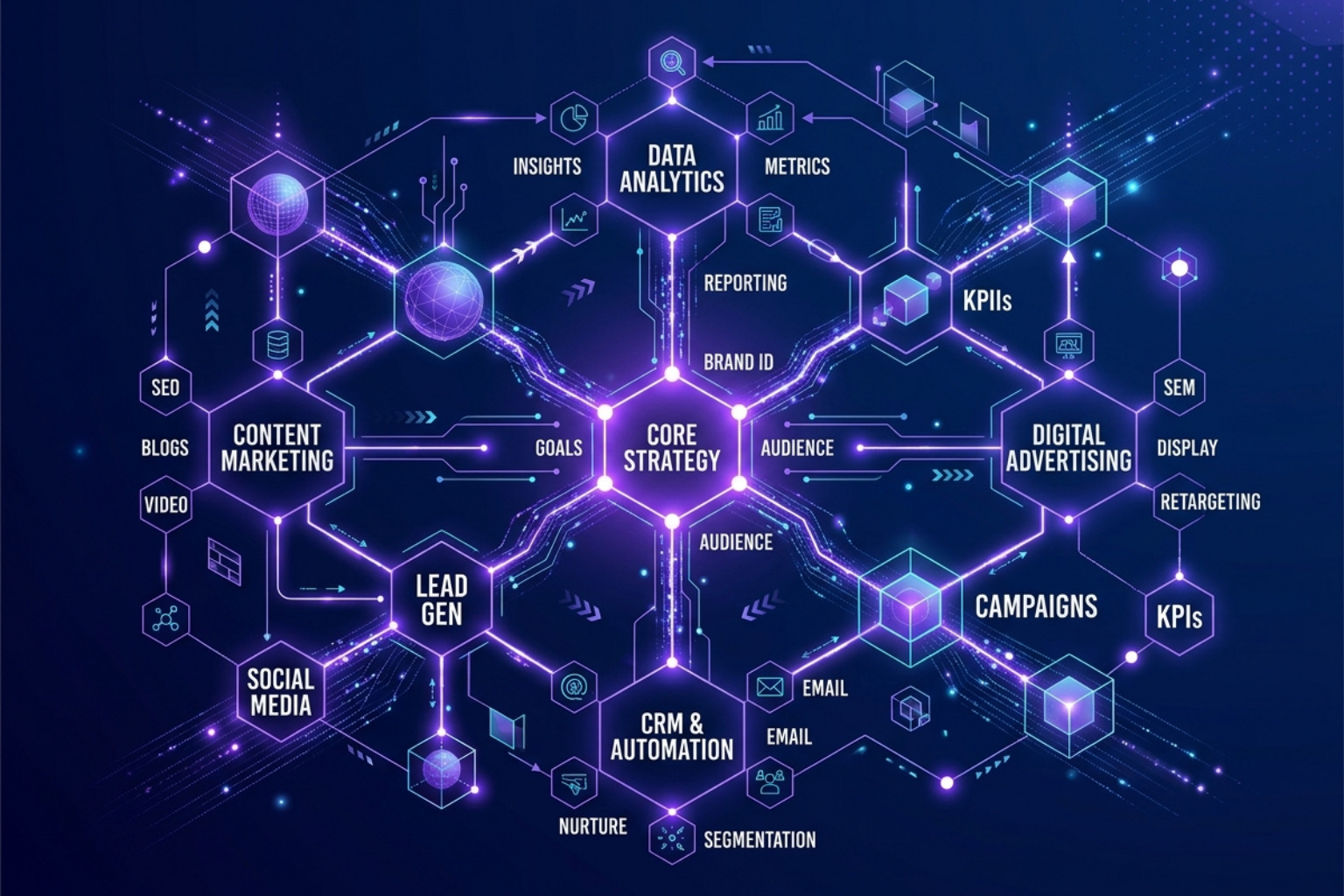
How AI is Changing the Face of Marketing Forever


How AI Is Permanently Reshaping Marketing — And What It Means for Your Brand
Artificial intelligence marketing is the use of machine learning, natural language processing, and data analysis to automate decisions, personalize customer experiences, and optimize campaigns in real time.
Here is what you need to know at a glance:
- What it is: AI that processes customer data to make smarter marketing decisions, faster than any human team can
- Why it matters: AI adoption has reached 72% across global businesses, and over 70% of top-performing executives say competitive advantage now depends on it
- What it delivers: Personalization that can drive revenue increases of up to 25%, automated workflows, and campaign optimization at scale
- Who it's for: Any marketing team that needs to do more with less — and differentiate in a crowded, commoditized content landscape
- The risk of ignoring it: Competitors using AI are already outpacing those who aren't, on speed, relevance, and ROI
Marketing has always been about reaching the right person with the right message at the right moment. For decades, that was an educated guess backed by broad demographic data. Today, AI makes it a data-driven, real-time operation — one that learns, adapts, and scales in ways no traditional playbook could match.
The shift isn't coming. It's already here. The question is no longer whether to use AI in your marketing. It's whether you're using it strategically enough to build something competitors can't easily copy.
I'm Florian Radke, a brand strategist and fractional CMO who has spent 25 years building brands at the frontier of technology — leading AI-driven content engines for international brands, running viral DTC campaigns, and working at the intersection of artificial intelligence marketing and brand differentiation. In this guide, I'll share the frameworks and practitioner perspective that actually move the needle — not just the hype.
The Strategic Evolution of Artificial Intelligence Marketing

We have moved past the era where AI was a "nice-to-have" experimental tool. In May 2026, artificial intelligence marketing has become the central nervous system of the modern brand. It’s no longer just about background automation; it’s about a fundamental shift in how we collect data, process insights, and execute creative strategy.
According to IBM, AI in marketing utilizes machine learning (ML) and natural language processing (NLP) to transform raw data into actionable intelligence. For us, this means moving away from retrospective analysis—looking at what happened last month—and moving toward proactive, real-time decision-making. As we navigate this AI transformation in Martech, we must view these tools as a way to enhance, not replace, the strategic vision of the CMO.
Defining Artificial Intelligence Marketing in 2026
Today, the definition has expanded. It’s no longer just a chatbot on a website. It encompasses:
- Predictive Analytics: Forecasting customer behavior before it happens.
- Generative AI: Creating high-fidelity assets that maintain brand voice.
- Real-time Insights: Analyzing micro-signals from customer journeys to adjust messaging instantly.
This evolution is particularly relevant for marketing professors and practitioners who must now teach and implement systems that think as much as they execute.
Why AI is a Game-Changer for Marketing Strategies
The reason AI is a game-changer isn't just speed; it's the ability to handle complexity at scale. With AI adoption reaching 72% in the global business landscape, the "early adopter" advantage has evaporated. The new advantage lies in how deeply you integrate these tools to drive growth.
We are seeing a shift from "broad strokes" marketing to "precision-engineered" interactions. When you can process millions of data points to find the one "lookalike" trait that defines your best customer, your efficiency doesn't just improve—it multiplies.
Why AI is the Ultimate Force Multiplier for Brand Differentiation
At The Brand Algorithm, we believe that in an age of automated noise, brand is the moat. AI is the force multiplier that allows us to build that moat faster and deeper.
The benefits are quantifiable:
- ROI Improvement: AI-driven campaigns can lead to a 20% increase in ROI.
- Revenue Growth: Personalization at scale can drive revenue increases of up to 25%.
- Efficiency: Automation of repetitive tasks allows teams to focus on high-level brand strategy.
- Scalability: Tools like HubSpot's AI-Powered Marketing Software enable small teams to run 15+ channel campaigns that used to require a massive agency.
By using generative AI for branding, we can maintain a distinctive identity while producing the volume of content required by modern algorithms.
Real-World Applications of Artificial Intelligence Marketing
We’ve seen incredible examples of this force multiplier in action. Consider the food delivery platform that used neural voice cloning and GANs (Generative Adversarial Networks) to create millions of hyper-personalized video ads. These ads featured celebrities calling out specific local restaurants and dishes in the user's native language. This wasn't just "personalization"—it was a localized experience delivered at a global scale.
Whether you are optimizing Google Ads with AI or refining your email marketing strategy, the application remains the same: using technology to make the brand feel more human and relevant to the individual.
Sector-Specific AI Implementation
Different industries are finding unique ways to apply these "intelligent" layers:
- Retail: Using recommendation engines that analyze browsing history to suggest the "next best product."
- Financial Services: Leveraging predictive modeling to offer personalized loan products based on life-stage data.
- Healthcare: Deploying AI to send tailored wellness reminders based on patient history.
- Manufacturing: Using AI market research tools to segment B2B audiences by industry and company size for hyper-targeted demos.
Core Applications: From Predictive Analytics to Generative Engine Optimization
To win in 2026, we must distinguish between different types of AI capabilities.
| Feature | Predictive AI | Causal AI |
|---|---|---|
| Core Function | Identifies correlations in data | Identifies the cause of an event |
| Marketing Use | Forecasting churn or purchase intent | Understanding why a specific creative worked |
| Outcome | "What will happen next?" | "How do we make it happen again?" |
By analyzing micro-signals—such as engagement heatmaps and sentiment analysis—we can move beyond simple automation. This is critical for Salesforce users who are integrating these insights into their CRM to create a unified view of the customer. Furthermore, we are now optimizing for "Generative Engines" (GEO) rather than just SEO, ensuring our brand appears in the answers provided by AI assistants. You can find more on this in our AI Content Optimization Guide and our list of the best GEO brands.
Content Strategy in the Age of AI

Content production has been commoditized. If anyone can generate a 1,000-word blog post in ten seconds, the value of that post drops to zero. Our strategy must shift to AI-driven content creation that prioritizes brand voice consistency.
Using tools like Jasper, we can embed our "Brand IQ"—the specific rules, tone, and logic that make our brand unique—into every piece of content. This ensures that even when we scale production 10x, the output still sounds like us, not like a generic machine.
The Future of Artificial Intelligence Marketing: Agentic Systems
The next frontier is "Agentic Marketing." We are moving from tools that help us work to AI agents that work for us. These autonomous systems can reason, plan, and execute multi-step actions—like detecting a drop in ad performance and independently swapping creative assets or reallocating budgets.
We must also learn to track brand mentions in generative AI responses to ensure our brand remains visible and accurately represented in this new conversational landscape.
Navigating the Ethical Frontier and Data Privacy
As we lean into AI, we must also lean into trust. 68% of customers say advances in AI make it more important for companies to be trustworthy.
Challenges and Ethical Considerations
The risks are real:
- Algorithm Bias: AI can inadvertently perpetuate stereotypes if trained on non-representative data.
- Hallucinations: Generative models can state falsehoods as facts.
- Creativity Loss: Over-reliance on AI can lead to "bland" marketing that lacks emotional resonance.
- Privacy: With the death of third-party cookies, we must rely on first-party data and transparent governance to maintain GDPR compliance.
We explore these nuances deeply in our AI Content Generation Ethics Guide and our framework for ensuring brand voice consistency.
Best Practices for Responsible AI Implementation
We recommend a "Human-in-the-loop" approach. AI should do the heavy lifting of data processing and initial drafting, but humans must provide the strategic guardrails and emotional connection. Upskilling your team is non-negotiable; your job won't be taken by AI, but by a marketer who knows how to use AI. For leadership, this requires a complete CMO strategy.
The Implementation Roadmap: Building Your AI Marketing Infrastructure
How do you actually get started? We suggest a structured transformation roadmap:
- Audit Your Tech Stack: Identify manual bottlenecks where AI can provide immediate relief.
- Define Clear KPIs: Are you looking for a 50% increase in content output or a 20% reduction in CAC?
- Unify Your Data: AI is only as good as the data it feeds on. Break down silos between your CRM, website, and ad platforms.
- Launch Pilot Projects: Start with a high-intent segment and a specific use case, like AI campaign measurement.
- Iterate and Scale: Use the insights from your pilot to refine your models and expand to other channels.
Advanced Techniques for Workflow Optimization
Once the basics are in place, we can look at advanced workflow optimization. This includes automated SEO, programmatic bidding that adjusts in milliseconds, and content repurposing tools that turn one webinar into dozens of social posts, emails, and blogs instantly.
Frequently Asked Questions about AI Marketing
Will AI replace human marketers?
No. AI replaces tasks, not people. It handles the repetitive, data-heavy work, freeing us to focus on what humans do best: strategy, storytelling, and building emotional connections.
How does AI improve marketing ROI?
By reducing the cost of content production and increasing the effectiveness of targeting. When you stop wasting budget on the wrong audience and start delivering hyper-relevant messages, your ROI naturally climbs.
What is the difference between predictive and generative AI?
Predictive AI uses historical data to forecast future events (like "who will buy next"). Generative AI uses data to create new content (like text, images, or video).
Conclusion
At The Brand Algorithm, we know that the future belongs to those who use AI as a strategic force multiplier. While the tools are becoming more accessible, the ability to build a distinctive, defensible brand identity remains the ultimate competitive advantage.
AI is changing the face of marketing forever, but it is not changing the fundamental need for a brand that people trust. Use the technology to scale your reach, but use your human insight to build your moat.
Ready to lead the transformation? Build your future-ready marketing technology stack today.