How to Monitor Your Brand in AI Search: A Practical Measurement Framework
Your brand exists in AI answers — do you know what it's saying? Tracking brand mentions in generative AI responses has moved from nice-to-have to core marketing function. Here's the 5-step workflow.
The Visibility Problem You Can't Ignore
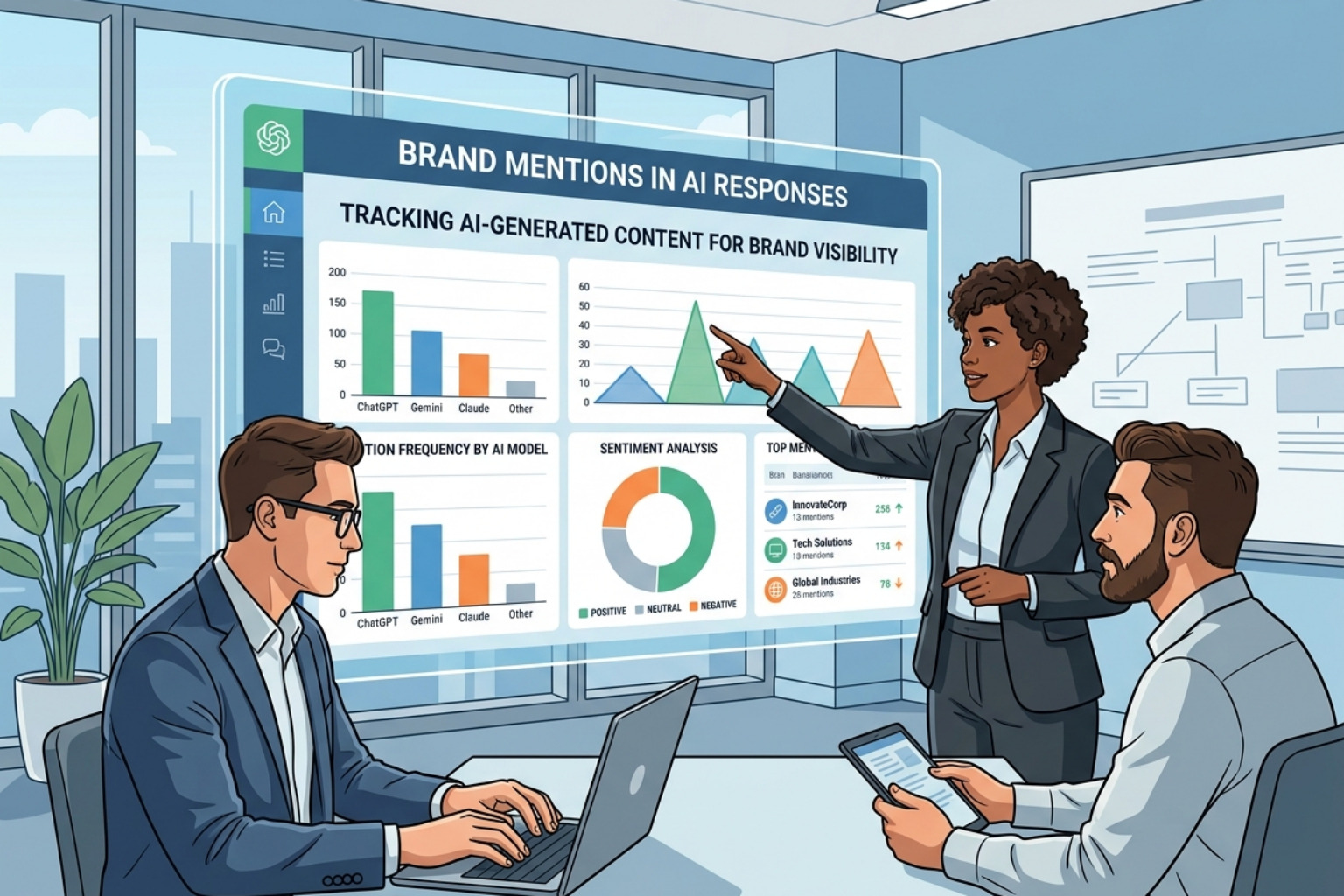
When a potential customer asks ChatGPT, Gemini, or Perplexity "what's the best project management tool for remote teams," your brand either appears in that response or it doesn't. Unlike traditional search — where you can check rankings, track impressions, and measure clicks — AI-generated responses are a black box.
No click-through data. No impression counts. No ranking positions. Just presence or absence in a conversational answer that the user may never verify by visiting your site.
This is the new brand visibility challenge, and most marketing teams have no system for measuring it. They're flying blind on a channel that's rapidly capturing search volume from Google.
Why This Matters Strategically
Let me be direct about the stakes: Gartner estimates that by 2028, 30% of all search interactions will happen through AI interfaces rather than traditional search engines. Some categories — particularly B2B software, professional services, and considered purchases — are already seeing higher shifts.
If your brand isn't appearing in AI-generated recommendations today, you're building a compounding visibility deficit. AI models train on data that reinforces existing patterns. Brands that are mentioned today become more likely to be mentioned tomorrow. The rich get richer.
This isn't a future problem. It's a present one with future consequences.
The Measurement Framework
I've developed a five-layer framework for systematically monitoring and improving brand presence in AI-generated responses. Each layer builds on the previous one.
Layer 1: Query Universe Definition
Before you can measure AI brand visibility, you need to define what you're measuring against. This means building a comprehensive query set that represents how your potential customers actually ask AI assistants about your category.
Category queries: "What is the best [your category]?" "Top [your category] tools in 2026." "Compare [your category] options."
Problem queries: "How do I solve [problem you address]?" "What tools help with [pain point]?" "Best approach to [challenge]."
Competitor queries: "Is [competitor] good?" "Alternatives to [competitor]." "[Competitor A] vs [Competitor B]."
Use-case queries: "Best [category] for [specific use case]." "How to [task] for [segment]." "[Category] for [industry/company size]."
Build a minimum of 50 queries across these four types. For enterprise brands, aim for 200+. These queries are your measurement surface.
Layer 2: Systematic Querying Protocol
Consistency in measurement requires a protocol. AI responses vary based on context, phrasing, and even time of day. Here's how to control for that variance:
Platforms to monitor:
- ChatGPT (GPT-4 and GPT-4o — responses differ)
- Google Gemini (both direct and AI Overviews in search)
- Perplexity (most citation-transparent)
- Claude (growing market share in professional contexts)
- Microsoft Copilot (enterprise relevance)
Querying cadence: Run your full query set across all platforms at minimum monthly. For competitive categories, bi-weekly. Each query should be run in a fresh session (no conversation history contamination) and logged with timestamp, platform, model version, and full response text.
Response capture: Save complete responses, not just mention/no-mention. The context of your mention matters enormously — being listed fifth in a generic list is different from being recommended as the top choice with specific reasoning.
Layer 3: Scoring Methodology
Raw mention counts aren't useful. You need a scoring system that captures both quantity and quality of brand presence. Here's the model I recommend:
Brand Mention Score (BMS) per query:
- 0 — Absent: Brand not mentioned in response
- 1 — Listed: Brand mentioned as one option among many (no differentiation)
- 2 — Described: Brand mentioned with specific attributes or positioning
- 3 — Recommended: Brand positioned as a top choice or specifically recommended for the query context
- 4 — Featured: Brand is the primary focus of the response with detailed explanation of why
Aggregate metrics:
- Visibility Rate: Percentage of queries where BMS ≥ 1 (you appear at all)
- Recommendation Rate: Percentage of queries where BMS ≥ 3 (you're actually recommended)
- Average BMS: Mean score across all queries (your overall positioning strength)
- Category Share of Voice: Your total BMS divided by the total BMS of all brands mentioned across your query set
Layer 4: Competitive Benchmarking
Your scores only mean something relative to competitors. For every query, score every brand mentioned — not just yours. This gives you:
Competitive position map: For each query type, where do you rank versus alternatives? Are there categories where you dominate and others where you're invisible? (See also: The CMO's Martech Evaluation Framework.)
Gap analysis: Where competitors score 3-4 and you score 0-1, what's different about their digital footprint that earns them AI recommendations?
Trend tracking: Month-over-month, are you gaining or losing share of voice? Are new competitors appearing? Are AI models consolidating around fewer recommendations?
The competitive view often reveals more actionable insights than your absolute scores. You might discover that no brand scores well on certain query types — which represents an opportunity to become the default recommendation by filling a content gap.
Layer 5: Source Attribution
This is where measurement connects to action. When AI models recommend your brand (or don't), understanding why requires source analysis.
Perplexity's citations are your rosetta stone. Unlike other AI platforms, Perplexity shows its sources. Analyze which sources are cited when your brand is mentioned versus when competitors are. This reveals what content types and publications influence AI recommendations.
Common source patterns that drive AI visibility:
- Detailed comparison articles on authoritative third-party sites
- Product review aggregators (G2, Capterra, TrustRadius for B2B)
- Industry analyst reports
- Your own content that directly answers the query format
- Reddit and forum discussions with authentic user experiences
- Wikipedia and structured knowledge sources
Sources that don't seem to influence AI visibility:
- Paid media and advertorials
- Generic press releases without substance
- Social media posts (with rare exceptions)
- Gated content (AI can't access it to learn from it)
Tools for Implementation
The tooling landscape for AI brand monitoring is still immature, but here's what works today:
Manual Monitoring (Every Team Should Start Here)
Before buying any tool, spend two weeks manually running your top 20 queries across three platforms. This gives you intuition that no dashboard provides. You'll notice patterns in how AI models talk about your category, what language they use, which brands they default to, and where your positioning breaks down.
Document everything in a spreadsheet with: query, platform, date, full response text, BMS score, competitors mentioned, sources cited (where visible).
Dedicated AI Monitoring Platforms
Several tools have emerged specifically for this use case:
- Profound (getprofound.ai): Tracks brand mentions across AI platforms with competitive benchmarking. Best for ongoing automated monitoring once you've established your query set manually.
- Otterly.ai: Focuses on AI search visibility specifically. Good for tracking changes over time and correlating with content changes you make.
- Peec AI: Provides AI share-of-voice tracking with emphasis on recommendation quality, not just mention presence.
Caveat: this space is brand new. Evaluate any tool against your manual baseline before trusting its data. If a tool's scores don't roughly match what you see manually, its methodology may not fit your category.
API-Based Custom Solutions
For enterprise teams with engineering resources, building custom monitoring provides the most control:
- Use OpenAI, Anthropic, and Google APIs to programmatically run your query set
- Build scoring automation using a secondary AI model to evaluate responses
- Store results in a database for trend analysis
- Alert when scores change significantly (positive or negative)
Cost is surprisingly low — running 200 queries across 4 platforms monthly costs under $50 in API fees. The engineering investment is the real cost, but once built, it scales indefinitely.
What the Data Tells You Strategically
Monitoring without action is expensive navel-gazing. Here's how to translate AI visibility data into strategic decisions:
If Your Visibility Rate Is Below 30%
AI models don't know you exist in the contexts where customers are asking. This is a content strategy problem. You need ungated, authoritative content that directly answers the query formats your potential customers use. The content must be on domains that AI models treat as authoritative — either your own (if sufficiently established) or third-party publications.
If Your Visibility Rate Is High But Recommendation Rate Is Low
AI models know you exist but don't prefer you. This is a positioning problem. Your brand is being mentioned as an option but not endorsed. Look at what language AI uses when recommending competitors versus merely listing you. The gap usually reveals a differentiation failure — the model can't articulate why someone should choose you over alternatives.
If Your Scores Vary Wildly Across Platforms
Different AI models weight different sources. If you score well on Perplexity (which emphasizes recent web content) but poorly on ChatGPT (which emphasizes training data), your recent content strategy is working but you have a historical authority deficit. The inverse pattern suggests legacy brand strength with weak recent content.
If Competitors Score 3-4 on Queries Where You Score 0
Examine those queries specifically. What content exists about your competitor that doesn't exist about you? Often the answer is: detailed, unbiased comparison content on third-party sites; authentic user reviews with specific use-case context; or direct, comprehensive answers on their own domain to the exact question being asked.
The Optimization Playbook
Based on your diagnostic, here are the highest-impact interventions:
For Visibility Problems
- Create comprehensive, ungated guides that directly answer query formats
- Earn mentions on comparison sites and review platforms
- Publish original research that others cite (AI models love citing primary sources)
- Ensure your site has clear, structured content about what you do, for whom, and why
For Recommendation Problems
- Sharpen your positioning — make your differentiation unmissable
- Generate authentic, detailed customer stories (not generic testimonials)
- Create content that explicitly positions you for specific use cases rather than being generalist
- Build thought leadership that demonstrates expertise, not just existence
For Platform Inconsistency
- Diversify your content distribution across source types each platform weights differently
- Ensure your Wikipedia presence (if applicable) is accurate and comprehensive
- Build depth on review platforms that appear in multiple AI models' source bases
- Maintain consistent messaging across all public-facing content so models form a coherent picture
Building the Monthly Reporting Cadence
AI brand monitoring should become a standard section of your monthly marketing report. Here's the format I recommend:
Executive summary (2 sentences): Overall visibility trend and most significant change from last period.
Key metrics: Visibility Rate, Recommendation Rate, Average BMS, Category Share of Voice — each with month-over-month trend.
Competitive position: Top 5 competitors' scores versus yours, with movement arrows.
Platform breakdown: Scores by AI platform to identify where you're gaining or losing.
Query type analysis: Which query categories are your strongest/weakest, and what's changing.
Action items: 2-3 specific content or positioning initiatives driven by the data.
Where This Is Heading
AI search is not a separate channel. It's becoming the primary discovery interface for a growing percentage of your audience. The brands that treat AI visibility as a measurement discipline today — with the same rigor they apply to organic search — will have a structural advantage within 18 months.
The framework above gives you a starting point. The teams that win will iterate on it monthly, building proprietary understanding of what drives AI recommendations in their specific category.
Don't wait for perfect tools. Start measuring manually, build the muscle, then automate. The compounding advantage goes to whoever starts first.