The Definitive Guide to Evaluating Brand Reputation in AI Assistants
The Mechanics of Brand Reputation in AI Assistants
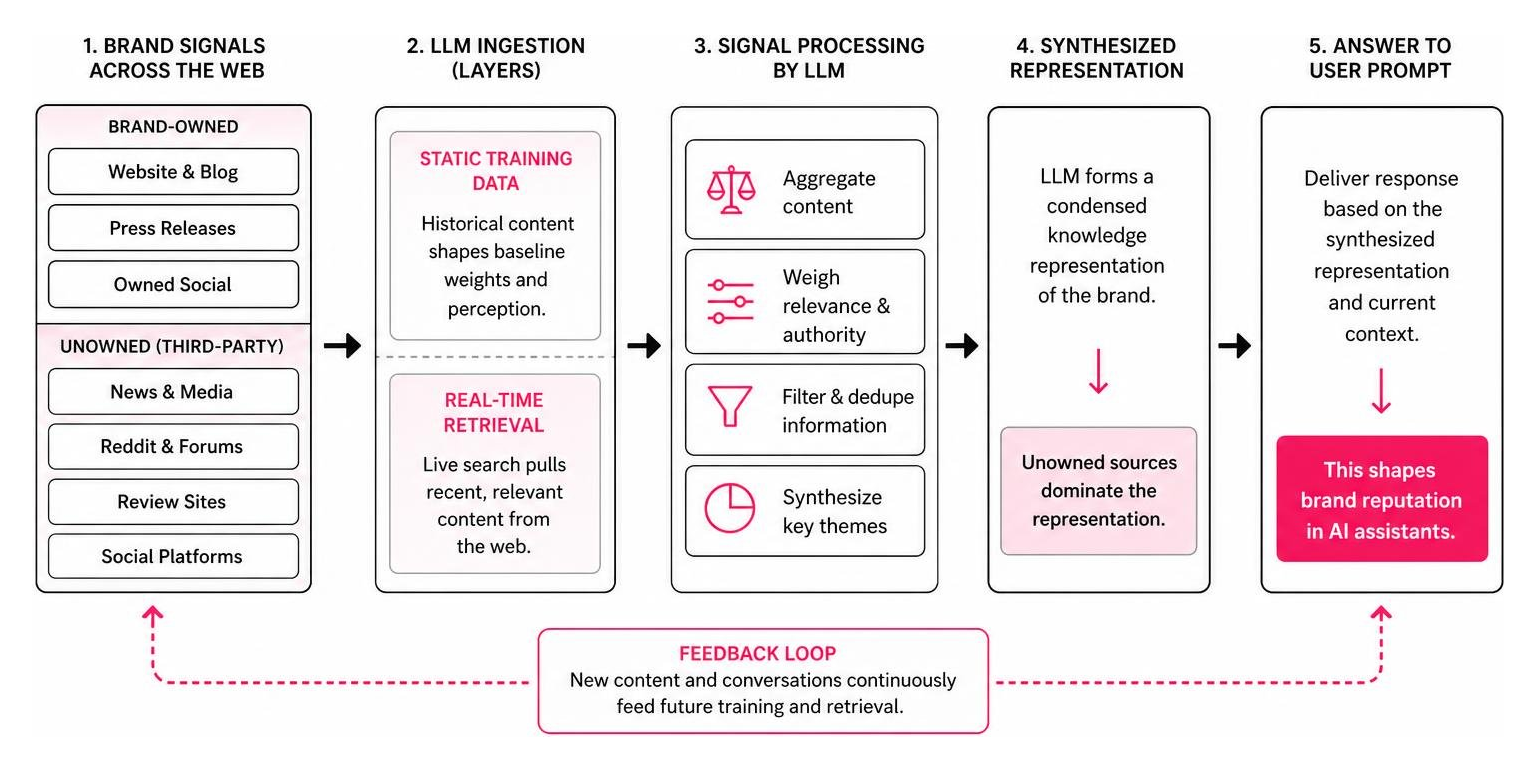
Your marketing team spent $5 million establishing a brand positioning framework last year, but Claude just compressed your company into two dismissive paragraphs based on a four-year-old Reddit thread. That is the real crisis of brand reputation in ai assistants. Large language models ignore your brand guidelines; they aggregate, weight, and synthesize dynamic digital footprints across third-party web nodes.
If you do not actively manage the third-party web footprint, the model invents your positioning for you. When an AI engine answers an enterprise query, it operates across two distinct layers: static weights from historical training sets and real-time retrieval via live search crawlers. Across both layers, LLMs exhibit severe unowned source dominance. Data demonstrates that only 10.15% of AI citations point back to brand-owned domains, while roughly 90% originates from third-party platforms.
Unowned channels dictate your narrative in conversational discovery. When buyers ask unbranded evaluation queries (e.g., "What is the best enterprise compliance software?"), brand-owned domain citations collapse to a meager 2.2%, while user-generated platforms like Reddit account for nearly 31% of citations.
This reliance creates a structural vulnerability known as sentiment inheritance. If forum users repeatedly frame your product with a specific critique—such as "clunky UI" or "hidden enterprise pricing"—the LLM absorbs that framing as an intrinsic factual trait. According to research on the exposure gap in AI brand trust, buyers rely on these tools for speed despite low baseline trust, making inherited negative sentiment a direct pipeline killer. To protect revenue, marketing leaders must master how to measure AI visibility for marketing campaigns beyond shallow web traffic metrics.
How LLMs Synthesize Unowned Brand Signals
Every industry vertical features a distinct "citation fingerprint" within generative search engines. DevSecOps queries cite GitHub and Medium, B2B SaaS relies heavily on review aggregators like G2, and consumer brands pull from Reddit, YouTube, and digital publications.
When synthesizing these unowned inputs, AI engines prioritize three core attributes:
- Source Corroboration: A claim made on your website carries minimal weight unless verified by independent third-party outlets.
- Citation Density: If twenty Reddit threads and three trade publications repeat the same complaint, the LLM treats it as consensus truth.
- Recency Weighting: Real-time retrieval algorithms favor recent discussions, allowing legacy PR crises or outdated pricing threads to dominate answers if left unaddressed.
The Four Common Modes of AI Misrepresentation
AI misrepresentation rarely stems from outright fabrication. It usually manifests in four nuanced patterns:
- Outdated Facts: The LLM reports discontinued tier pricing, retired features, or past executive leadership because legacy data outnumbers recent updates.
- Positioning Drift: The model categorizes your enterprise platform as a "small business tool" because early media coverage from five years ago lingers in its training weights.
- Competitive Hedging: The assistant recommends your product, but appends qualifying clauses ("a strong choice, though users note poor customer support") inherited from comparison forums.
- Zero-Click Invisibility: Your brand is excluded entirely from category recommendation sets despite maintaining strong traditional SEO rankings.
The Four-Dimensional Framework for AI Reputation Audits
To manage what you cannot see in a traditional analytics dashboard, you need a structured audit methodology. We evaluate brand reputation in ai assistants using our original named framework: The Synthetic Perception Matrix (SPM).
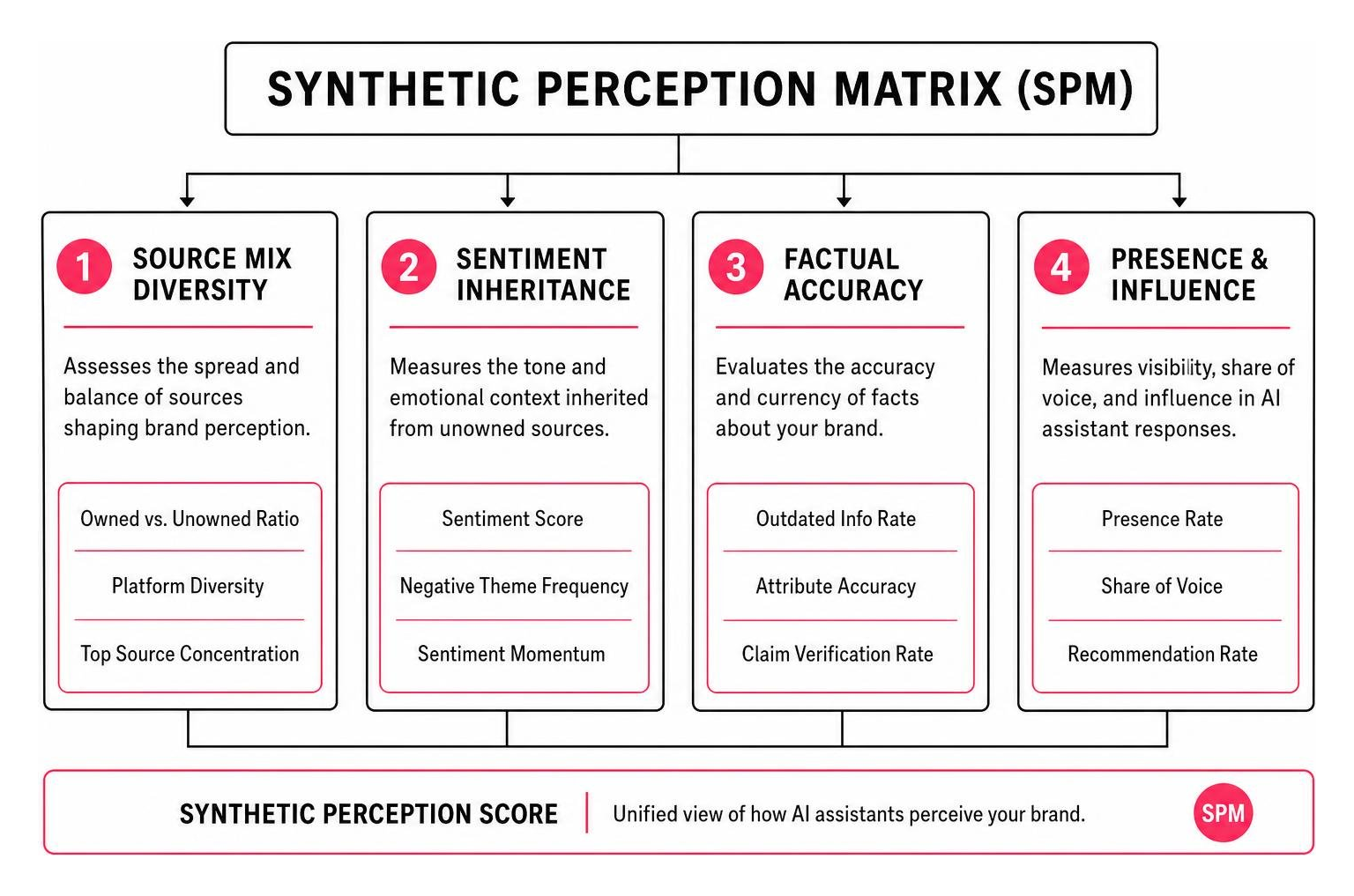
The SPM breaks brand representation down into four distinct, measurable dimensions:
- Factual Accuracy: Evaluating whether the model outputs correct data regarding pricing, feature sets, target markets, and integrations.
- Sentiment Framing: Assessing qualitative tone. Research indicates 58% of brand references in AI outputs contain sentiment cues that steer perception.
- Consideration Share: Measuring how often your brand is included in unbranded, category-level recommendation lists compared to key competitors.
- Citation Authority: Mapping the underlying URLs grounding the generated response to determine if the LLM relies on owned assets, press coverage, or user forums.
Measuring Brand Reputation in AI Assistants Across Models
Different AI architectures process and present brand narrative differently. A brand can appear market-leading in ChatGPT while getting flagged for liabilities in Google AI Overviews.
A cross-engine analysis reveals distinct operational biases:
- Google AI Overviews: Operates as a top-of-funnel risk engine. It relies heavily on news media, surfacing public controversies, regulatory scrutiny, and product recalls 4.5 times more frequently than ChatGPT.
- ChatGPT: Functions as a bottom-of-funnel evaluation engine. It is three times more critical on product fit, pricing value, and operational limits during consideration-stage queries.
- Perplexity: Acts as a citation-exposure engine. It displays real-time web sources directly alongside answers, meaning a single negative review on an authoritative domain can permanently damage buyer perception.
Understanding these model variations is essential when evaluating Google vs ChatGPT brand reputation risk. If your goal is category inclusion on conversational tools, you must master how to get mentioned by ChatGPT.
The Trust-Query Tax and Sentiment-Adjusted Share of Voice
Measuring raw Share of Voice (SOV) on branded prompts ("Is [Brand] legitimate?") is a vanity metric. If a user includes your brand name in the prompt, the AI assistant will yield a 100% Share of Voice by default.
The true test lies in measuring the Trust-Query Tax. When queries transition from unbranded discovery ("What are the top CRM platforms?") to branded validation ("What are the downsides of [Brand]?"), AI models introduce hedging clauses ("However, users report..."). Top performers routinely suffer an 11 to 15-point drop in sentiment when users shift from category discovery to trust validation.
To account for this drop, calculate Sentiment-Adjusted Share of Voice (SA-SOV):
$$\text{SA-SOV} = \text{Raw SOV} \times \left( \frac{\text{Sentiment Score (0-100)}}{100} \right)$$
If your brand achieves 80% presence in category prompts with a sentiment score of 60 due to hedging, your true SA-SOV is 48%.
Building an Enterprise AI Reputation Monitoring Protocol
Legacy social listening tools fail in conversational search because generative answers are context-dependent, dynamic, and unindexed by standard web scrapers. Tracking brand health across LLMs requires automated prompt simulation.
| Capability | Manual AI Audits | Automated Prompt Simulation Tools |
|---|---|---|
| Query Scale | Low (10-20 manual prompts/month) | High (Thousands of simulated variations) |
| Bias Tracking | Subjective, localized to single user | Statistical analysis across IP addresses & personas |
| Source Tracing | Manual link verification | Automated extraction of cited web domains |
| Cadence | Ad-hoc or monthly | Continuous real-time alerting |
| Cost | High internal labor cost | Predictable software licensing cost |
To execute prompt simulation at scale, deploy specialized AI brand monitoring tools designed to track LLM outputs. Evaluating the best platforms for monitoring brand mentions in AI-generated content ensures you capture sentiment shifts before they impact sales pipeline performance.
Cross-Functional Accountability for AI Brand Governance
AI reputation management cannot live in a vacuum. It requires cross-departmental coordination:
- Chief Marketing Officer: Owns positioning integrity and resource allocation for AI search defense.
- Content Operations: Executes structured data standards and maintains central messaging repositories.
- Public Relations & Earned Media: Secures authoritative third-party coverage to displace negative community forum citations.
- Customer Experience / Support: Resolves recurring product complaints on public review platforms (e.g., G2, Reddit, Capterra) to fix the primary data sources feeding LLMs.
Tactical Execution: Fixing Misinformation and Optimizing LLM Outputs
Fixing incorrect AI responses requires altering the underlying web sources that fuel model retrieval. Changing website copy on your homepage will not change an LLM output if twenty third-party domains contradict your claim.

Core Strategies for Defending Brand Reputation in AI Assistants
- Component-Based Content Architecture: Structure owned web pages using modular, machine-readable headings, clear tables, and explicit bullet points.
- Schema Markup Implementation: Implement comprehensive JSON-LD Organization, Product, and FAQ schema markup so AI crawlers parse factual information cleanly.
- Multi-Surface Content Syndication: Publish authoritative product documentation, whitepapers, and FAQs across third-party networks (e.g., Medium, LinkedIn, YouTube transcripts) to build multi-source corroboration.
- Community Reputation Defense: Actively engage on Reddit and vertical review platforms to resolve user grievances transparently, updating the exact text engines ingest.
Applying systematic generative engine optimization ensures your messaging dominates both static models and live web citations. Implementing best practices for increasing brand visibility in AI-generated search results builds long-term defense against hallucinated brand liabilities.
Remediating False Claims in LLM Training Sets
When an AI engine generates explicit errors regarding your brand, execute this remediation workflow:
- Trace the Source: Use citation links in Perplexity or Gemini to locate the exact third-party pages driving the error.
- Correct the Source Signal: Update the outdated content on the external site, submit press release corrections, or publish updated technical documentation.
- Submit Direct Model Feedback: Utilize developer feedback portals (e.g., OpenAI Developer Forum, Google AI feedback loops) to flag factual inaccuracies.
Proactive remediation is critical because, as detailed in recent studies on why consumer AI adoption outruns reputation, consumer adoption of AI assistants continues to outpace overall brand trust in the underlying tools.
Long-Term Brand Equity and Longitudinal AI Performance Tracking

Managing brand reputation in ai assistants requires tracking longitudinal trends over months rather than reacting to daily output variations.
To establish reliable longitudinal benchmarks, track three core KPIs on a monthly cadence:
- Model Sentiment Delta: The net positive or negative sentiment drift across Claude, ChatGPT, Gemini, and Perplexity.
- Unbranded Consideration Rate: The percentage of category discovery queries where your brand appears in the top three recommended options.
- Owned vs. Unowned Citation Ratio: The percentage of citations in AI answers that link to properties you control versus third-party sites.
Independent data from research evaluating how ChatGPT compares to other AI brands shows that market leaders maintain high general impression metrics, but niche models often deliver higher accuracy scores. Long-term brand health depends on maintaining authority across all systems. Learning to track brand mentions in generative AI responses allows you to join the ranks of the best generative engine optimization brands for AI.
Frequently Asked Questions About AI Brand Reputation
Why do traditional social listening platforms fail to track AI assistant responses?
Traditional social listening tools track static web pages, social media posts, and public RSS feeds using simple keyword scrapers. AI assistants generate dynamic, personalized, and conversational outputs in real-time within private sessions. They do not publish static web pages that web scrapers can index, requiring specialized prompt-simulation tools to audit output sentiment.
How quickly do fixes to third-party web sources reflect in AI generated answers?
Fixes to third-party web sources reflect at different rates depending on the model's architecture. Real-time retrieval engines like Perplexity and Google AI Overviews can reflect third-party web source corrections within days or weeks once crawlers index the updated URLs. Base model weights (static training sets) update only during major model retraining cycles, which can take several months.
Who should lead AI reputation management within an enterprise marketing team?
AI reputation management should be led by the Vice President of Brand or Chief Marketing Officer, with operational execution shared between Content Operations, Public Relations, and Technical SEO. While SEO handles technical schema and web indexing, PR manages the external third-party media sources that feed AI models, and Content Operations ensures messaging consistency across owned channels.
Strategic Next Steps for Enterprise Brand Defense
Managing brand narrative across conversational engines requires treating LLM training data and retrieval indexes as your primary brand surface. Massive media spend cannot override a negative sentiment loop inside Perplexity or OpenAI.
Marketing leaders must audit their unowned citation footprint immediately, enforce structured schema across technical documentation, and build active response workflows on high-density citation platforms like Reddit, G2, and Capterra.
To evaluate how these shifting discovery dynamics impact your organization, explore our deep dive on how generative AI impacts brand visibility. To deploy automated LLM brand monitoring across your enterprise, visit The Brand Algorithm sign up page.