A Quick Start Guide to Generative Engine Optimization

Why Generative Engine Optimization Is the New Battleground for Brands
Generative engine optimization is the practice of structuring your brand's content, entity signals, and off-site presence so that AI-powered answer engines — ChatGPT, Google AI Overviews, Perplexity, Claude, and Gemini — cite, recommend, or mention you when users ask questions relevant to your category.
Here is what that means in practice:
- What it is: Optimizing content to appear inside AI-generated answers, not just in ranked blue links beneath them
- How it differs from SEO: SEO targets a position in a results list; GEO targets inclusion as a cited source in a synthesized prose answer
- Why it matters now: AI Overviews appear in at least 16% of all searches, ChatGPT reaches over 800 million weekly users, and retailers saw up to a 520% increase in traffic from AI search engines compared to 2024
- What actually moves the needle: Pages containing statistics and direct quotations show 30-40% higher visibility in AI responses; keyword stuffing actively hurts citation likelihood
- Where the work happens: 85% of brand mentions in AI answers come from third-party sources — listicles, review roundups, comparison pages — not your own domain
The strategic implication is uncomfortable for most marketing teams. Your website is no longer the primary surface that determines whether AI mentions your brand. The platforms you don't control — Reddit, LinkedIn, industry publications, review sites — carry the majority of the weight.
Most brands are optimizing the wrong thing. They are rewriting title tags and adding FAQ schema while the actual citation signals are accumulating (or not) across a dozen platforms they rarely monitor and almost never actively shape. That asymmetry is the opportunity — and the risk.
I'm Florian Radke, brand strategist, fractional CMO, and founder of The Brand Algorithm, where I help senior marketing leaders build brand systems that remain discoverable and defensible as generative engine optimization reshapes how buyers find, evaluate, and shortlist vendors. Over 25 years building and scaling brands at the frontier of technology — from Facebook-acquired companies to eight-figure venture-backed startups — I have watched search behavior shift before, and this one moves faster than any prior cycle. What follows is the framework I use with clients to get ahead of it.

Traditional search engines operate on a linear retrieval model: a user types a query, and the engine returns a list of indexed URLs ranked by authority and relevance. Generative engines rewrite this playbook. They use Retrieval-Augmented Generation (RAG) and query fan-out to run concurrent related sub-queries behind the scenes, gather information from multiple sources, and synthesize a single, cohesive response.
This shift has accelerated the rise of zero-click searches. A field study from ISB and Carnegie Mellon University revealed a 38% reduction in organic clicks when Google AI Overviews appear, with zero-click searches jumping from 54% to 72%. For transactional searches, the shift is even more dramatic: retailers are experiencing up to a 520% surge in traffic from chatbots and AI engines compared to 2024.
To survive this transition, brands must pivot from ranking to citation. Academic research presented at KDD 2024 shows that applying targeted optimization tactics can yield up to a 40% visibility boost in generative engine responses. If you rank fifth on a traditional SERP, using the Cite Sources method can trigger a 115.1% increase in visibility within the AI-generated response. To understand how to achieve these gains, we must look at how these models evaluate your content. For a deeper look at this shift, read our analysis on Generative AI Impact Brand Visibility and explore the foundational tactics in Generative Engine Optimization (GEO): How to Win in AI Search .
The S.P.I.R.E. Framework for AI Visibility
To systematically earn citations inside AI responses, we developed the S.P.I.R.E. Framework. This model translates raw engine preferences into actionable content standards.
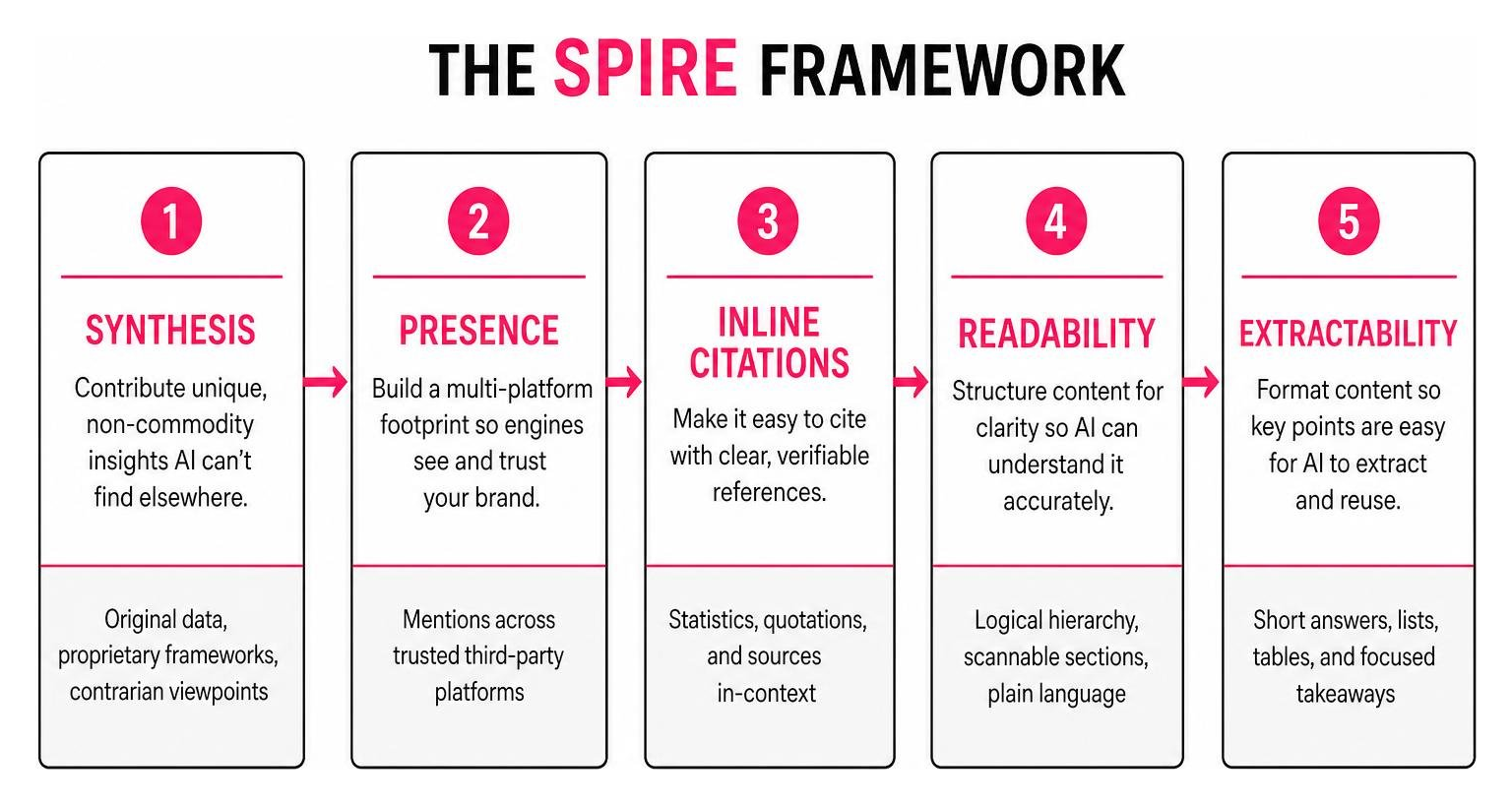
1. Synthesis
Generative engines do not copy and paste; they synthesize. Your content must contribute unique, non-commodity insights that the model cannot find in its baseline training data. If your article simply summarizes existing web content, an LLM has no reason to retrieve or cite your URL. It already knows what you are going to say. We focus on publishing original data, proprietary frameworks, and contrarian viewpoints that force the engine to pull our content to complete its answer.
2. Presence
AI engines build trust through co-citation and multi-platform entity clarity. If your brand is only mentioned on your own website, the engine's confidence in your authority remains low. You must build a footprint across trusted third-party platforms. In our client campaigns, we prioritize Reddit, LinkedIn, YouTube, and industry-specific review platforms. If ChatGPT or Perplexity finds your brand mentioned alongside your top competitors across five independent domains, its likelihood of recommending you increases exponentially.
3. Inline Citations
Credibility signals are the strongest driver of AI visibility. The Princeton GEO research paper confirmed that adding named statistics and direct quotes to a page increases its visibility in generative responses by 30% to 40%. On Perplexity, adding direct quotations yielded a 22% improvement over the baseline. We design our content assets to be citation-dense, ensuring every claim is backed by a specific, named source or proprietary data point.
4. Readability
Stylistic fluency directly influences whether a model selects your text. The same academic benchmarks show that fluency optimization and simplifying complex language produce a 15% to 30% visibility gain. Generative engines prefer clear, authoritative, and direct prose. We strip out corporate jargon, passive voice, and unnecessary adverbs, ensuring our content is highly readable for both humans and machine parsers.
5. Extractability
Your content must be structured to stand alone. When an engine retrieves a passage, that passage must make complete sense without the surrounding context. We write in self-contained paragraphs and use clear, logical heading hierarchies. If a paragraph relies on vague pronouns or references to previous sections, the AI crawler will pass it over for a more extractable alternative.
Applying these five pillars ensures your brand is built to be discovered. For a step-by-step breakdown of how to put this into practice, read our guide on Best Practices for Increasing Brand Visibility in AI Generated Search Results.
Tactical Execution: How to Optimize Content for AI Crawlers
Optimizing for generative search requires a fundamental shift in your tactical checklist. Traditional SEO metrics like keyword density are not only obsolete in this context; they can actively damage your performance.
| Traditional SEO Factor | AI Citation Signal (GEO) | Business Impact |
|---|---|---|
| Keyword Density | Semantic Relevance & Entity Clarity | Keyword stuffing causes an 8% to 10% drop in AI visibility. |
| Dofollow Backlinks | Co-citations & Brand Mentions | Nofollow links perform nearly identically to dofollow links for AI visibility. |
| Site Structure | Passage-Level Extractability | Logical heading hierarchies increase citation rates by 2.8x. |
| Content Volume | Content Freshness & Accuracy | Outdated pages are 3x more likely to lose AI citations. |
To win in this environment, you must execute across both technical and content-level signals. For inspiration on how leading organizations are executing these plays, see our analysis of the Best Generative Engine Optimization Brands for AI.
Technical Foundations of Generative Engine Optimization
The technical execution of generative engine optimization is about removing friction for AI crawlers and providing clear machine-readable signals.
- Crawler Access: You must explicitly manage your robots.txt file to allow access to search-specific AI bots while blocking training bots if you wish to protect your IP. Ensure
GPTBot,OAI-SearchBot,Claude-User,Claude-SearchBot,Google-Extended, andPerplexityBotare allowed. - Server-Side Rendering (SSR): AI crawlers are resource-constrained and often struggle to execute complex client-side JavaScript. If your site relies on client-side rendering, crawlers may see empty pages. Ensure your critical content is rendered server-side.
- Structured Data: Implement extensive schema.org markup. Prioritize
Organization,Product,FAQPage, andArticleschemas. While schema does not directly guarantee a citation, it provides the unambiguous entity signals that AI systems use to verify claims. - Natural-Language URLs: URL structure matters. Research shows that natural-language URL slugs achieve an 89.78% citation rate compared to just 81.11% for opaque, parameter-driven paths. Keep your URLs descriptive and readable.
For a complete technical roadmap updated for the current year, explore our AI Content Optimization Strategies Guide 2026.
Content Signals That Drive Generative Engine Optimization
Once the technical foundation is secure, you must format your on-site content to match the extraction patterns of generative models.
- The 3-Layer Page Format: We structure our high-value pages into three distinct layers:
- The Direct Answer (First 50 words): A concise, bold statement that directly answers the primary query. This is designed for direct extraction by AI Overviews.
- The Context (100–150 words): A brief explanation of why the answer matters, packed with named statistics or expert quotes.
- The Deep Dive (1,000+ words): Detailed, structured analysis with logical subheadings for users who click through.
- Self-Contained Paragraphs: Every paragraph should express one complete idea. Avoid starting paragraphs with transitional phrases like "As mentioned above" or "In addition to this." The paragraph must be readable and accurate if extracted in isolation.
- Named Statistics and Quotes: Do not write "studies show our industry is growing." Write "According to a 2026 Gartner report, the enterprise software market grew by 14% year-over-year." This level of specificity gives the LLM the grounding data it needs to trust and cite your page.
- Targeting Comparative Assets: B2B buyers rely heavily on comparison. Over 32% of all LLM citations come from comparative listicles and review roundups. To get cited, you must ensure your brand is present on these third-party comparison pages.
To align your overall editorial calendar with these requirements, check out our framework on Content Strategy in the Age of AI.
Measuring Success: Metrics That Matter Beyond the Click
Traditional analytics dashboards are built to measure clicks, sessions, and keyword rankings. In a zero-click world where AI engines synthesize answers directly on the search page, these metrics can paint a misleading picture of your brand's health.

To track performance accurately, we must monitor three advanced metrics:
- Share of Model (SoM): This replaces traditional Share of Voice. It measures how frequently your brand is mentioned or cited across a representative sample of 50 to 100 conversational prompts relevant to your category.
- Citation Volatility: AI search results are highly volatile. Research indicates that 40% to 60% of cited sources in AI answers change month-to-month. Tracking how consistently your URLs remain cited across consecutive runs of the same prompt is critical to understanding your brand's authority stability.
- Sentiment and Framing: It is not enough to be mentioned; you must track how you are mentioned. Is the model positioning your brand as a premium enterprise solution or a budget-friendly alternative? Is it associating you with the correct product categories?
Because of this volatility, manual testing is insufficient. We use automated tools like Profound to track brand mentions across models at scale, while monitoring branded search volume in Google Search Console as a proxy for AI-driven discovery. To build your own measurement framework, read our guide on how to Track Brand Mentions in Generative AI Responses.
Frequently Asked Questions About AI Search
Is SEO still relevant for generative AI search?
Yes. Generative AI features on Google Search are not a separate index; they are built directly on top of Google's core ranking and retrieval systems. Roughly 88% of ChatGPT-cited URLs are pulled from its standard search index. Traditional SEO fundamentals — crawlability, page speed, mobile optimization, and high-quality backlinks — remain the absolute prerequisite for AI discovery. GEO does not replace SEO; it is the optimization layer that occurs after you have secured a spot in the retrieval index. To learn more about how global search systems are adapting, see our guide on Global AI Content Optimization Strategies.
Do I need an LLMS.txt file for Google Search?
No. Google's John Mueller has compared the llms.txt file to the legacy keywords meta tag: a well-intentioned initiative that major search crawlers do not actively use for ranking purposes. While having an llms.txt file does not hurt and can serve as a clean roadmap for specific developers training custom models on your site, it is not a primary ranking or citation lever for mainstream engines like Google Gemini or ChatGPT Search. Focus your resources on structured schema markup and clean server-side HTML instead. For a broader view on building an AI-ready brand, read our AI Brand Strategy Complete Guide.
How do I track brand mentions in AI responses?
Tracking brand mentions across LLMs requires a mix of automated platforms and structured manual testing. Platforms like Semrush are expanding their capabilities to report on AI Overview appearances, while specialized tools like Profound allow you to track your Share of Model across multiple platforms. For a manual, high-intent approach, we recommend building a library of your top 20 category queries, running them weekly across ChatGPT, Claude, and Perplexity, and documenting your brand's presence, sentiment, and cited URLs. For a complete competitive intelligence framework, explore our AI Competitive Intelligence Guide 2026.
Conclusion
As AI commoditizes content production and paid media execution, the traditional playbooks of scaling organic traffic through sheer volume are failing. When anyone can generate a 2,000-word article in ten seconds, commodity content ceases to be an asset. It becomes noise.
In this environment, brand is the ultimate moat.
The companies that win in the age of generative search will not be those that attempt to game the engines with automated content loops. They will be the brands that build undeniable, distinctive authority across the entire web ecosystem. By prioritizing unique data, earning trusted third-party mentions, and structuring content for machine extractability, you ensure that when an AI engine searches the web for an answer, your brand is the only logical choice.
If you are ready to move past generic content strategies and build a defensible brand system optimized for the future of search, Sign up for The Brand Algorithm to receive our latest strategic frameworks and insights.