How to Maintain Quality with AI Content Creation in 5 Easy Steps

Why AI Content Creation Without Losing Quality Is the Defining Challenge for CMOs Right Now
AI content creation without losing quality is not a tooling problem — it is a governance problem, and most marketing organizations are solving it backwards.
Here is what maintaining quality in AI content actually requires:
- Start with human-led strategy. AI should execute against a brief, not generate one.
- Encode your brand voice. Style guides and tone rules must be built into your AI workflows as deterministic constraints, not loose suggestions.
- Use multi-model consensus. Running outputs through a single LLM compounds hallucination risk; cross-validating across models reduces factual errors by roughly 90%.
- Humanize structurally, not cosmetically. Sentence cadence and burstiness matter more than swapping synonyms.
- Gate every output through human editorial review. Automated quality evaluators catch pattern failures; human editors catch strategic ones.
The productivity case for AI is not in dispute. McKinsey estimates generative AI could add up to $4.4 trillion in annual global productivity, with marketing capturing a meaningful share through faster drafting, localization, and personalization. And 88% of organizations are already using AI in at least one business function. The problem is the execution gap: the majority of teams have not moved beyond pilots into governed, repeatable workflows. What gets published often reflects the speed of AI without the judgment of the humans who are supposed to be in charge.
The more dangerous risk is subtler than a hallucinated statistic. When everyone uses the same models with similar prompts, content converges — not to something wrong, but to something indistinguishable. A 2025 SSRN study found that when one business group temporarily lost access to ChatGPT, their published content became 15% more lexically diverse and 12% more syntactically varied. That is what AI homogenization looks like in the data. And 52% of readers reduce engagement when they suspect content is machine-generated, while 84% say a factual error would significantly damage their trust in the source. Brand equity erodes quietly, then all at once.
I'm Florian Radke — brand strategist, fractional CMO, and founder of The Brand Algorithm — and over 25 years of building brands at companies ranging from venture-backed startups to global consumer brands, I have built and stress-tested AI content engines that scale without sacrificing the distinctiveness that makes a brand worth remembering. In this guide, I will walk you through the exact five-step framework I use to achieve ai content creation without losing quality, with the governance infrastructure to make it repeatable at enterprise scale.
The Commoditization Trap: Why Scaled Production Fails Without a Brand Moat
Your current content strategy is likely building a mountain of invisible assets. When marketing teams treat generative AI as a magic typewriter, they enter a race to the bottom. The internet is being flooded with mathematically average text. Because large language models are trained to predict the next most likely word, their native output represents the statistical consensus of their training data. It is, by definition, mediocre.
This is the commoditization trap. It occurs when a brand scales production volume while abandoning the strategic friction that makes content useful.
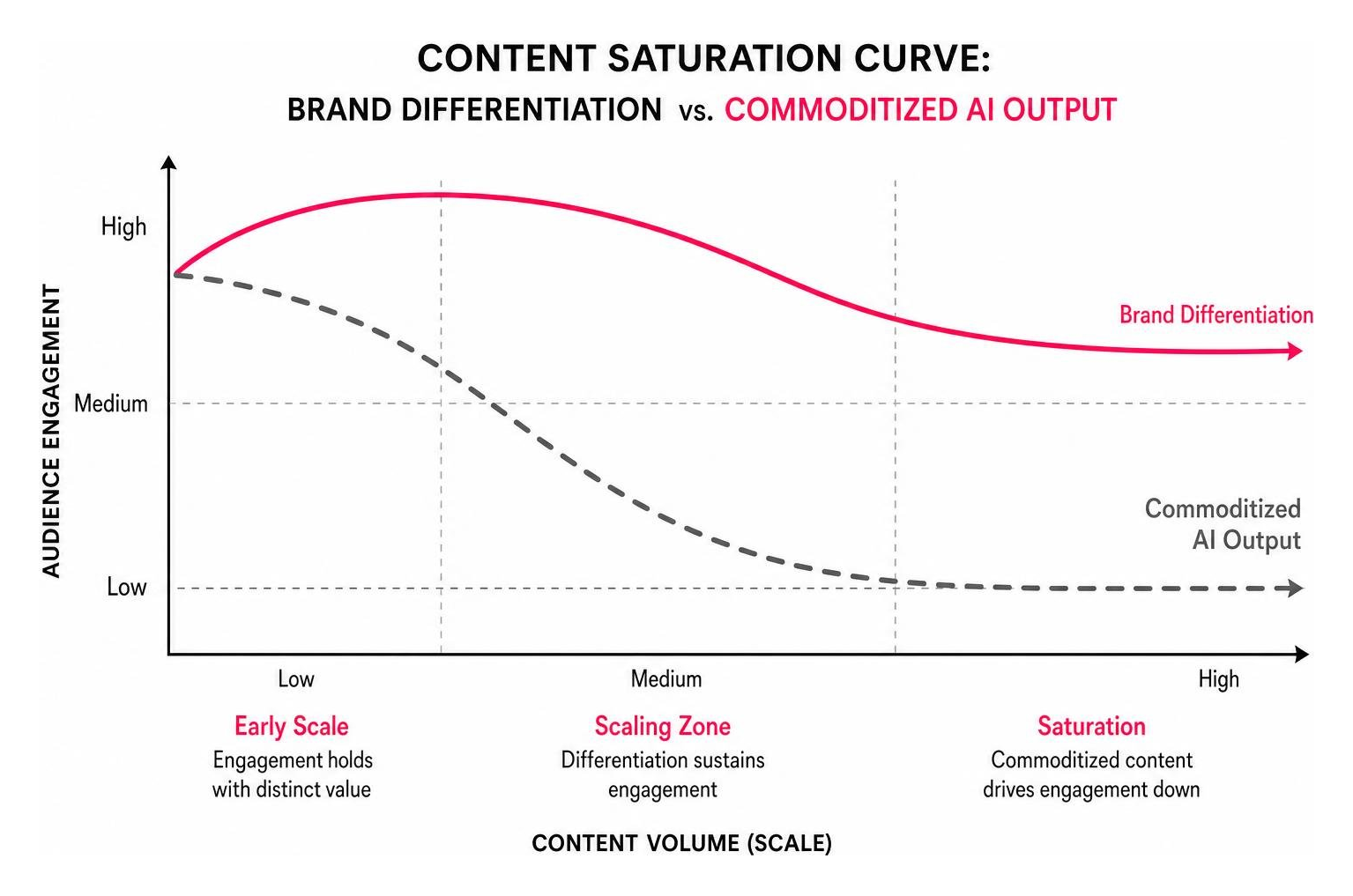
This saturation curve shows that as volume scales through raw automation, audience engagement drops. This occurs because of the "human favoritism" bias. Academic research indicates that audiences rate content lower when they know it was fully automated, even if the objective quality is identical to human-written text. The market rewards the perception of effort, original thought, and structural variety.
To win, we must treat brand as our primary defensive moat. When paid acquisition channels are saturated and search engines prioritize direct answers, the only defensible asset you own is a distinctive brand that audiences actively seek out. Our focus must shift from high-volume publishing to high-density value. This transition requires a complete restructuring of how we view content strategy in the age of AI.
The 5-Step Framework for AI Content Creation Without Losing Quality
To build a defensible content engine, we developed The Cognitive Resonance Protocol (CRP). This is our five-step operational framework designed to scale content production by 10x while maintaining strict editorial quality, brand alignment, and factual accuracy.
This protocol shifts your team's role from manual writers to system orchestrators. It ensures that every piece of content that leaves your organization carries your unique brand perspective, backed by verifiable data.
Step 1: Human-Led Strategy and Voice Dictation
We must eliminate the blank-canvas prompt. Asking an LLM to "write a blog post about B2B growth" is an admission of strategic failure. The AI has no context, no proprietary data, and no unique point of view. It will give you a generic listicle that looks exactly like your competitor's blog.
To prevent this, we use voice dictation to capture raw, unfiltered human thoughts.
When we type, we naturally edit ourselves. We strip away our personality, our weird analogies, and our strong opinions, leaving a sterilized draft. Voice dictation preserves these human elements.
To execute this step:
- Record a 5-minute messy voice memo detailing your specific perspective, real-world examples, and hard-won lessons on a topic.
- Feed this raw audio file into a dedicated project space in your LLM.
- Instruct the AI to extract the key arguments, structure them into a logical outline, and retain your exact phrasing and unique opinions.
This is the foundation of project-based AI. By keeping separate, single-purpose workspaces for distinct content assets, we prevent context dilution. The AI does not mix up your technical product documentation with your casual LinkedIn thought-leadership voice. To dive deeper into this methodology, read our guide on how to train AI to write in your brand voice.
Step 2: Encoding Brand Voice Guidelines into Deterministic Routines
A PDF style guide sitting in a shared drive is useless for an AI content engine. To maintain quality at scale, we must translate brand voice guidelines into deterministic routines—rules that the model must follow programmatically.
Instead of writing loose system prompts like "be professional but friendly," we encode exact linguistic constraints. This includes:
- The Lexicon Filter: A list of banned "AI words" that models over-index on (e.g., leverage, navigate, unlock, testament, dynamic, ecosystem).
- Sentence Length Mandates: Explicit instructions to vary sentence structures (e.g., "Write one punchy sentence of under 6 words for every 3 complex sentences").
- Perspective Anchors: Explicit rules outlining what your brand believes and, more importantly, what it vehemently disagrees with.
These instructions are saved as system templates within our central prompt library. Every prompt run through our engine automatically appends these style rules, ensuring brand compliance before a single draft is generated. For a detailed breakdown of how to build these parameters, explore our resource on ai brand voice guidelines.
Step 3: Executing AI Content Creation Without Losing Quality Through Multi-Model Consensus
Single-model pipelines are a major liability. If you rely on one API to research, draft, and edit your content, you are highly likely to encounter hallucinations. LLMs are optimized for fluency, not truth. They will confidently invent statistics, misattribute quotes, and flatten nuanced arguments.
To solve this, we use a multi-model consensus architecture. Rather than relying on a single model, we route different stages of the content lifecycle to different LLMs based on their specific strengths, then run a consensus validation step.
| Content Stage | Primary Model | Task |
|---|---|---|
| Research & Fact Verification | Perplexity / Claude | Extracting verified sources, checking timestamps, and building a claim-evidence library. |
| Nuanced Drafting | Claude | Executing the structural layout and drafting long-form prose with high lexical diversity. |
| Tone & Style Compliance | Gemini / GPT-4o | Auditing the draft against the encoded brand voice rules and flagging deviations. |
| Consensus Validation | Custom Multi-Model Pipeline | Cross-examining every factual claim across three independent models to verify accuracy. |
This multi-model consensus pipeline reduces factual errors by roughly 90% compared to single-model generation. It ensures your content is built to be cited by other search engines and AI discovery platforms.
To implement this programmatic routing, enterprise teams use ai content generators with built-in brand voice customization that support multi-model orchestration and LLM routing.
Step 4: Structural Humanization Over Word-Level Synonym Swaps
Most marketing teams try to bypass AI detectors by using basic paraphrasing tools. This is a mistake. Word-level synonym swapping does not improve writing quality; it simply makes it erratic and hard to read.
AI detectors do not look for specific words. They analyze statistical signatures: perplexity (the predictability of word choices) and burstiness (the variation in sentence length and structure). AI-generated text has low burstiness because the model writes with a uniform, metronomic rhythm. Humans, on the other hand, write with irregular pauses, fragments, and sudden shifts in cadence.
True humanization requires structural rewriting. We must break up uniform sentences, inject conversational transitions, and rebalance the vocabulary register.
If you are scaling high-volume content, you can use specialized programmatic humanizers to clean up your connective prose. Tools like the Undetectable AI Writer, AI Humanizer for Writers, the Manuscripts.ai Humanizer, or the programmatic AI Humanizer API can quickly eliminate the predictable statistical signatures of AI drafts.
However, these tools are post-processors. They cannot fix a draft that lacks original arguments, proprietary data, or genuine human insight. They are meant to polish the prose, not invent the strategy.
Step 5: The "Human-in-Charge" Editorial Gate and Feedback Loops
We do not believe in fully autonomous content pipelines. The final step of our protocol is a mandatory human-in-charge editorial gate.
We divide our review process into two distinct phases:
- Automated Quality Gates: Before an editor sees a draft, automated scripts score the content for SEO alignment, brand voice compliance, readability, and originality. If a draft fails to meet our minimum thresholds, it is automatically routed back to the AI engine for adjustment.
- Human Editorial Review: Once the draft passes the automated gate, a human editor takes over. Their job is not to fix grammar or typos—the AI has already handled that. The editor's job is to evaluate strategic value. Does this article actually solve a real customer problem? Does it take a clear, defensible stance? Does it contain real-world expertise?
Every edit made by our human team is captured and fed back into our training datasets. This continuous feedback loop ensures that our custom AI models learn from human corrections, steadily improving the quality of future drafts. To set up these governance structures, read our deep dive on ai brand voice and governance.
Operationalizing the Workflow: From Voice Dictation to Multi-Model Consensus
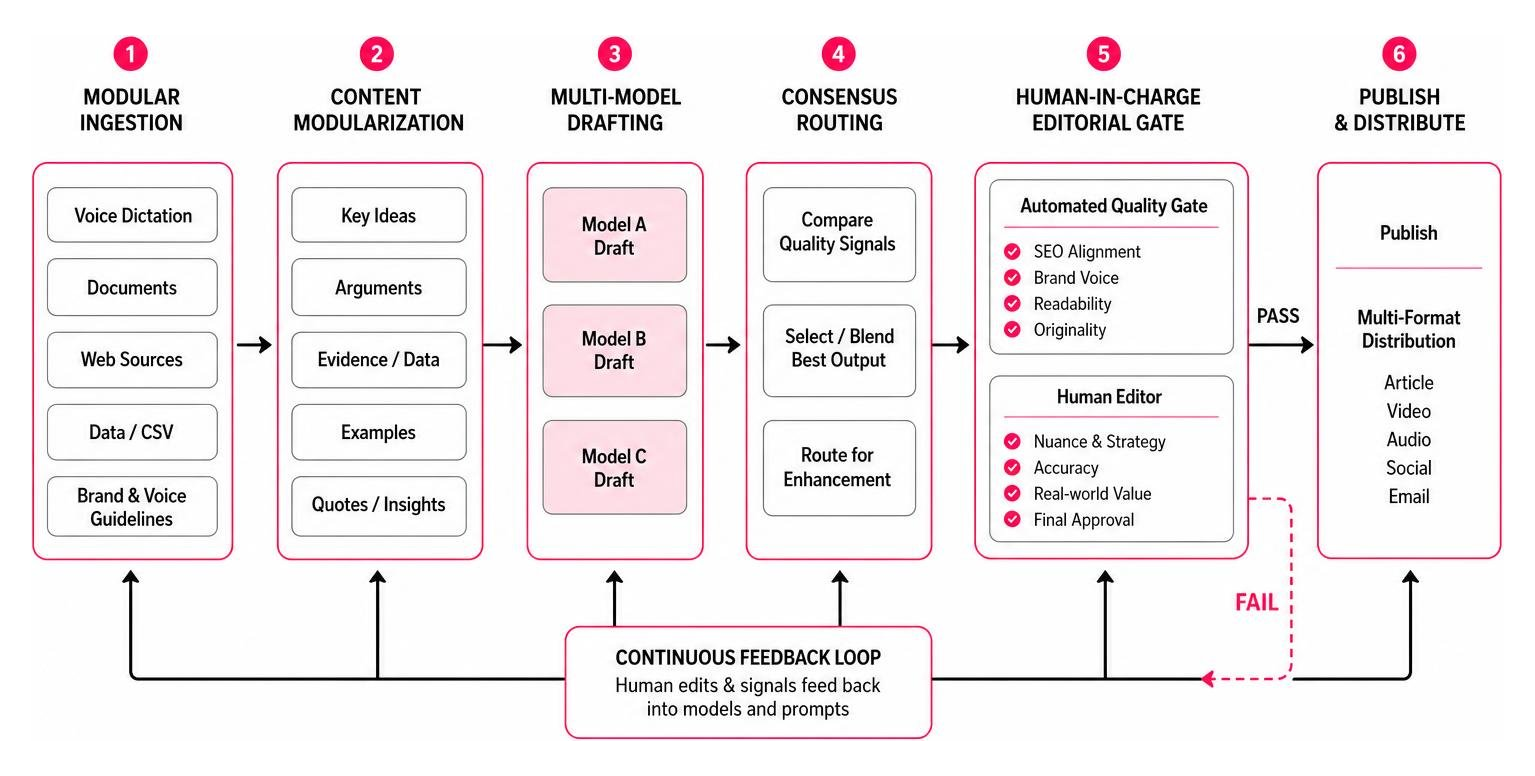
To execute this protocol at scale, you must restructure your content operations. The traditional marketing team structure—where siloed writers spend days researching and drafting individual articles—is too slow and expensive.
We must shift toward a centralized content engine that treats creative assets as modular, reusable blocks.
Scaling Video and Multi-Format AI Content Creation Without Losing Quality
Scaling multi-format content does not mean generating hundreds of cheap, AI-generated videos from scratch. Pure AI video tools often land in the "uncanny valley," producing content that feels synthetic and untrustworthy.
Instead, we use a process called video productization. We start by producing one high-quality, human-led master asset—such as a comprehensive interview with a subject matter expert or a detailed case study.
Once we have this master asset, we use AI as an execution assistant to split, adapt, and localize it across multiple channels.
AI tools are highly effective at:
- Auto-captioning and generating localized transcripts in over 20 languages.
- Creating short-form social media snippets from long-form video files.
- Adapting transcripts into structured blog posts, newsletters, and technical documentation.
By pairing a human-led master asset with AI execution pipelines, you can scale your multi-format output without losing brand authenticity. To discover the best systems for this, check out our guide on ai content repurposing tools.
Structuring Modular Content Blocks for Strategic Reuse
To make your content operations highly efficient, you must organize your existing assets into modular content blocks. This means separating your content into independent, tagged elements:
- Headers and Hooks: Designed to capture attention on specific channels.
- Core Arguments: The foundational, expert-verified concepts.
- Data and Claims: Verifiable statistics and proprietary metrics.
- Call-to-Actions (CTAs): Channel-specific conversion prompts.
When your assets are structured this way, AI agents can easily retrieve and remix them to create new, targeted formats—such as transforming a long-form white paper into a series of highly specific LinkedIn posts or localized emails. This modular approach allows you to scale content production without losing brand voice because the underlying building blocks have already been approved by your editorial team.
Mitigating Brand Risk: Claims Governance and Ethical AI Guardrails
As we scale our content operations, our exposure to brand risk increases. If your automated pipeline publishes a single hallucinated statistic, a misplaced claim, or an unverified legal assertion, the consequences can be severe. Consumers blame the brand, not the AI tool.
According to research, 35% of consumers hold the brand entirely accountable for factual errors in AI-assisted content. In regulated spaces like finance or healthcare, a single error can trigger severe compliance issues.
To mitigate this risk, we implement strict claims governance:
- The Centralized Claims Library: We maintain a verified database of every statistic, customer metric, and product claim our brand is legally allowed to make.
- Assertion-Level Auditing: Our AI engine is programmed to cross-reference every generated claim against this library before publication. If a model generates a statistic that does not exist in our database, the content is flagged and blocked from the publishing queue.
- Compliance Audit Trails: In highly regulated environments, we align our content workflows with strict governance standards, such as FDA 21 CFR Part 11, ensuring every edit, approval, and publication step has a clear, unalterable digital signature.
By building these ethical and technical guardrails directly into your operational stack, you protect your brand equity while moving at the speed of AI. For more details on building an ethical framework, consult our ai content generation ethics guide.
Frequently Asked Questions about AI Content Quality
How do you maintain brand voice consistency when scaling AI content?
Maintaining consistency requires translating your brand guidelines into deterministic routines rather than relying on loose prompts. You must program explicit rules, style constraints, and custom lexicons directly into your system prompts. Additionally, use automated quality evaluators to score every draft against your brand voice profile before it reaches human editors, routing any outliers back for revision.
Will search engines penalize AI-generated content if it lacks human editing?
Google's helpful content system does not penalize content simply because it was created with AI. However, search engines actively deprioritize low-effort, mass-produced automation that lacks original value or expertise (E-E-A-T). To rank well and earn citations in algorithmic search engines (GEO), your content must feature unique perspectives, proprietary data, and clear claim-evidence structures that demonstrate genuine authority.
What is the difference between word-level synonym swapping and structural humanization?
Word-level synonym swapping uses basic paraphrasing tools to replace individual words with synonyms, which leaves the predictable, metronomic sentence structure of AI intact and easily detectable. Structural humanization rewrites prose at the architectural level. It shatters uniform sentence rhythms, varies sentence lengths (burstiness), shifts vocabulary registers, and restores natural human cadence to make the text engaging and authentic.
Conclusion
The brands that win in the age of AI will not be those that publish the most content, but those that maintain the highest standards of distinctiveness and trust. AI is a powerful execution assistant, but it cannot replace human empathy, strategic direction, and creative vision.
By implementing a governed, multi-model consensus pipeline and keeping humans firmly in control of your strategy, you can scale your content operations without sacrificing the quality that defines your brand. To optimize your brand's digital presence for the future of search, explore our ai content optimization strategies.