Building a Robust AI-driven Content Strategy for Success


Why AI Tools for Content Strategy Are Now a Competitive Necessity
ai tools for content strategy have moved from "nice to have" to table stakes — here are the most important ones to know in 2026:
| Tool | Best For |
|---|---|
| Surfer SEO | SEO optimization and content scoring |
| MarketMuse | Topical authority and content planning |
| Jasper | AI copywriting and brand voice |
| Copy.ai | Fast social and short-form copy |
| Conductor | Enterprise content optimization |
| Notion AI | Brainstorming and workflow |
| Descript | Audio and video editing |
| Canva AI | Visual content creation |
| Synthesia | AI avatar video generation |
| Grammarly | AI writing and editing assistant |
More than 90% of marketers now use AI in some part of their content workflow. That number isn't surprising when you look at what's at stake.
Content teams are under pressure to produce more, faster, at lower cost — while still hitting SEO targets, maintaining brand voice, and proving ROI to the board. That's a brutal combination without the right tools.
The problem isn't a lack of AI tools. There are hundreds. The problem is knowing which tools actually move the needle — and which just add noise to an already crowded stack.
This guide cuts through that. Whether you're a CMO building an AI content strategy from scratch, an agency director fielding client questions, or a brand manager figuring out what to adopt and what to skip — you'll find a clear, practical breakdown of the tools worth your attention in 2026.
Essential ai tools for content strategy terms:
The Evolution of AI in Marketing Strategy
To understand where we are in 2026, we have to look back at how we got here. AI in marketing isn't a "post-ChatGPT" phenomenon; it has a deep history of helping brands connect with humans more effectively.

The journey began in earnest back in 1998 when Amazon pioneered collaborative filtering. Based on research by Jussi Karlgren, a computational linguist at Columbia University, this technology allowed Amazon to display product recommendations based on collected data. It was the first major instance of a machine predicting what a human might want to consume.
By 2013, the industry saw the rise of Natural Language Generation (NLG). Yahoo famously used tools like Wordsmith to generate personalized fantasy football reports. These weren't just dry data dumps; they were intentionally snarky and sarcastic, proving that AI could mimic a specific brand tone even a decade ago.
The mid-2010s brought programmatic advertising and Google’s RankBrain in 2015. This was a turning point for SEO. RankBrain forced us to stop "keyword stuffing" and start focusing on user intent. Google’s search algorithm refinement has since evolved into a sophisticated system that rewards grammatically correct, informative, and engaging content over mere technical optimization.
Essential AI Tools for Content Strategy and Research
In 2026, building a strategy based on "gut feeling" is a recipe for failure. We now use data-powered creativity to identify exactly what our audience is looking for before we ever type a single word.
| Feature | MarketMuse | Surfer SEO | Conductor |
|---|---|---|---|
| Primary Focus | Topical Authority | Page-level Optimization | Enterprise Visibility |
| Best For | Strategic Planning | Ranking Individual Posts | Large-scale SEO Ops |
| Key Metric | Content Score & Difficulty | SEO Score | Market Share/Visibility |
Using these ai tools for content strategy allows us to move from "content creation" to "content engineering." We aren't just writing; we are filling specific data gaps identified by machine learning.
Engineering Rankings with AI Tools for Content Strategy
Surfer SEO remains a staple in our toolkit because it analyzes the top-performing pages for any given keyword and tells you exactly what you need to do to beat them. It looks at semantic density, word count, and even the number of images required to rank.
Newer platforms like Contentra AI take this a step further by "mathematically reverse-engineering" the Search Engine Results Pages (SERP). By analyzing over 200 signals across the top 50 results, these tools remove the guesswork. Instead of wondering why a competitor is outranking you, you can see the exact semantic depth and intent signals you're missing.
Brand-Aligned Planning with Yahini and Cobomba
One of the biggest complaints about AI is that it sounds generic. Tools like Yahini solve this by building a "Brand Intelligence Hub." By analyzing your website URL, Yahini learns your products, positioning, and customer personas. This ensures that every content brief it generates is grounded in your actual business reality, not just open-web data.
Similarly, Cobomba uses NLP and graph analysis to audit your existing content. It identifies "content gaps" where your audience has questions that you haven't answered yet. This is essential for AI Content Strategy Services because it aligns your editorial calendar with the actual customer journey.
Leveraging MarketMuse for Topical Authority
MarketMuse is the "heavy lifter" for long-term strategy. It doesn't just look at keywords; it looks at topics. Its patented AI analyzes your entire content inventory to provide a "personalized difficulty" score.
Most SEO tools give you a generic difficulty score based on backlinks. MarketMuse tells you how hard it will be for your specific site to rank for a topic based on the authority you've already built. This allows us to prioritize "quick wins"—topics where we already have a foothold and can dominate with just one or two more high-quality pieces.
Scaling Production with Generative AI Ecosystems
Once the strategy is set, the challenge shifts to execution. We live in an era where high-quality content demand is at an all-time high. To stay consistent, brands are leveraging AI to handle the "commodity" parts of creation.
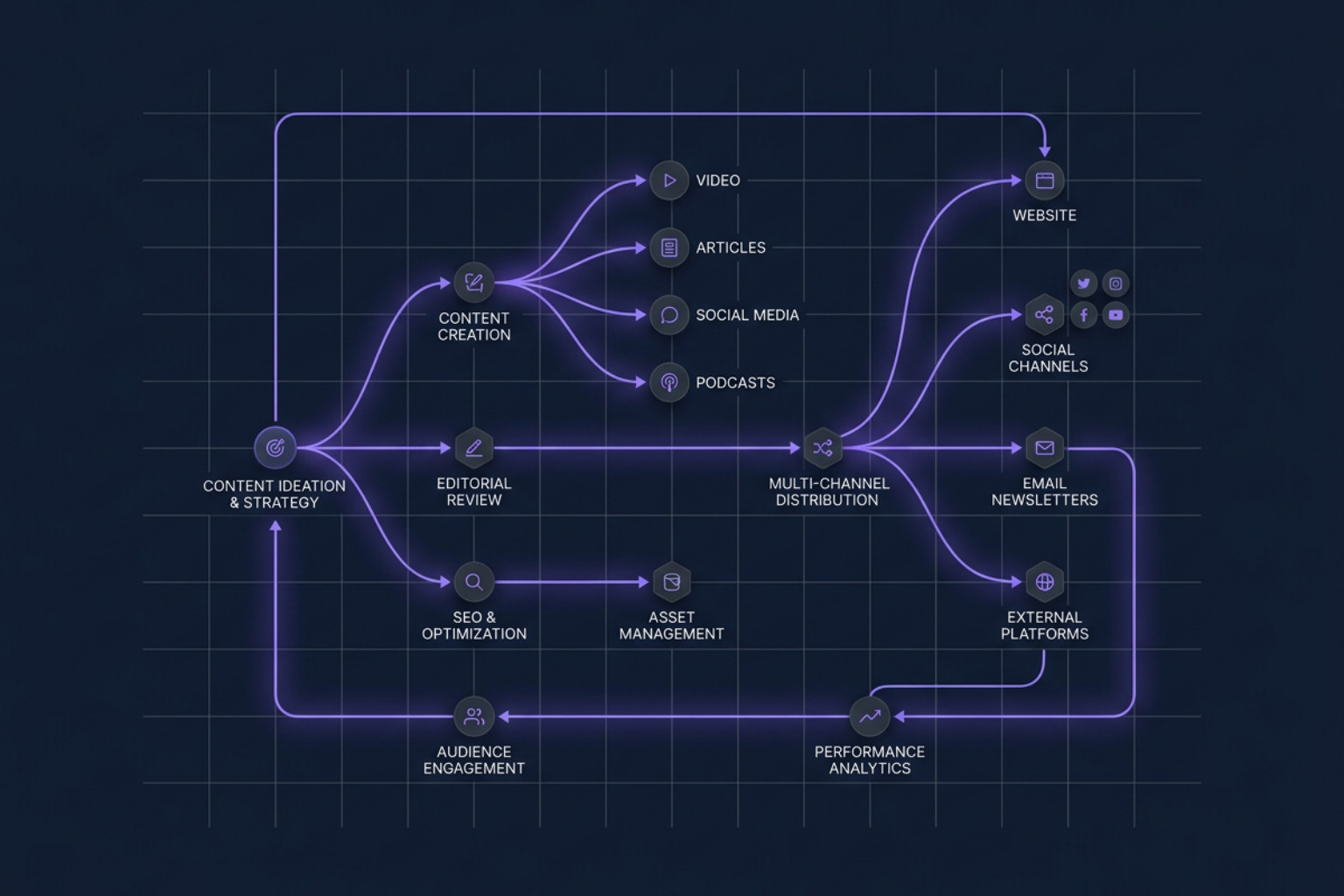
The goal of using ai tools for content strategy in production isn't just speed—it's scalability. According to research, a typical 500-word blog post used to take 4 hours to complete. With a modern AI workflow, that same time can yield a pillar article, five social posts, and an email newsletter.
Advanced Copywriting with Jasper and Copy.ai
For short-form copy and social media, Jasper and Copy.ai are the industry leaders. Jasper is particularly effective for teams because it allows you to upload "Brand Voices." You can feed it your past successful campaigns, and it will learn to mimic your specific style—whether that’s professional and authoritative or snarky and bold.
Content Generation Services often use these tools to break through creative blocks. Instead of staring at a blank page, marketers use AI to generate ten different hooks for a LinkedIn post, then pick the best one to refine.
Visual and Video AI Tools for Content Strategy
Visual content is no longer a bottleneck for small teams. DALL-E2 and more advanced generators allow us to create custom, on-brand imagery without a full design team for every blog post.
In the video space, Synthesia allows brands to create training or explainer videos using AI avatars, while Descript has revolutionized editing. With Descript, you can edit video by editing a text transcript. If you want to delete a "um" or a whole sentence from a video, you just highlight the text and hit delete. It even has an "Overdub" feature that can generate your voice from text to fix a mistake in the recording.
Automating Outreach with Smartwriter and Seventh Sense
Strategy doesn't end when the "Publish" button is hit; it ends when the content reaches the audience. Seventh Sense uses AI to optimize email delivery times. Instead of sending a blast to everyone at 10:00 AM, it analyzes when each individual subscriber is most likely to open an email and delivers it at that exact moment.
For B2B teams, Smartwriter.ai automates the personalized part of outreach. It can "read" a prospect's LinkedIn profile or latest blog post and generate a personalized opening line that feels human, significantly increasing conversion rates.
Overcoming Challenges and Ensuring Quality
Despite the efficiency, AI is not a "set it and forget it" solution. 77% of companies are currently exploring AI, but many struggle with maintaining quality. Issues like "hallucinations" (where AI confidently states a fact that is entirely made up) and lack of cultural nuance are real risks to brand equity.
McKinsey reveals that the highest revenue increases come when AI adoption is paired with human oversight. We call this the "Human-in-the-loop" model. AI does the heavy lifting of research and first drafts, but humans provide the "soul"—the lived experience, the empathy, and the final fact-check.
Navigating Google’s Stance on AI Content
A common fear is that Google will penalize AI-generated content. However, Google’s guidance has been clear: they reward high-quality, helpful content that demonstrates E-E-A-T (Experience, Expertise, Authoritativeness, and Trustworthiness). They don't care how the content was produced, as long as it's useful to the user.
To whip their websites into shape, brands must ensure their AI content isn't just a rehash of what's already on the web. We use AI to find the data, but we use human experts to provide the "Experience" part of the E-E-A-T equation.
Maintaining Authenticity and Tone
Consistency is the bedrock of branding. If your AI writes one post like a college professor and the next like a TikTok influencer, you lose consumer trust. Grammarly and specialized style-guide tools help maintain this by flagging when a draft deviates from your established brand voice.
Professional editing remains non-negotiable. An editor’s job in 2026 isn't just to fix typos; it's to ensure the content feels relatable and culturally aware—something machines still struggle to grasp fully.
Frequently Asked Questions about AI Content Strategy
Will AI replace human content creators?
The short answer is no, but it will replace those who refuse to use it. As Gary Vaynerchuk has noted, AI eliminates "commodity tasks"—the repetitive, low-value work like formatting or basic research. This frees up humans to focus on creative storytelling, high-level strategy, and building genuine emotional connections with an audience. The human experience is something an algorithm cannot replicate.
How do I choose the right AI tool for my team?
Don't start with the tool; start with the problem. Are you struggling with ideation? Look at Google’s Natural Language Processing tool or ChatGPT. Is your content not ranking? You need an optimization tool like Surfer SEO. Is your workflow a mess? Look at Notion AI or Zapier. The best tool is the one that integrates seamlessly into your existing stack without creating more work.
Can AI create content that genuinely converts?
Yes, by using "data-powered creativity." Tools like Albert.ai can personalize and optimize ad content at scale, analyzing thousands of variables to see what triggers a conversion. By A/B testing headlines, CTAs, and intros in real-time, AI can find the "winning" version of a piece of content much faster than a human could.
Conclusion
As we look toward the end of 2026, the future of ai tools for content strategy is moving toward "Predictive Analytics" and "AI Engine Optimization" (AEO). We aren't just optimizing for Google anymore; we are optimizing for how AI assistants like Perplexity and ChatGPT summarize our brand's information.
The brands that win in this era will be those that treat AI as a partner, not a replacement. By combining the "science" of AI with the "art" of human creativity, you can build a content engine that is both incredibly efficient and deeply resonant.
For more deep dives into how AI is reshaping the craft of marketing, explore our tag/ai-content-strategy/ archives.
Ready to stay ahead of the curve? Sign up for The Brand Algorithm newsletter to get practitioner-level analysis delivered to your inbox 3–4 times a week. We help senior marketers navigate the AI era without losing their brand's soul.