Ultimate Guide to AI Creative Testing Tools

The Death of Guesswork: Why AI for Creative Testing and Optimization is the New Brand Moat
AI for creative testing and optimization has quietly become one of the highest-leverage decisions a marketing organization can make — not because it saves time, but because creative quality drives 56% of digital ad performance while media placement accounts for only 37%. Most teams are still optimizing the wrong variable.
Here is what AI creative testing actually does, in plain terms:
- Predicts ad performance before launch using attention modeling, implicit response data, and pattern recognition trained on millions of creative assets
- Generates and rotates variants automatically so winning creative replaces fatiguing ads before CTR drops signal the damage is already done
- Identifies which specific elements — headline, CTA, hook, visual frame — drove performance, not just which ad won
- Compresses the feedback loop from weeks of post-launch data collection to minutes of pre-launch diagnostic scoring
- Scales testing volume from the industry average of fewer than 3 variants per campaign to dozens running simultaneously
The numbers make the case plainly. The best-performing ads, as measured by Kantar's LINK testing, can deliver 4x the long-term return on marketing investment compared to average creative. Yet only 17% of marketing teams test more than three variants per campaign. That gap — between what the research says is possible and what teams actually do — is where AI creates its sharpest advantage.
The real problem is not a shortage of AI tools. It is a shortage of structured frameworks for deciding what to test, when to test it, and what the results actually mean for brand strategy.
Winning creative also has a shelf life. On high-frequency campaigns, even top-performing ads decay within three to six weeks. Without a systematic approach to generation, testing, and rotation, brands burn budget defending creative that the algorithm has already moved past.
This guide exists because 83% of ad executives deployed AI in creative processes in 2025 — yet adoption is running well ahead of trust, methodology, and organizational readiness. Most teams are using AI as a production accelerator. The teams pulling ahead are using it as a pre-launch intelligence system and a continuous performance loop.
I'm Florian Radke — brand strategist, fractional CMO, and founder of The Brand Algorithm — and over 25 years of building brands across immersive digital experiences, AI-driven content engines, and viral DTC campaigns generating over 25 million in earned media, I've seen AI for creative testing and optimization evolve from a research-lab concept into a genuine source of competitive separation. What follows is the framework I use with clients to build it properly.
If you are competing on bidding strategies, budget hacks, and granular audience targeting, you are fighting yesterday's war. The major ad networks have commoditized distribution. Meta’s Advantage+ and Google's AI-driven delivery systems have leveled the playing field; they can find your target customer faster and cheaper than your best media buyer ever could.
When distribution is a utility, creative expression becomes your only defensible moat.

Yet, most marketing departments treat creative development as an exercise in subjective intuition. We sit in conference rooms debating whether a blue background "feels" more aligned with our brand than a green one. We argue over headlines based on personal preferences rather than empirical data. This subjective bottleneck is incredibly expensive.
According to industry data, creative quality drives 56% of performance in digital channels, while media placement accounts for only 37%. When you run non-optimized creatives, you are essentially taxing your media budget. The best-performing ads, validated by Kantar’s LINK testing, achieve a 4x long-term return on marketing investment compared to average assets. Meanwhile, optimized AI creative generators claim to improve conversion rates by up to 14x compared to static, non-optimized baselines.
The industry has taken note. In 2025, 83% of ad executives deployed AI within their creative workflows, a massive jump from 60% the previous year. The primary driver behind this shift is clear: 64% of advertisers cite cost efficiency as the top benefit of AI in advertising.
But cost savings are a secondary benefit. The real prize is the ability to test at a scale that was previously physically and financially impossible. When only 17% of marketing teams test more than three variants per campaign, they are leaving millions of dollars in performance on the table.
To win, we must combine high-volume production with predictive evaluation. We cannot simply flood the market with automated noise; we must build a system of Ai Driven Content Creation that preserves brand distinctiveness while systematically finding winning patterns.
The Pre-Launch Diagnostic Framework: Moving Testing Upstream
The greatest waste in modern marketing is spending actual media budget to discover that an ad is a dud. Traditional A/B testing is fundamentally reactive. You design two concepts, launch them, spend thousands of dollars over two weeks, and wait for the ad account to tell you which one failed.
We must move creative testing upstream. Pre-launch creative intelligence allows us to diagnose and refine assets before audiences ever see them.
This is not a theoretical concept. Major holding companies and global brands are already implementing this shift. For example, Omnicom and Google recently launched a joint AI ad evaluation system in the Middle East, piloting it with the telecommunications company du. The system combines Google’s ABCD framework (Attention, Branding, Connection, Direction) with Omnicom’s Brave Bot.
When du ran 10 video assets through this system, the AI generated effectiveness scores ranging from 44% to 80%. More importantly, it translated vague, subjective human feedback (like "the video feels slow") into structured data and explicit edits, such as tightening the first two seconds to secure immediate brand visibility. This is how we transform creative intuition into a measurable variable, a concept we explore deeply in our Ai Competitive Intelligence Guide 2026.
To implement this ourselves, we use a structured, four-step sequence:
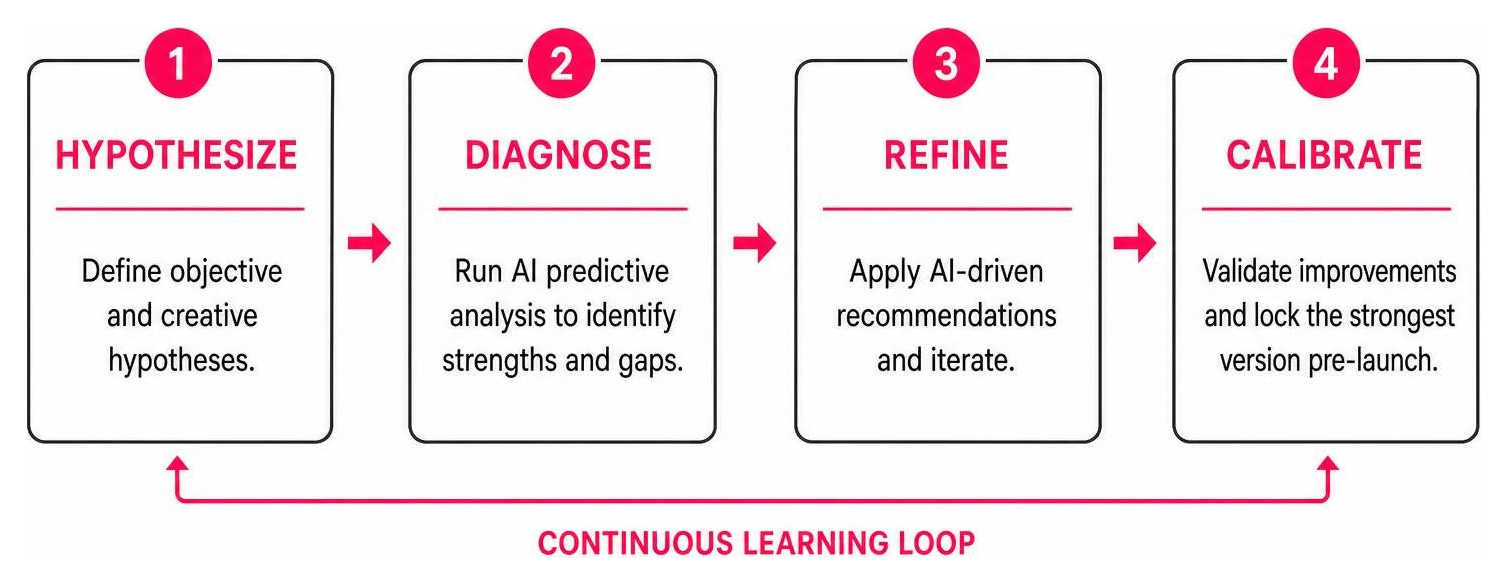
Predictive Science vs. Traditional A/B Testing
Predictive testing platforms use machine learning models trained on massive databases of eye-tracking studies, facial coding, and implicit response data to simulate how human brains will react to an ad in the first critical seconds.
Platforms like Neurons AI can generate attention heatmaps and cognitive impact scores in minutes, showing exactly where a user's eye will land. Will they look at the product, or will they be distracted by a busy background? Will they actually see the CTA?
Similarly, Behavio delivers ad testing results in under five business days from 500+ respondents per creative, focusing on implicit responses rather than claimed preferences. This is crucial because what consumers say they like in a survey rarely matches their actual buying behavior.
| Metric / Feature | Traditional A/B Testing | Survey-Based Concept Testing | AI Predictive Testing |
|---|---|---|---|
| Speed to Insight | 2–4 weeks | 5–14 days | 15 minutes to 2 hours |
| Cost Profile | High (requires live media spend) | Very High ($15k–$50k per study) | Low (SaaS subscription model) |
| Data Basis | Click/conversion actions | Stated intent (claimed preferences) | Neural attention models & implicit response |
| Primary Risk | Wasted media budget on bad ads | Consumer response bias | Model limitations on highly novel concepts |
| Feedback Resolution | Ad-level (which ad won) | General theme-level | Element-level (visual salience, cognitive load) |
How to Implement AI for Creative Testing and Optimization Before Media Spend
The practical goal of using AI before media spend is to produce clean, structured hypotheses. If you upload ten completely different ads into an AI testing tool, you will get ten different scores, but you won't understand why.
First, formulate a clear strategic hypothesis. For example, are your target customers more motivated by a problem-led hook or an outcome-led hook?
Next, generate your variants while keeping one dominant variable constant. If you are testing headline variations, keep the background image, CTA, and color scheme identical across all versions. If you are testing visual layouts, keep the copy identical. This is the exact methodology we employ when using Testing & Optimization | Imagive to run continuous, high-velocity iterations.
When evaluating your creative assets through predictive AI, you must focus on four core metrics:
- Attention Salience: The percentage of immediate visual attention captured by your primary brand elements (logo, product, CTA) within the first 1.5 seconds. If your logo scoring is below 20% salience, the ad is failing to build brand equity.
- Cognitive Load: The cognitive effort required to process the ad. High cognitive load leads to immediate scrolling. We want clean, high-clarity designs that communicate the value proposition instantly.
- Predicted Thumb Stop Rate (TSR): An AI-calculated score predicting the probability of stopping a user's scroll on social feeds. A predicted TSR above 25% is solid; anything above 40% is elite.
- Emotional Resonance: How well the visual and copy elements trigger implicit emotional connection, mapped against historical industry benchmarks.
The Closed-Loop Creative Engine: Generation, Automation, and Analytics
Pre-launch testing gets you to the starting line with high-potential assets. But once your campaign goes live, the work of ai for creative testing and optimization shifts into an automated, closed-loop execution system.
We must move away from static campaigns and toward dynamic, self-optimizing creative loops. Traditional Dynamic Creative Optimization (DCO) was limited by a production bottleneck; it could only assemble pre-built components based on static, manual rules.
Modern agentic AI systems remove this barrier by continuously generating new assets, deploying live tests, and swapping variations based on real-time performance data.
This is the direction the major platforms are moving. Meta’s Advantage+ suite, which claims to boost ROAS by 22% on average, is integrating generative tools directly into its delivery engine. Marketers can now automatically generate image-to-video variations, create AI-powered video highlights, and test customized CTAs on the fly.
To prevent your brand from becoming a generic template within these platform-native systems, you must build your own closed-loop creative engine, a strategy we map out in our Ai Content Optimization Strategies Guide 2026.

Integrating Multi-Variant Generation with Real-Time Feedback
A true closed-loop system requires multimodal testing. It must evaluate video, audio, and dynamic visuals simultaneously, tracking performance down to the individual asset element.
When you run campaigns through platforms like the AI Ad Creative Testing & Rotation for B2B — YEpsilon , the system does not just tell you that "Ad A" beat "Ad B." It provides element-level attribution.
It isolates the performance of specific hooks, CTAs, and visual frames. If the system discovers that a problem-led headline framing performs 2.1x better than an outcome-led framing over a 14-day cycle, it feeds that specific signal directly back into the generation engine to write the next batch of challengers.
Overcoming Creative Fatigue with Autonomous AI for Creative Testing and Optimization
Every performance marketer knows the pain of creative fatigue. You launch a campaign, hit your target CPA, and watch performance compound beautifully—only for the numbers to fall off a cliff three weeks later. On high-frequency campaigns, winning ad creative typically decays within three to six weeks.
Manually monitoring and replacing these assets is a operational nightmare.
Autonomous conversion systems, such as pagent.ai - Your conversion co-pilot , solve this by turning your campaign destinations and ad accounts into self-optimizing engines. The system monitors live performance signals, such as a drop in CTR or an increase in frequency caps.
Using Bayesian statistics and continuous confidence checks, the AI detects early-stage fatigue before it impacts your bottom line. It automatically pauses the decaying assets and deploys pre-approved, fresh variants built from the latest winning patterns.
The Human-in-the-Loop Governance Model: Protecting Brand Distinctiveness
Here is where the pure automation play breaks down, and where many modern marketing teams are making a fatal mistake. They are treating AI as an autopilot, letting algorithms make every creative and strategic decision.
If you let an algorithm optimize your creative without human guardrails, it will inevitably optimize for the lowest common denominator. It will write clickbait headlines, use generic layout templates, and strip away everything that makes your brand distinctive.
Furthermore, consumer sentiment is not keeping pace with marketer enthusiasm. While 82% of ad executives believe Gen Z and millennial consumers feel positive about AI-generated ads, only 45% actually do.
In fact, more than 30% of consumers across every age group say that knowing an ad was AI-generated makes them less likely to choose that brand. Gen Z is particularly skeptical, with 39% reporting negative sentiment toward AI ads—nearly double the rate of millennials.
To build a defensible brand in an automated world, we must deploy a "Human-in-the-Loop" governance model.
In this model, we divide responsibilities based on unique strengths:
- What we automate: High-volume asset variations, predictive attention mapping, layout scaling across formats, real-time fatigue detection, and statistical significance monitoring.
- What we keep human: Core brand strategy, emotional positioning, narrative distinctiveness, ethical compliance, and final creative approval.
We must also implement strict brand governance systems. This means uploading defined brand kits, typography hierarchies, and negative-prompt guardrails to ensure that any AI-generated asset feels like it was crafted by our internal design team.
Instead of using AI to replace creative thinkers, we must upskill our teams to become creative directors of algorithmic engines. We need our creative teams focusing on prompt quality, strategic hypotheses, and visual distinctiveness, while our operational teams focus on translating Ai Campaign Measurement insights into long-term brand equity.
Frequently Asked Questions about Algorithmic Creative Testing
How accurate are AI-generated creative predictions compared to real-world performance?
AI-generated creative predictions are highly accurate for structural and cognitive metrics, but they should not be treated as absolute truth for complex emotional resonance. Platforms like Ipsos Creative|Spark AI are trained on decades of validated creative data and tens of thousands of real human responses, making their predictions of human attention and brand recall incredibly reliable.
Similarly, Kantar’s LINK AI can deliver decision-quality ad effectiveness predictions in as few as 15 minutes. However, these systems are built to predict attention and processing capability. They cannot predict sudden cultural shifts, viral trends, or highly nuanced humor.
The best practice is to use AI predictions as a pre-launch filter to eliminate obvious failures, while relying on live, small-budget ad account testing to validate your strategic hypotheses.
How does AI creative testing impact agency relationships and internal headcounts?
The rise of AI creative testing and optimization is fundamentally restructuring the agency-brand dynamic. In 2025, global ad spend rose by 8.6%, yet holding company revenues fell by 1.2%. This divergence is happening because brands are insourcing creative production and testing using AI tools.
Additionally, 91% of senior agency leaders expect AI to reduce headcounts, and 57% have already slowed or paused entry-level hiring. Agencies can no longer charge premium retainers for basic asset formatting and manual A/B test setup.
To survive, agencies must transition from execution partners to strategic orchestrators—focusing on brand positioning, proprietary data development, and generative engine optimization, while leaving the high-volume variant production to automated systems.
What criteria should brands use to evaluate and choose an AI creative testing platform?
When evaluating platforms, senior marketing leaders must look beyond basic generation features and assess enterprise readiness. Use these three core criteria:
- Multivariate Capabilities: Can the platform test complex, multimodal assets (video, audio, and interactive formats) or is it limited to static images and copy?
- Integration Depth: Does the tool integrate directly with your existing ad accounts (Meta, Google, TikTok, LinkedIn) and analytics suites (GA4) to enable automated, closed-loop data feedback?
- Enterprise Security and Compliance: Does the platform offer robust data privacy, SOC2 compliance, ISO27001 certification, and GDPR/CCPA alignment to protect your proprietary creative data?
For teams looking to scale conversion rate optimization without developer bottlenecks or complex spreadsheets, platforms like Fibr AI provide an excellent framework for automated, compliant landing page and creative testing.
Conclusion
In the age of AI, brand is the ultimate moat. As algorithmic tools commoditize the production of copy, images, and videos, the market will continue to be flooded with generic, optimized content. The brands that win will not be those that produce the most noise, but those that use AI as a force multiplier for genuine, strategic differentiation.
By moving your creative testing upstream, building a closed-loop performance engine, and protecting your brand distinctiveness with a rigorous human-in-the-loop governance model, you can transform creative development from an expensive guessing game into a predictable driver of business growth.
If you are ready to transition your marketing department from manual workflows to a high-performance, AI-native brand engine, learn how to structure your team, protect your margins, and scale your creative impact by exploring our strategic frameworks.