The Complete Guide to Content Operations AI Workflow

Your Content Pipeline Is the Bottleneck. Not Your Team.
A content operations AI workflow is the structured system that connects strategy, AI-assisted creation, governance, and distribution into a single, measurable pipeline — replacing the fragmented handoffs, manual coordination, and tool-switching that currently consume the majority of your team's productive hours.
Here is what a modern content operations AI workflow covers:
- Ingestion — automated research, sitemap scanning, and content gap analysis
- Synthesis — AI-assisted drafting, metadata generation, and variant creation guided by brand voice profiles
- Governance — automated compliance checks, version control, style guide enforcement, and human approval gates
- Distribution — multi-channel adaptation, scheduled publishing, and performance feedback loops
Most enterprise content teams already know this. What they are still working out is how to wire these stages together without creating new failure points.
Up to 80% of companies now treat end-to-end business process automation as their primary technology goal. AI adoption in business operations grew from 20% in 2017 to 78% in 2024. Generative AI tool usage nearly doubled from 33% to 71% in a single year, between 2023 and 2024 alone. The tools exist. The adoption curve is steep. The problem that remains is the absence of a working operational model — one that tells you what to automate, how to govern it, and where human judgment is non-negotiable.
The real bottleneck in most marketing organizations is not a shortage of content or even a shortage of AI capability. It is the administrative overhead surrounding creative work: brief assembly, approval routing, metadata tagging, variant creation, performance reporting. Research consistently shows that content teams spend the majority of their hours on everything around the writing, not the writing itself. AI removes that tax. But only when the workflow is designed deliberately, not assembled from disconnected tools.
The content bottleneck has shifted from production to governance. AI removed scarcity around first drafts and versioning. It did not remove rights clearance, brand review, or channel-specific risk.
That distinction matters enormously for how you architect your system — and for where you keep humans in the loop.
I'm Florian Radke, a brand strategist and fractional CMO who has spent 25 years building content engines for companies ranging from venture-backed startups to international enterprise brands, including AI-driven content operations AI workflow systems that scaled from pilot to full deployment. In this guide, I'll share the frameworks, failure modes, and integration decisions that actually determine whether these systems deliver measurable business value — or become another expensive proof of concept.
Designing a Modern Content Operations AI Workflow
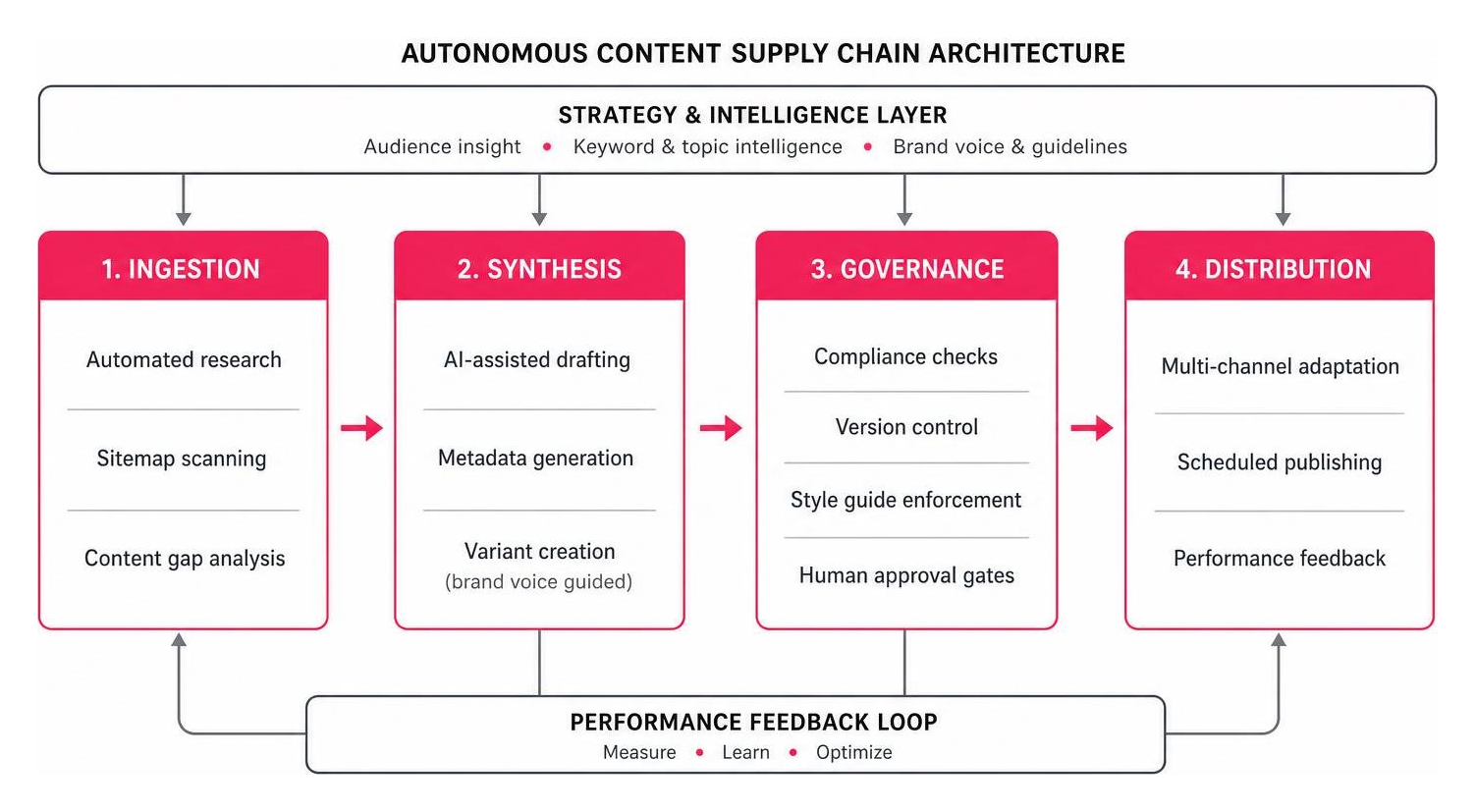
Redesigning workflows has the greatest impact on increasing earnings before interest and taxes (EBIT) when deploying generative AI. Simply bolting an AI writing assistant onto a broken, manual process does not scale; it only generates high volumes of low-quality, generic draft material that clogs your review channels.
True optimization requires shifting from a series of ad-hoc tasks to a centralized, autonomous content supply chain. This transition relies on cognitive reasoning systems rather than basic, rule-based automation. While 88% of organizations consider AI the key to successful automation, and 78% identify productivity gains as their primary KPI, the top performers are those that redesign the actual sequence of work. In fact, 73% of top performers in content management have automated previously manual processes to build a defensible brand moat.
Deconstructing the Content Operations AI Workflow vs. Rule-Based Systems
Traditional rule-based automation relies on rigid, deterministic "if-this-then-that" logic. If a writer moves a card to "Review" in your project management software, the system sends a Slack notification to the editor. If the editor approves, it uploads the draft to the CMS.
While helpful, these systems cannot read, evaluate, or adapt the content itself. They break the moment a variable changes or human nuance is required.
A cognitive content operations AI workflow uses machine learning, natural language processing (NLP), and semantic understanding to make contextual decisions. It reads the draft, evaluates it against your brand voice guidelines, flags compliance issues, suggests internal links based on semantic relevance, and automatically generates platform-specific distribution variants.
| Operational Dimension | Traditional Rule-Based Automation | Cognitive AI Workflows |
|---|---|---|
| Logic Foundation | Hardcoded conditional statements (IF/THEN) | Machine learning models and semantic reasoning |
| Data Handling | Structured data fields only | Unstructured text, images, and audio |
| Brand Control | Manual checklist verification | Automated voice calibration and style-guide matching |
| Process Adaptability | Breaks on unexpected inputs or API changes | Dynamically reroutes based on context and intent |
| Scale Capability | Linear growth in administrative overhead | Exponential scale with flat operational costs |
By moving beyond rigid rules, cognitive workflows allow enterprise teams to automate complex tasks while preserving the editorial standard required for AI-Driven Content Creation.
Eliminating the Administrative Tax on Creative Teams
The primary objective of automated workflows is not to replace human writers; it is to eliminate the administrative tax that keeps them from doing their best work.
Consider the typical lifecycle of an enterprise article. A writer spends hours gathering source links, parsing competitor structure, building keyword lists, and writing meta descriptions. After drafting, they copy-paste the text across multiple documents to create social media variants, email copy, and executive summaries.
By automating these repetitive tasks through structured Marketing Workflow Software, you return valuable hours to your strategic leaders. Instead of managing file versions and formatting, your editors focus on refining the narrative angle, verifying proprietary insights, and ensuring the content aligns with your brand's core values.
The Architecture of an Autonomous Content Supply Chain
To build an autonomous content supply chain, you must connect your existing systems into a unified ecosystem. This requires moving away from isolated browser extensions and individual chat prompts, and moving toward integrated APIs and microservices.
Enterprise orchestration platforms like Box Automate, Adobe GenStudio, and Contentful AI Actions serve as the connective tissue, allowing your digital asset manager (DAM), content management system (CMS), and AI engines to communicate in real time.
Orchestrating the Content Operations AI Workflow with Modern APIs
The backbone of any scalable AI integration is a clean API architecture. By using standardized REST endpoints and Model Context Protocol (MCP) schema discovery, your systems can dynamically discover and execute AI capabilities.
For example, when a new asset is uploaded, your DAM can trigger an API call to analyze the document, extract entities, generate optimized metadata, and update the workflow status on your Kanban board.
Using a structured Content Workflow API - Vellocity Documentation allows developers to programmatically execute capabilities, track execution progress, and move assets through review states without manual intervention. This level of automation is essential for maintaining a high-velocity Marketing Technology Stack that does not collapse under its own operational weight.
Multi-Agent Systems vs. Controlled Retrieval-Augmented Generation
When architecting your AI workflow, you will face a choice between deploying autonomous multi-agent systems or controlled Retrieval-Augmented Generation (RAG) pipelines. 52% of companies see the automation of complex workflows as a top benefit of agentic AI. However, unconstrained multi-agent systems often introduce unpredictable behavior, hallucinated facts, and brand voice drift.
For enterprise content operations, a hybrid approach is superior. We use controlled RAG pipelines for ingestion and synthesis to ensure all generated drafts are grounded in verified, proprietary data.
By storing your company's white papers, product documentation, and past publications in a secure vector database, your AI agents can perform semantic search queries to pull exact context before drafting. This limits the model's creative parameters, ensuring that every claim is traceable to an internal source of truth while keeping model context windows highly efficient.
The Cognitive Content Lifecycle Framework
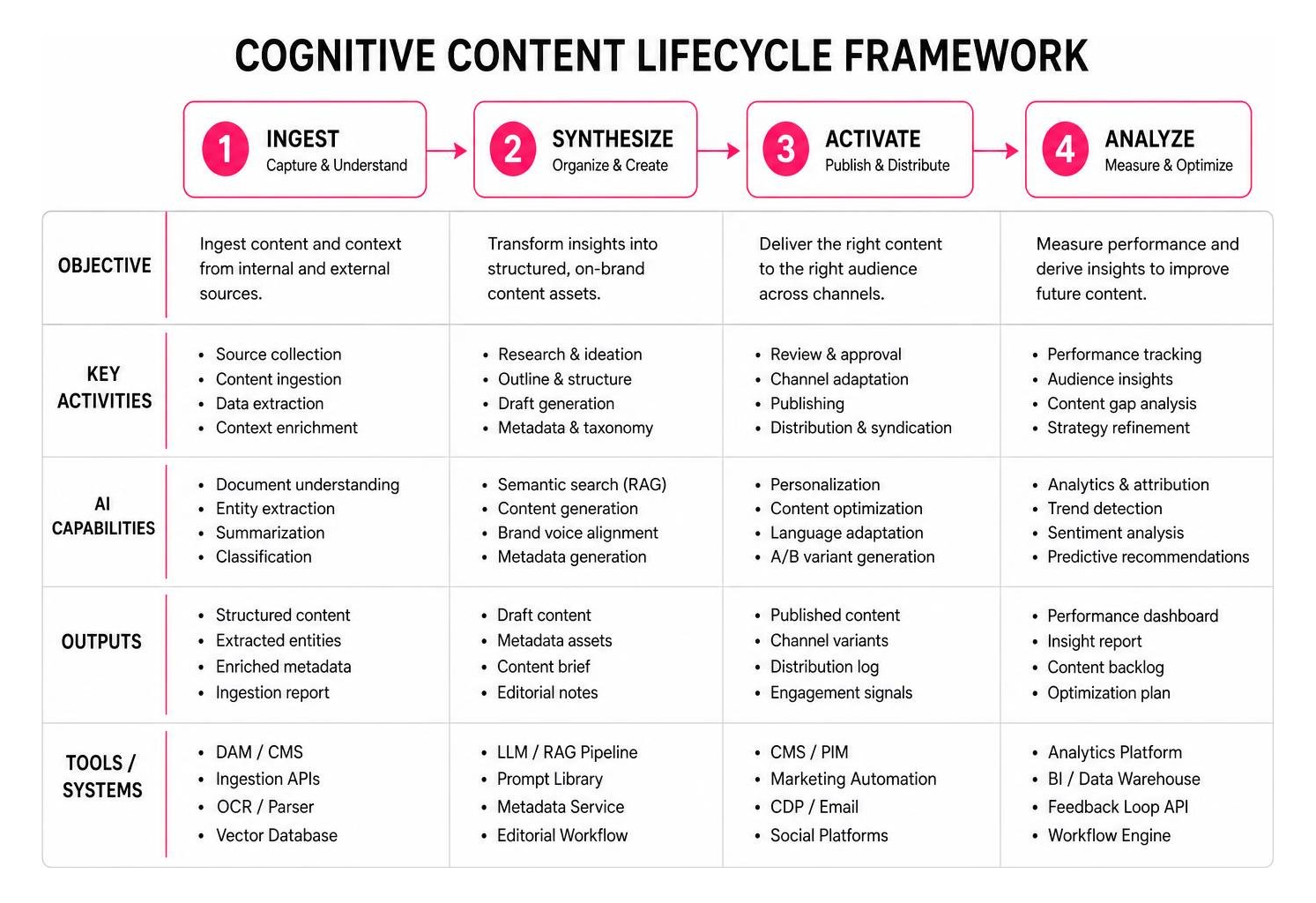
To help enterprise teams design and deploy these systems, we developed The Cognitive Content Lifecycle Framework. This framework organizes your content operations into four distinct, automated phases, moving from initial strategy to final performance analysis.
By mapping your tools and prompts to this matrix, you ensure that AI serves as a strategic partner throughout the entire lifecycle, rather than a superficial writing assistant. We cover the core strategies behind this architecture in our AI Tools for Content Strategy Guide.
Phase 1 and 2: Ingestion and Synthesis
The first half of the framework focuses on turning raw data and search signals into highly structured, brand-aligned drafts.
- Ingestion: In this phase, automated agents scan your existing sitemaps, analyze competitor search visibility, and identify topical gaps. The system normalizes this data into a centralized content index, flagging duplicate topics to prevent keyword cannibalization before a single word is written.
- Synthesis: Once a topic is approved, the system generates a comprehensive content brief. This brief pulls semantic keywords, target audience intent, and required reference links directly into your editor. The AI then drafts first-pass copy that matches your exact structural patterns and style constraints, applying Advanced AI Techniques for Content Creators Workflow Optimization to ensure the draft is highly relevant from the start.
Phase 3 and 4: Governance and Distribution
The second half of the framework ensures your content remains safe, compliant, and widely distributed.
- Governance: Before any asset moves to a human editor, automated compliance engines run style-guide checks, verify factual claims against your internal database, and flag potential trademark violations. This automated gate ensures that human editors only spend time on high-level positioning and creative polish, rather than basic proofreading.
- Distribution: Once approved and published to your CMS, the distribution engine automatically reformats the core asset into platform-specific variants. It generates tailored social media threads, newsletter sections, and executive summaries, preserving the core meaning while adapting to the unique constraints of each channel. This dramatically increases your asset reuse rate without adding manual writing tasks.
Governance, Trust, and the Human-in-the-Loop Safeguard

As content volume scales, maintaining brand integrity and compliance becomes your primary operational challenge. 40% of global businesses are already using AI in their daily operations, but the organizations that succeed are those that treat governance as a core creative capability rather than a final legal checkpoint.
To maintain trust, you must build explicit human-in-the-loop safeguards directly into your automated pipelines.
Enforcing Brand Voice and Style at Scale
A common failure point in automated content production is the "generic output" trap. When multiple teams use default AI prompts, the resulting content sounds uniform, dry, and detached from the brand's unique identity.
To prevent this, we run a brand-voice calibration process. By feeding your last 20 high-performing, human-written assets into a specialized model, you can extract a persistent voice profile.
This profile serves as a permanent reference for all downstream generation tasks. Combined with an "anti-slop" quality gate, which scans drafts for overused AI filler words and generic phrasing, you can reduce repetitive patterns and keep your voice distinctive across every channel.
Platforms like Content Agent: AI-powered content operations at scale | Sanity help teams enforce these standards programmatically at the CMS level, ensuring that your core messaging remains intact as you scale. This approach is central to maintaining Content Strategy in the Age of AI.
Mitigating Legal, IP, and Reputational Risks
77% of brands cite IP and copyright issues as their main concern when deploying generative AI. If your workflow lacks clear traceability, you risk publishing unlicensed imagery, plagiarized text, or inaccurate claims that expose your brand to legal liability.
Our rule is simple: every factual claim must link to a verifiable source.
Your synthesis models must be configured to cite their sources inline, allowing human editors to verify the accuracy of a claim with a single click. Furthermore, all automated changes must be logged in a centralized audit trail, and any user-facing content should utilize digital content credentials (such as the C2PA standard) to maintain absolute transparency with your audience.
Optimizing Performance: Predictive Modeling and Generative Engine Optimization
A modern content engine does not stop at publication. To maximize your return on investment, your workflow must connect real-time performance analytics back into the planning phase, creating a continuous optimization loop.
By utilizing predictive modeling and adapting to the mechanics of modern search engines, you can ensure your content remains visible in an increasingly automated world. We help brands design these advanced data systems through our AI Content Strategy Services.
Predictive Content Success Modeling
Instead of relying on retroactive monthly traffic reports, enterprise teams use predictive models to evaluate an asset's potential before publishing.
By analyzing historical performance data, competitor content gaps, and audience sentiment trends, these systems can score a draft's likelihood of success. This allows you to allocate your editing and promotion resources to the assets that are most likely to drive meaningful business outcomes.
Generative Engine Optimization and Modern Discovery
Traditional search engine optimization is changing. Modern discovery environments—such as AI search assistants and conversational search engines—synthesize and summarize information rather than simply listing blue links. To remain visible, your content must be optimized for Generative Engine Optimization (GEO).
This requires structuring your content into clear, semantically tagged, modular components. When your data is organized logically with clear entity relationships, AI search assistants can easily interpret, cite, and recommend your brand.
To measure the health and performance of your automated content engine, track these key metrics:
- Asset Reuse Rate — the number of distribution variants successfully derived from a single core asset
- Approval Cycle Duration — the average time an asset spends in the review and compliance pipeline
- AI-to-Human Edit Ratio — the percentage of text modified by human editors before publication
- Semantic Coverage Score — your brand's authority and ranking depth across core topical clusters
- Traceability Compliance — the percentage of published assets with fully verified, cited sources
The 90-Day Enterprise Integration Roadmap
Transitioning your marketing department to an automated content supply chain requires a deliberate, phased approach. Trying to automate your entire operation overnight will overwhelm your team and introduce severe operational risks.
We recommend following a structured AI Integration Guide 2026 and establishing a clear AI Transformation Roadmap to guide your transition over a 90-day period.
Setting Up the Phased Pilot
To test your workflows safely, classify your automation tasks into three distinct execution modes based on risk and reversibility:
- Draft-Only Mode (Days 1-30): The AI generates briefs, outlines, and first-pass drafts, but does not publish anything. A human writer must explicitly review, edit, and move the asset forward.
- Approval-Gated Execution (Days 31-60): The AI handles complex steps like translating content, generating metadata, and formatting social variants. The assets are staged automatically, requiring a single human click to approve and publish.
- Auto-Executed Parameters (Days 61-90): Low-risk, internal tasks—such as updating old URLs, tagging images, and running compliance audits—are executed automatically by the system within defined parameters, logging all actions to an audit trail.
Restructuring the Modern Marketing Organization
As your automated workflow takes hold, your team's day-to-day responsibilities will naturally shift. Senior editors will spend less time writing basic copy and more time acting as Workflow Owners and Channel Approvers.
Workflow Owners are responsible for designing and tuning the AI's prompts, data parameters, and routing logic. Channel Approvers focus entirely on creative quality, brand alignment, and strategic impact, ensuring that your human creativity remains your primary competitive advantage.
Frequently Asked Questions about Content Operations AI Workflows
How do we prevent AI hallucinations in automated workflows?
We prevent hallucinations by grounding all generation tasks in verified, internal data sources using a Retrieval-Augmented Generation (RAG) pipeline. The AI is restricted from pulling information from the open web unless specifically instructed, and every factual claim is programmatically linked back to a verified source document for editorial review.
What is the minimum content volume required to justify an AI workflow?
If your team publishes fewer than 8 to 10 comprehensive content assets per month across all channels, the initial setup investment and operational overhead of a fully automated workflow may not be justified. However, once you exceed this threshold, the time savings—averaging 8 to 10 hours per week per team member—quickly offset the integration costs.
How do we maintain brand voice consistency across multiple AI agents?
We maintain consistency by utilizing a centralized, calibrated brand voice profile that is fed as persistent context to every AI agent in the pipeline. This is paired with automated style-guide compliance checks and an "anti-slop" quality gate that programmatically flags and removes generic language before any draft reaches an editor.
Build Your Brand Moat with Systemized Creativity
In an environment where generative tools can produce infinite volumes of generic text, content volume is no longer a sustainable competitive advantage. The companies that win will be those that use a content operations AI workflow to remove administrative friction, allowing their creative leaders to focus entirely on building a distinctive, defensible brand.
By designing a structured, governed, and highly integrated content supply chain, you transform AI from a tool of generic compromise into a force multiplier for your brand's unique perspective.
To design your automated content engine and protect your brand's visibility in modern search environments, explore our Defend your brand moat with our AI Content Optimization Strategies Guide 2026 or sign up for our strategic platform updates to receive our latest operational playbooks.