Compare AI Competitive Intelligence Tools

Your Competitors Are Copying Your Features in Real-Time, and Your Expensive Market Intelligence Dashboard Is Doing Nothing but Documenting Your Slow Demise
Most marketing executives are drowning in competitor data while starving for actual strategic clarity. They buy software to track every pricing change, every minor landing page tweak, and every hiring post, believing that faster reaction times equal a defensible strategy. They are wrong. Speed without synthesis is just faster noise. If your competitive intelligence program merely helps you achieve feature parity faster, you are funding your own commoditization.
AI competitive intelligence tools only build a defensible brand moat when they are used to identify where your rivals are uniform and weak, rather than helping you copy them.
I'm Florian Radke, brand strategist and fractional CMO. Over 25 years of building brands at the frontier of technology—scaling venture-backed startups to eight figures and advising global enterprises—I have evaluated dozens of ai competitive intelligence tools. I have seen million-dollar intelligence budgets produce beautiful dashboards that absolutely nobody reads. In this guide, I will bypass the vendor sales pitches and give you a cold, operational framework for choosing a platform that actually drives win rates and protects your margins.
The Signal-to-Moat Framework: Evaluating AI Competitive Intelligence Tools
Buying competitive intelligence software based on a checklist of features is a tactical failure. If you and your competitors are using the same scrapers to monitor the same public data, your intelligence is commoditized the moment it hits your inbox. You do not need more alerts; you need a systematic way to find the gaps your competitors are leaving wide open.
To do this, we use the Signal-to-Moat Framework. It is a four-part filter designed to turn raw market noise into distinct brand positioning:
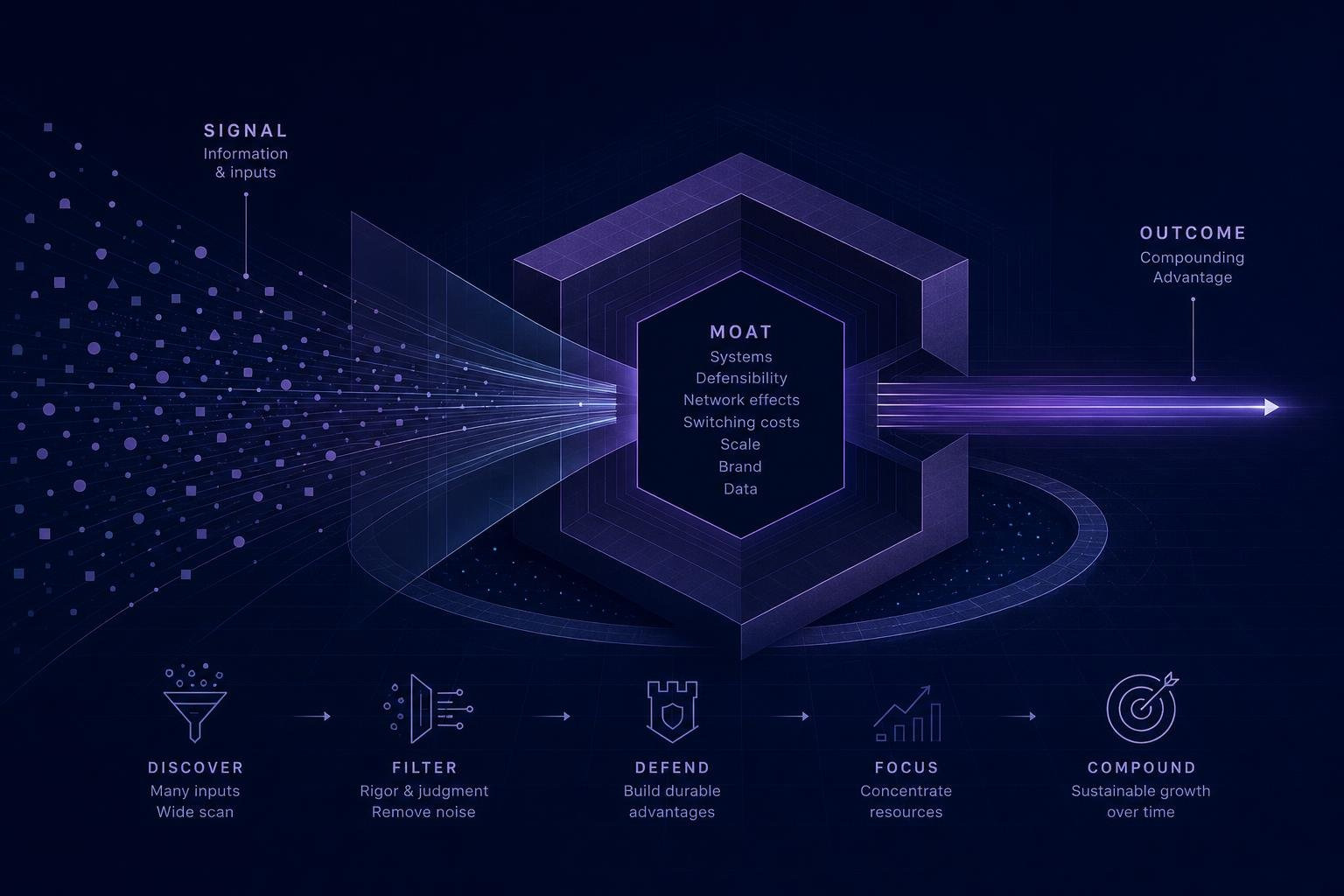
- Automated Sourcing: The platform must ingest unstructured, high-friction data—like SEC filings, expert transcripts, and developer forums—without requiring your team to write custom scraping scripts. If a tool only tracks public pricing pages, it is insufficient.
- Semantic Synthesis: The system must explain the intent behind a competitor's move, not just the action. It should analyze why a rival changed their pricing structure—for example, signaling a shift upmarket to cover rising customer acquisition costs—rather than just alerting you that a number changed.
- Actionable Distribution: Insights must exist where decisions are made. If your sales reps have to log into a separate portal to find a battlecard during an active deal, your program has failed. The data must flow directly into Slack, your CRM, or your custom LLM workflows.
- Brand Moat Translation: The final output must highlight market white space. If the tool's recommendations lead you to copy a competitor's messaging, discard the tool. It must show you where their positioning is weak so you can double down on your distinctiveness.
This framework breaks down if your internal team lacks the strategic capability to act on the synthesized signals. If your product marketing managers are purely execution-focused, high-fidelity intelligence will simply sit on a digital shelf. Before committing capital to these platforms, audit your data pipelines using our guide on AI Market Research Tools to ensure your team can handle automated ingestion.
Deep Dive: Comparing the Leading AI Competitive Intelligence Platforms
The competitive intelligence market is split into two distinct architectures: enterprise-grade engines built for deep corporate strategy, and agile, AI-native tools designed for high-velocity startups and agencies. Choosing the wrong architecture is an expensive mistake.
| Platform | Core Focus | Key AI Capability | Best For | Rating (Gartner Peer Insights) |
|---|---|---|---|---|
| AlphaSense | Financial & Market Research | Generative Search & Smart Summaries | Corporate Strategy & Finance | 4.6/5 |
| Klue | Sales Enablement | Compete Agent & Auto-Battlecards | Mid-Market to Enterprise B2B Sales | 4.7/5 |
| Crayon | Website & Messaging Tracking | Human-AI Hybrid Change Classification | Product Marketing Teams | 4.3/5 |
| Contify | Multi-Source Monitoring | Multi-lingual Semantic Filtering | Global Enterprises | 4.7/5 |
| Kompense | Agile CI & Agency White-Label | Self-Evolving Cross-Tenant Intelligence | Founders & Growth Agencies | 5.0/5 (Market Rating) |
| Nira | Daily Audio/Text Briefings | Zero-Dashboard Synthesis | Busy Executives | 5.0/5 (Market Rating) |
| Caelian | Slack-Native Intelligence | Regulatory & HR Signal Mining | FinTech & Regulated Verticals | 5.0/5 (Market Rating) |
| OpenFunnel | Live TAM & Intent Sourcing | Domain-Specific Sourcing Agents | Outbound GTM Teams | 5.0/5 (Market Rating) |
| IntelCue | MCP-Integrated Workflows | Direct LLM Context Injection | AI-First Marketing Teams | 5.0/5 (Market Rating) |
For deeper context on how these categories fit into a broader corporate strategy, review our curated insights in the Tag: Competitive Intelligence archive.
Enterprise-Grade Engines: High Cost, Deep Data
AlphaSense
AlphaSense is built for corporate strategy teams defending multi-million dollar decisions to a board. It is not a marketing tool. It excels because of its proprietary data access, offering over 240,000 expert call transcripts and real-time financial models. Its Generative Grid allows you to run semantic searches across thousands of SEC filings instantly.
The trade-off: It is incredibly expensive, often costing upwards of $10,000 per seat. If your team does not have dedicated financial analysts to parse these reports, you are paying for horsepower you will never use.
Klue
Klue is designed for sales-heavy B2B organizations where competitive intelligence directly impacts win rates. It tracks competitor product shifts and synthesizes them into live sales battlecards. Its Compete Agent filters out roughly 87% of the noise, ensuring sales reps only see high-priority updates. It integrates directly into Salesforce and HubSpot.
The trade-off: Klue requires significant manual setup and ongoing curation. If your product marketing team does not actively maintain the battlecards, sales reps will quickly lose trust in the data and stop using the tool entirely.
Crayon
Crayon is the choice for tracking digital footprints. It monitors competitor websites, social channels, and app store updates to map messaging shifts. It uses a human-in-the-loop AI model to classify changes, which keeps accuracy high.
The trade-off: The human-AI hybrid model introduces latency. If you need instant, real-time alerts to counter a competitor's flash pricing drop, Crayon's verified updates might arrive too late.
Contify
Contify is built for global enterprises operating across multiple languages and highly regulated markets. It pulls data from over 500,000 sources, including local news and regulatory portals, using machine learning to clean and translate multilingual data.
The trade-off: The interface is complex and built for professional intelligence analysts. For a fast-moving marketing team, the learning curve is steep and onboarding can take months.
Agile and Specialized AI Tools: High Velocity, Low Overhead
Kompense
For fast-moving B2B SaaS teams and marketing agencies, legacy enterprise tools are too slow and expensive. Kompense - Competitive Intelligence Platform delivers a self-evolving intelligence engine that sets up in five minutes. It tracks competitor pricing, feature updates, and customer sentiment, offering automated severity scoring and white-label reporting for agencies.
The trade-off: It lacks the deep financial database of AlphaSense, making it less suitable for heavy M&A or corporate finance research.
Nira
If your executive team suffers from dashboard fatigue, Nira - Your AI Competitive Intelligence Analyst is the solution. Nira eliminates dashboards entirely, delivering a single, highly curated three-minute briefing to your inbox or phone every morning. It scans competitor website changes, hiring signals, and LinkedIn activity, synthesizing them into a clear narrative.
The trade-off: It is designed for consumption, not deep-dive research. If you need to build a complex, data-heavy competitive matrix for a product roadmap meeting, Nira's high-level summaries will not suffice.
Caelian
For teams operating in highly regulated spaces like FinTech or healthcare, Caelian — The Central Intelligence Platform is a standout. It acts as an always-on intelligence agent inside Slack, allowing you to pull a comprehensive competitive brief on any company in 15 seconds. It monitors specialized signals, including regulatory filings and employee tenure shifts.
The trade-off: If your organization does not run on Slack or Microsoft Teams, Caelian's core value proposition is lost.
OpenFunnel
Traditional go-to-market strategies rely on static account lists that decay rapidly. OpenFunnel replaces these lists with a live, domain-specific TAM database. By deploying autonomous sourcing agents that monitor target accounts 24/7, it identifies real-time buying triggers—such as a company hiring for a specific technical role or an executive engaging with a competitor's content.
The trade-off: This is a pure outbound sales enablement tool. It will not help your product marketing team analyze competitor messaging or pricing strategies.
IntelCue
For organizations running AI-first workflows, IntelCue | AI Competitive Intelligence Platform & Market Monitoring offers direct integration with LLMs like Claude and ChatGPT via the Model Context Protocol (MCP). Instead of requiring you to log into a separate platform, IntelCue feeds real-time competitor alerts and newsletter updates directly into your custom AI assistants.
The trade-off: It requires your team to have a mature understanding of LLM prompting and custom GPT/Claude workflows to get any value from the raw data feeds.
Upfinity
When expanding into new geographic regions or analyzing highly technical markets, AI PLATFORM FOR BIG DATA RESEARCH (Upfinity.io) provides automated, large-scale competitor and partner research. It uses a semantic pipeline to scrape, filter, and summarize product features across millions of companies.
The trade-off: The output is highly structured and data-dense, which can feel overwhelming for creative marketing teams looking for quick positioning insights.
Integrating AI Intelligence with Your GTM Stack and Internal Workflows
Most software integrations are where good data goes to die. If your competitive intelligence platform requires your sales reps to leave their CRM or your marketing team to log into a separate dashboard, your investment is wasted.

For sales-led organizations, you must establish a two-way sync between your intelligence platform and your CRM. When an opportunity is created, the system should automatically surface relevant competitor battlecards and recent win/loss data directly within the CRM interface.
For marketing and product teams, Slack or Microsoft Teams integration is non-negotiable. High-severity alerts—such as a competitor launching a major product feature or dropping their pricing—must route directly to dedicated channels, prompting immediate cross-functional review.
When evaluating pricing models, look beyond the initial subscription cost. Enterprise platforms often charge significant fees for seat licenses, custom integrations, and data onboarding, while agile tools typically offer transparent, tiered pricing with self-service setups. Choose the model that aligns with your team's actual operational capacity.
To design a highly effective intelligence workflow for your organization, review our strategic frameworks in our Competitive Intelligence Reports.
Frequently Asked Questions About AI Market Monitoring
How do AI competitive intelligence tools automate data collection compared to traditional manual methods?
Traditional competitive intelligence relies on manual website checks, Google Alerts, and ad-hoc sales feedback. This is slow, incomplete, and prone to human error. AI-powered tools automate this process by using web scraping agents to monitor thousands of digital sources simultaneously. Natural language processing (NLP) algorithms then clean and categorize this data, automatically filtering out noise—like minor website formatting updates—and highlighting meaningful shifts, such as pricing updates or new product pages.
What are the main limitations and ethical boundaries of using AI in competitive intelligence workflows?
AI tools cannot access data behind private logins, paywalls, or secure corporate networks. Relying solely on public data scraping can also create a blind spot regarding a competitor's internal health or customer churn. Ethically, organizations must ensure their tools comply with web scraping regulations, terms of service, and data privacy laws like GDPR. Additionally, users must verify high-priority insights to avoid decisions based on LLM hallucinations or inaccurate automated summaries.
How should buyers evaluate pricing models and ROI for AI-driven intelligence platforms?
Buyers should evaluate platforms based on their primary business objectives. For sales enablement, measure the platform's impact on competitive win rates and the time saved by sales reps looking for positioning materials. For product and marketing teams, evaluate the reduction in manual research hours and the speed with which your team can respond to competitor moves. Compare the total cost of ownership—including seat licenses, integration fees, and onboarding times—against the potential revenue protected by responding quickly to competitive threats.
Your 30-Day Competitive Intelligence Audit
Stop looking at dashboards and start auditing your actual strategic output. Over the next 30 days, execute these three steps to turn your competitive data into a strategic brand moat:
- Audit the Usage: Check your CRM analytics. If your sales reps are not opening your competitor battlecards in at least 40% of competitive deals, your current intelligence delivery is broken. Scrap the current format and move the data directly into their daily workflow.
- Identify the Gaps: Look at your top three competitors' messaging. If your marketing team is using the same adjectives and positioning angles, you are participating in a race to the bottom. Use your intelligence tools to find where their positioning is uniform and weak, and rewrite your core messaging to exploit those gaps.
- Consolidate the Stack: If you are paying for enterprise-grade seats that only your product marketing managers use twice a quarter, downgrade to an agile, self-service tool. Reallocate that budget to high-intent sourcing or direct customer interviews.
To learn how to transform competitive data into a strategic brand moat, Sign Up for our newsletter and join senior marketing leaders building the future of strategic brand building.