The Complete Guide to Building Distinctive Brand Assets
As AI floods every channel with generic content, distinctive brand assets are the moat that compounds. Here's how to audit, design, and protect the brand codes that make you instantly recognizable.

Why Building Distinctive Brand Assets Is the Only Brand Moat That Survives AI Commoditization
How to build distinctive brand assets is one of the most urgent strategic questions facing CMOs right now — not because branding is new, but because the conditions that once made brand-building forgiving have disappeared.
Here is a fast answer before we go deeper:
- Audit your existing assets — inventory every color, shape, sound, character, and tagline your brand currently owns and measure how many consumers actually associate each one with your brand alone.
- Identify your strongest signals — use a fame-versus-uniqueness framework (more on this below) to determine which assets are worth defending and which are generic noise.
- Design for recognition, not meaning — prioritize assets that trigger instant, effortless brand recall over assets that require explanation.
- Deploy with consistency — repeat the same assets across every touchpoint, every campaign, and every channel without exception.
- Measure and govern — track asset strength over time with a structured management system and treat erosion as a strategic threat, not a creative refresh opportunity.
Now for the harder truth.
AI-generated creative is cheap, fast, and increasingly indistinguishable from human-produced work. That means visual noise is no longer expensive to produce — it is infinite. Every brand in your category can now flood the market with polished imagery, slick copy, and on-trend aesthetics at a fraction of what it cost three years ago. The result is a paradox: more creative output, less brand differentiation.
In this environment, the brands that win are not the ones with the best-looking campaigns. They are the ones whose specific visual cues, sounds, and verbal patterns have been so consistently deployed that consumers recognize them before conscious attention kicks in. That is the cognitive shortcut your brand needs to own. And it cannot be replicated overnight, because it is built on memory structures accumulated over time — not assets generated last Tuesday.
The data is unambiguous. Brands with strong distinctive assets are 52% more salient than competitors. Campaigns that embed those assets consistently deliver a 62% higher ROI than the average campaign. And yet fewer than 15% of brand assets tested globally qualify as truly distinctive. Most brands are not losing the attention battle because their creative is bad. They are losing it because their assets are either not unique enough, not famous enough, or not consistent enough to do any real cognitive work.
The first job of advertising is to be noticed. The second job is for consumers to know it's you. Most brands are failing at both simultaneously.
I'm Florian Radke — brand strategist, fractional CMO, and founder of The Brand Algorithm — and over 25 years of building brands at companies ranging from venture-backed startups to global consumer giants, I have seen how mastering how to build distinctive brand assets separates brands that compound in value from those that reset with every new agency brief. What follows is the framework I use with clients to build, measure, and protect brand assets that actually hold up.
How to Build Distinctive Brand Assets: The Strategic Imperative
Most brand guidelines are documents filled with high-minded philosophy. They explain what the logo "means," why the color palette reflects "innovation," and how the brand voice embodies "integrity."
This is a creative trap. Your customers do not care about your brand's philosophical depth.
When a buyer is making a decision, their brain is not performing a deep, logical analysis of your brand's values. Instead, it relies on System 1 thinking — the fast, automatic, and emotional decision-making engine that accounts for the vast majority of daily human choices. In this split-second process, visual saliency and cognitive fluency rule. The brain is naturally lazy; it consumes roughly 20% of our energy despite making up only 4% of our body mass. To conserve energy, it uses mental shortcuts (heuristics) to identify things that stand out.
If your brand lacks clear, non-verbal shortcuts, it does not exist in the consumer's mental consideration set.
[Visual/Auditory Cue] ---> [System 1 Fast Processing] ---> [Instant Brand Recognition] ---> [Purchase Decision]
This is why chasing "meaning" is a distraction compared to chasing recognition. A distinctive brand asset is a non-brand-name trigger — a color, shape, sound, character, or scent — that instantly evokes your brand in a buyer's memory without needing to display your name or wordmark.
Think of Mastercard’s red and yellow overlapping circles, McDonald’s golden arches, or Intel's five-note sonic signature. These elements bypass conscious logical evaluation. They trigger immediate physical and mental availability.
In our deep dive on Brand Strategy in the Age of AI, we outline how algorithmic discovery engines reward brands with high cognitive availability. When AI models crawl the web, or when consumers use voice search, highly structured, recognizable brand assets act as a beacon. If your brand relies solely on a generic name or copycat design patterns, you are functionally invisible to both human brains and neural networks. To read more about what these assets are and why they matter, consult this guide on What are distinctive brand assets & why do they matter? .
The Cognitive Shortcut Protocol: A Framework for Asset Creation
To systematically build these mental shortcuts, we use an original framework: The Cognitive Shortcut Protocol. This protocol organizes your assets into three distinct layers to ensure they work together to capture automatic attention.

The protocol consists of three pillars:
- Sensory Anchors: The non-verbal, physical cues (colors, shapes, audio signatures, and tactile elements) that draw visual saliency.
- Behavioral Triggers: Contextual cues or characters that link your brand directly to a specific usage occasion or physical action (e.g., Corona's association with a lime at a beach bar).
- Contextual Reinforcers: Verbal patterns, taglines, and typographic styles that lock the identity in place during the final stages of the decision cycle.
By implementing this protocol, you stop treating branding as a series of disconnected design choices and start building a unified system of signals. For more executive insights on structuring these signals, explore our Tag: Brand Strategy archive.
Step 1: Audit Your Brand Heritage
Before you design anything new, you must understand what you already own. The biggest mistake new CMOs make when entering an organization is executing a "rebrand" that deletes decades of accumulated memory structures.
You must run a comprehensive asset inventory. Catalog every logo version, color hex code, packaging shape, sound, tagline, and character your brand has ever used.
Your goal is to identify "accidental equities" — assets that have quietly built strong customer associations over time despite never being officially prioritized. For example, a specific packaging shape or a secondary color might be doing more work to help customers find you on a shelf than your primary logo. If an over-eager creative agency sweeps these away in the name of modernization, your sales will crater simply because customers can no longer find you.
When reviewing your inventory, design a cohesive blueprint that maps how each element reinforces the others.
Step 2: Design for High Uniqueness
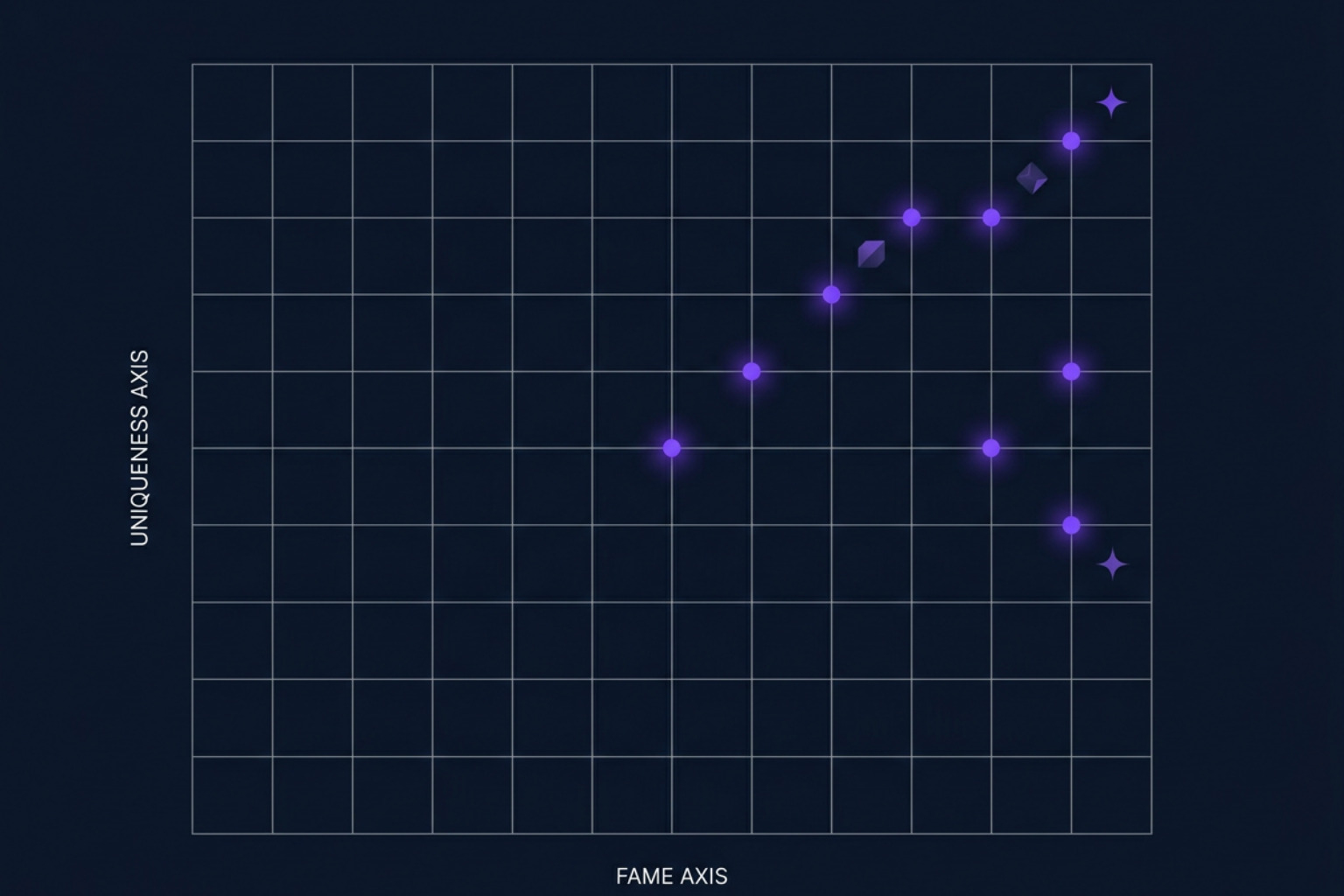
Once you have audited your heritage, you can begin designing new assets or refining existing ones. The golden rule here is simple: uniqueness is more important than fame. Fame (how many people recognize the asset) can be bought with media spend over time. Uniqueness (how exclusively the asset points to your brand and no one else) must be designed in from the start.
If you use a royal purple color but your main competitor does too, your asset is not unique. It is a category cue, not a brand asset. Your assets must evoke only your brand.
High Fame + Low Uniqueness = Waste of Media Spend (You are advertising your category)
High Fame + High Uniqueness = Distinctive Brand Asset (The holy grail)
This is where modern minimalist design often fails. Brands chasing clean, minimalist aesthetics often strip away the very quirks, shapes, and textures that made them recognizable in the first place. When everyone adopts flat, sans-serif typography and neutral color palettes, every brand looks like a generic software-as-a-service provider.
Keep your assets simple, but never generic. Companies with simpler brand assets outperform those with complex ones by 200%, but that simplicity must serve to make the asset more memorable, not more anonymous. For a deeper look into balancing simplicity with ownability, read this article on Building distinctive brand assets: What you need to know .
Measuring Asset Strength: The Distinctive Asset Grid
To evaluate whether your brand assets are actually performing, we use the Ehrenberg-Bass methodology to plot elements on a Distinctive Asset Grid. This grid measures two key metrics:
- Prevalence (Fame): The percentage of your target market that links the asset to your brand.
- Uniqueness: The degree to which the asset is linked only to your brand, rather than being shared with competitors.
By mapping your assets on this grid, you can easily prioritize which elements to invest in, which to defend, and which to retire.
| Asset Type | Prevalence (Fame) | Uniqueness | Strategic Action |
|---|---|---|---|
| Primary Color | High | Low | Refine or pair with a unique shape |
| Custom Typography | Low | High | Invest media spend to build fame |
| Mascot / Character | High | High | Defend aggressively; use as primary cue |
| Sonic Signature | Low | Low | Retire or completely redesign |
| Tagline | Medium | High | Maintain consistency across channels |
To systematically run this analysis for your own portfolio, use our proprietary Distinctive Asset Grid tool.
B2B vs B2C Asset Dynamics
A common error among enterprise marketers is assuming that distinctive assets are only for fast-moving consumer goods (FMCG). They believe B2B buyers are entirely rational decision-makers who only care about features, pricing, and SLAs.
This is fundamentally incorrect. B2B purchases involve higher risk, longer sales cycles, and multiple stakeholders. In these complex scenarios, cognitive fluency and trust are even more critical. If a buyer is risk-averse, they will instinctively lean toward the brand that feels familiar and safe.
B2C Decision: Low Risk -> Fast System 1 -> Instant Purchase
B2B Decision: High Risk -> Long Cycle -> System 1 Familiarity + System 2 Justification
B2B brands often fail because they copy B2C tactics blindly or, conversely, ignore branding entirely to produce dry, feature-heavy sales decks. The key is to apply the protocol to the specific touchpoints of a B2B buyer's journey. Your custom typography, a signature presentation layout, or a distinct verbal tone of voice can become powerful assets that differentiate you in a sea of identical whitepapers.
To understand these differences in detail, read our comparison on Branding B2B vs B2C and access our B2B Brand Strategy Complete Guide to structure your enterprise brand. For general B2B principles, see Branding for B2B.
Managing and Protecting Your Brand Codes Over Time
Building a distinctive asset is not a creative project; it is a long-term capital investment. Consistent brand identity drives a documented 23% revenue lift versus inconsistent brands. Yet, most organizations fail to protect their assets because of internal boredom. Marketing teams and agency partners get tired of using the same colors, fonts, and layouts long before the market does.
To prevent this, you must implement a strict asset governance system.

- Establish a Living Style Guide: Move away from static PDFs. Your style guide must be an accessible, interactive single source of truth that defines exactly how assets are deployed.
- Deploy an Early-Warning System: Set up continuous market tracking to monitor the uniqueness and fame of your core assets. If you see uniqueness scores dropping, it means a competitor is encroaching on your visual space.
- Defend Legally: Work with your legal team to trademark not just your logo, but your signature colors, shapes, and sounds.
By treating your brand codes as financial assets, you protect your market share from erosion. For a complete guide on how to quantify and track these dynamics, read our article on How to Measure Brand Equity.
Frequently Asked Questions About Distinctive Brand Assets
What is the difference between a logo and a distinctive brand asset?
A logo is just one type of brand asset. A distinctive brand asset can be any non-verbal cue — a color, shape, sound, character, or pattern — that triggers brand recognition without needing to show the logo or brand name. In fact, truly strong distinctive assets can replace the logo entirely in your advertising.
How long does it take to build a distinctive brand asset?
It depends on your media weight and consistency, but typically it takes years of continuous, unchanged execution to build deep memory structures in the consumer's mind. There are no shortcuts. This is why consistency over time is the most critical factor in brand success.
Why do most brand asset redesigns fail?
Most redesigns fail because they are driven by internal boredom or a desire to follow short-term design trends rather than market data. Creative teams often strip away the unique, "imperfect" elements of a brand's heritage that consumers actually use to recognize it, replacing them with generic, minimalist designs that destroy brand salience.
Actionable Next Steps for CMOs
If you want to move your brand away from generic, easily replicated marketing and build a defensible moat, you must start treating your assets systematically.
Here are three immediate steps to take this week:
- Conduct an Asset Audit: Gather your team and list every visual, verbal, and auditory element currently used across your touchpoints.
- Run a Distinctiveness Test: Test these assets with actual consumers without showing your brand name to see if they can identify you.
- Plot Your Assets: Use our interactive Distinctive Asset Grid to map your elements and identify where your brand equity actually lives.
In the age of AI, the companies that rely on generic, automated content will be commoditized. The companies that build, measure, and fiercely protect their distinctive brand assets will own the future. Let's build yours.