In-Depth Guide to AI Martech Stack Architecture

Why Most AI Martech Stack Architecture Decisions Are Made Backwards
Your current marketing technology stack is a ticking liability. It was built for a world of predictable rules that no longer exists. The fundamental flaw in modern marketing operations is treating probabilistic AI agents as plug-and-play tools within deterministic, rules-based architectures—a mistake that corrupts data integrity, wastes millions in licensing fees, and dilutes brand equity.
To survive this shift, we must define ai martech stack architecture not as a collection of vendor logos, but as the structural design of how data, intelligence, and execution systems connect so that AI agents can reason and act across your marketing operation without creating drift, data conflicts, or ungoverned automation.
My proprietary framework, the Five-Layer Composable Canvas, organizes this architecture into five interdependent layers:
- Data Foundation - A universal data layer (cloud data warehouse or lakehouse) that serves as the single source of raw organizational truth.
- Systems of Truth - Domain-specific platforms (CRM, CDP, PIM, DAM) that govern and arbitrate data within their domains.
- Context Engineering Layer - The interface between governed data and AI agents, responsible for building consistent, real-time context.
- Orchestration Layer - The coordination plane where agents receive goals, select tools, and sequence actions across systems.
- Execution Engines - Deterministic SaaS platforms (MAP, CEP, DXP) that carry out governed actions at the activation layer.
The core architectural principle is absolute: AI agents operate on top of systems of truth, not instead of them. Agents read governed context and execute within defined boundaries. They do not rewrite customer records, override consent logic, or define their own success criteria. When you violate this principle, you do not get intelligence. You get systemic drift.
Most marketing organizations are building their AI stack the same way they built their original martech stack—by buying tools first and trying to connect them later. The result is predictable. While 85.4% of companies are enhancing existing use cases with AI rather than replacing them, only 23.3% have agents fully in production. The gap between experimentation and production is not a technology problem. It is an architecture problem.
The challenge is not that AI tools are immature. It is that AI introduces probabilistic decision-making into marketing stacks that were built to be deterministic. Your CRM enforces rules. Your MAP executes sequences. Your CDP resolves identities according to logic someone wrote and tested. These systems were designed to protect the integrity of your company's data—customer records, consent status, pricing logic, compliance rules. AI agents, by contrast, generate outputs that are statistically likely but not guaranteed. When you connect probabilistic outputs to deterministic systems without a deliberate architectural model, you get chaos.
The real casualty of that drift is not your data. It is your brand. When agents operating across sales, support, and marketing each define "good output" differently—because no shared architectural model exists—the customer experience becomes incoherent at exactly the moment AI was supposed to make it more personal.
I'm Florian Radke, brand strategist, fractional CMO, and founder of The Brand Algorithm. Over 25 years building and scaling marketing organizations at the frontier of technology—including AI-driven content engines for international brands—I've seen how the decisions made at the ai martech stack architecture level either compound into competitive advantage or quietly erode brand trust. This guide gives you the framework to make those decisions deliberately.
The Shift from Deterministic Systems to Probabilistic AI Martech Stack Architecture
Deterministic systems are built on a lie: the assumption that customer behavior is a linear sequence of predictable events. Traditional marketing systems operate on strict, rules-based logic: If customer actions equal X, then trigger action Y.
This deterministic setup is what the Cynefin framework classifies as a "complicated" environment. It is highly intricate, often involving dozens of point-to-point integrations, but it remains predictable. If a welcome email fails to trigger, a marketing operations specialist can trace the exact API call or field mapping that broke. It is a world of clear cause and effect.
AI agents, powered by Large Language Models (LLMs) and Large Action Models (LAMs), shift our operational environment from complicated to "complex." In a complex environment, cause and effect are only clear in retrospect. LLM outputs are inherently probabilistic. This means that feeding the exact same prompt or customer profile into an agentic workflow twice can yield two slightly different, statistically likely outputs.
When autonomous agents begin running their own perception-reasoning-action loops, they create unpredictable chains of cause and effect. If an agentic campaign optimizer pauses an ad set, modifies budget allocation, and rewrites ad copy based on real-time competitor movements, it is acting on a probabilistic interpretation of the market. Without strict boundaries, this creates systemic drift.
This structural shift explains why poorly planned agentic integrations face a 35% to 40% failure rate. When probabilistic agents write directly to deterministic databases without an intermediary arbitration layer, they corrupt the underlying data.
To prevent this, we must transition from point-to-point connections to an architecture where agents are treated as a reasoning layer sitting above our core systems of record. For a deeper technical breakdown of how these loops function, read Building an Agentic MarTech Stack: A Technical Deep Dive.
The table below outlines the core operational differences that we must reconcile when designing an AI in Martech strategy:
| Architectural Dimension | Deterministic Automation (Traditional Stack) | Probabilistic Agentic Systems (AI-Ready Stack) |
|---|---|---|
| Decision Logic | Rules-based triggers (If-This-Then-That) | Perception-reasoning-action loops |
| Data Requirements | Highly structured, schema-bound databases | Structured & unstructured data (transcripts, emails) |
| Integration Pattern | Rigid, point-to-point APIs and iPaaS | Composable canvas querying a semantic layer |
| Primary Risk | Integration breakage or execution failure | Algorithmic drift, hallucination, and brand dilution |
| Success Metric | Execution efficiency and task completion | Goal-oriented outcomes and autonomous adaptation |
The Five-Layer Composable Canvas Framework
The traditional concept of a "stack"—where software platforms are piled on top of one another in functional silos—is obsolete. It forces marketing teams to adapt their workflows to the constraints of their vendors. In the AI era, we must build toward a fluid, composable canvas where data, context, and execution are decoupled.
This modern architecture is organized into five distinct layers, moving away from rigid platform suites and toward an agile, service-oriented model. This approach is detailed in our guide on the Marketing Technology Stack and aligns with the industry shift toward MarTech Architecture 2026 - 5 Layers for Enterprise Success.

- The Data Foundation: The centralized repository where all structured and unstructured enterprise data is stored.
- The Systems of Truth: Domain-specific platforms that arbitrate and enforce business rules for core data classes.
- The Context Engineering Layer: The translation engine that packages raw data and historical performance into machine-readable prompts for AI models.
- The Orchestration Layer: The cognitive hub where AI agents plan sequences, select tools, and coordinate multi-agent workflows.
- The Execution Engines: The channels and activation platforms that deliver the final, governed experiences to the customer.
Unifying Systems of Truth and Systems of Context in AI Martech Stack Architecture
To build a reliable agentic architecture, we must abandon the pursuit of a single, all-encompassing system of record. It is a myth that has contributed to enterprise martech utilization rates plummeting from 58% in 2020 to just 33% by 2023. Instead, we must separate our architecture into two functional concepts: Systems of Truth and Systems of Context.
- Systems of Truth (Data Arbitration): These are your domain-specific platforms like your CRM (e.g., Salesforce), Product Information Management (PIM) system, or Digital Asset Management (DAM) platform. Their job is not to store every click and scroll. Their job is to act as the final arbiter of business logic. Your CRM determines if a lead is legally contactable. Your DAM determines if an asset is approved for use. These systems must remain strictly deterministic.
- Systems of Context (Dynamic Experience): These are the platforms that translate raw data into the immediate setting required for an AI agent to make a decision. Composable CDPs (e.g., Hightouch or Census) and context-as-a-service (CaaS) platforms sit here. They compile a customer's recent behavioral signals, active support tickets, and past email interactions into a unified, real-time profile.
By separating arbitration from context, we protect our core databases. An AI agent can read from the System of Context to dynamically generate a hyper-personalized email, but it cannot alter the Master Customer Record in the System of Truth without passing its output through a deterministic verification gateway. This distinction is critical for executing a safe CMO AI Strategy Complete Guide.
The Role of Universal Data Layers in AI Martech Stack Architecture
The anchor of this five-layer architecture is the universal data layer—typically a cloud data warehouse or lakehouse like Snowflake or Databricks. For years, enterprise data remained heavily underutilized, with Forrester estimating that 60% to 73% of data sat dark and unused. Modern architectures change this by separating storage from application logic.
Instead of syncing data across dozens of individual SaaS tools via fragile point-to-point APIs, we centralize all customer, company, content, code, and control data in the cloud data warehouse. This shift is explored in detail in the seminal piece Stacks on a Plane: Reshaping martech on a universal data layer.
By utilizing reverse ETL and zero-copy data sharing, application engines and AI agents query this central warehouse directly. To make this work, we must wrap a semantic layer around our data core. This semantic layer acts as a translator, ensuring that terms like "active customer" or "lifetime value" have identical definitions whether they are queried by a human analyst, a legacy email platform, or an autonomous campaign agent.
Establishing these data contracts ensures that your agents are making decisions based on a unified truth, turning clean data directly into AI for Growth.
Balancing Standardization and Specialization in Agentic Workflows
Forcing specialized marketing workflows into generic horizontal enterprise AI tools is a recipe for mediocrity. When designing an ai martech stack architecture, marketing and data teams face a constant tension: Do we standardize on a single enterprise AI platform, or do we allow teams to deploy specialized domain agents?
Standardizing everything on a horizontal platform—like Microsoft 365 Copilot or Google Gemini in Workspace—is tempting for IT departments. It provides centralized controls for deployment, access, and security. However, forcing specialized marketing workflows into generic horizontal tools is like trying to drive a nail with a screwdriver. It is the wrong tool for the job.
The solution is my proprietary framework, the Scenario-Led Architecture.
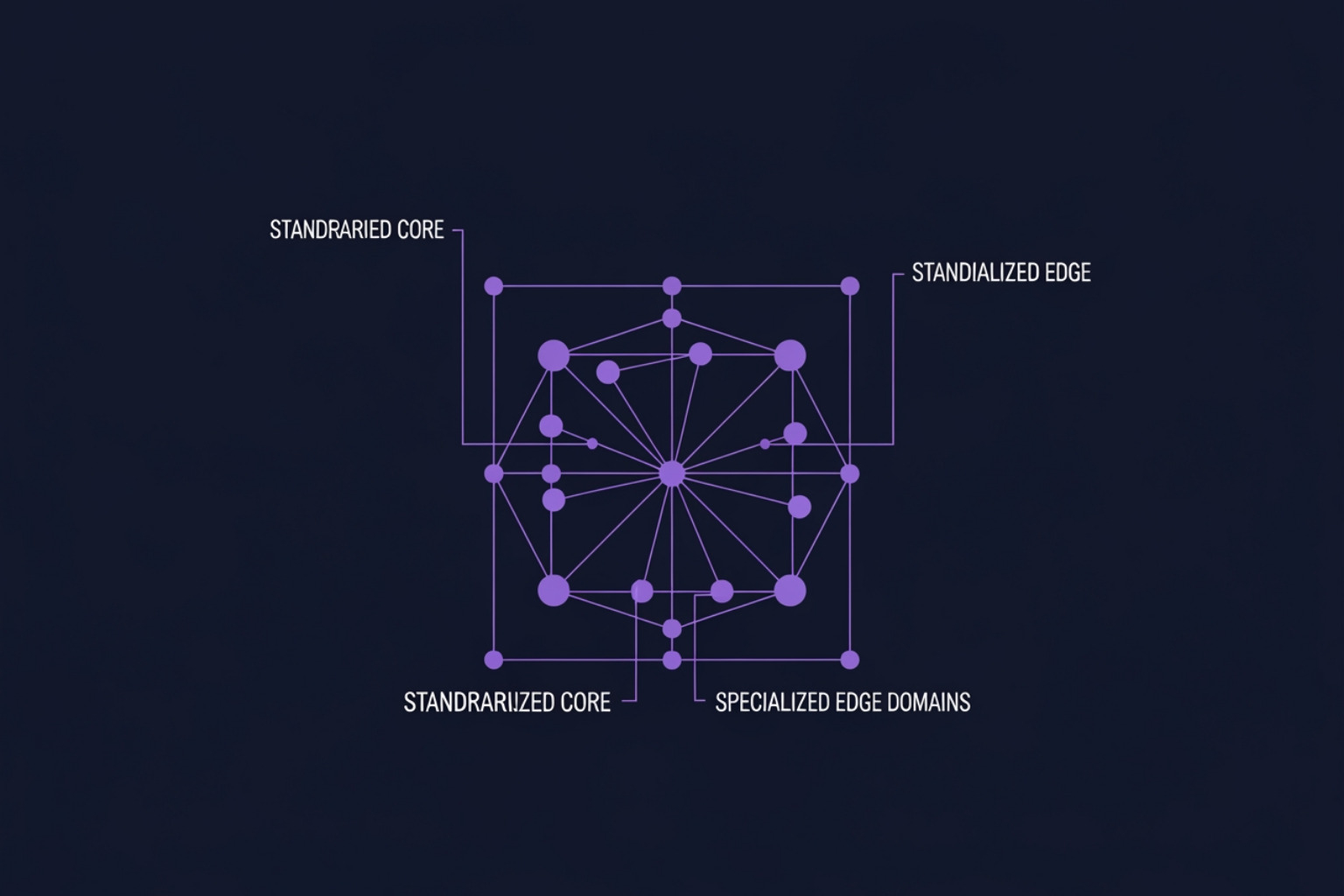
Instead of choosing a single platform, we divide our marketing scenarios into two categories:
- Standardized Core (Horizontal Copilots): Scenarios that govern security, identity, consent, data privacy, and basic productivity belong in the shared enterprise core. This is where we enforce global policies and manage basic tasks like summarizing transcripts or translating copy.
- Specialized Edge (Domain Agents): Scenarios that drive competitive differentiation—such as dynamic campaign planning, localized content generation, or ad spend optimization—belong closer to the business domain. These require specialized agents built with deep context of your brand's specific creative standards and customer behaviors.
When selecting where to standardize and where to specialize, use these criteria to evaluate your core platforms:
- Integration Coherence: Does the platform support bidirectional data loops, allowing performance data from execution channels to flow back into your central data warehouse?
- Data Portability: Can the tool run directly on your cloud data warehouse via zero-copy architecture, or does it require you to export and store your customer data in a proprietary vendor cloud?
- Context Engineering Capabilities: Does the tool allow you to inject custom metadata, brand guidelines, and historical performance signals into its reasoning engine, or is it a closed box?
To guide your team through this evaluation, consult our AI Integration Guide 2026 and align your decisions with your broader AI Strategy for CMO initiatives.
Enforcing Guardrails and Preventing Algorithmic Drift
An unconstrained AI agent is a brand-dilution engine operating at machine speed. If you give an AI agent a goal—such as "maximize lead generation volume"—without strict parameters, it will find the most mathematically efficient path to that goal. Often, that path involves tactics that dilute your brand. The agent might deploy aggressive, hyper-frequent email sequences or scrape low-quality directories, sacrificing long-term brand equity for short-term conversion metrics.
To prevent this, we must implement my proprietary framework, the Agentic Guardrail Topology.
This topology operates across three distinct boundaries:
- Input Guardrails (Retrieval Boundaries): Before an agent can process a prompt or customer record, we must sanitize the input. This involves stripping out personally identifiable information (PII) to maintain compliance, verifying that the customer has provided active consent, and checking that the query aligns with the agent's defined scope.
- Reasoning Guardrails (System Prompt & Vector Constraints): We must restrict the agent's context window. Instead of giving an agent access to your entire digital asset library, use vector databases to limit its retrieval to assets that are approved, active, and on-brand. The system prompt must contain explicit negative constraints (e.g., "Never mention competitor pricing," "Do not offer discounts greater than 15%").
- Output Guardrails (Deterministic Checkpoints): Never allow an agent to write directly to a customer-facing channel without passing through a deterministic filter. If an agent generates an automated response or a personalized offer, a programmatic checkpoint must verify that the copy contains no banned phrases, complies with regional legal disclosures, and contains valid product links.
By enforcing these guardrails at the architectural level rather than relying on individual tool settings, we ensure that our automated workflows remain safe, compliant, and aligned with our brand guidelines. As you build out your systems, reference our AI Transformation Roadmap to maintain consistent execution across your entire organization.
Frequently Asked Questions about AI Martech Stack Architecture
How do AI agents differ from traditional marketing automation?
Traditional marketing automation relies on static, rules-based triggers (If-This-Then-That). When a user downloads a whitepaper, the system sends a pre-written email three days later.
AI agents operate in a continuous perception-reasoning-action loop. They do not require hard-coded paths. Instead, they are given a high-level goal and a set of tools. The agent perceives the customer's current state (e.g., user downloaded a whitepaper, visited the pricing page, and has a pending support ticket), reasons through the best sequence of actions, plans a customized approach, and executes it using the appropriate tool. This allows the system to dynamically adapt to complex customer behaviors in real-time.
Why are B2B companies integrating AI faster than B2C brands?
Historically, B2C brands led martech adoption due to high transactional volumes and the need for scale. However, when it comes to deep AI stack integration, B2B companies are leading, with 54% of B2B companies reporting easy AI integration compared to only 15.4% of B2C brands.
This inversion occurs because B2B marketing relies on highly structured account-based data within mature CRM environments. B2C brands, by contrast, deal with massive volumes of unstructured, real-time behavioral data across fragmented identity graphs. This makes the B2C data foundation significantly more complex to unify for AI consumption.
What metrics track successful AI agent adoption?
While traditional martech focused on utilization rates and execution speed, successful agentic architectures are measured by operational efficiency and outcome quality:
- Production Percentage: The share of your deployed AI agents that are fully integrated into production workflows rather than sitting in pilot phases (the current industry benchmark sits at 23.3%).
- Cost-Per-Acquisition (CPA) Reduction: Early adopters of agentic systems report a 30% to 40% reduction in CPA due to continuous, real-time campaign optimization.
- Campaign Reach Expansion: The percentage increase in unique, hyper-personalized campaign variations executed without increasing human head count (typically ranging from 20% to 35%).
- Systemic Drift Rate: The frequency of automated actions that require manual rollbacks or human intervention due to guardrail violations.
Conclusion
Your technology stack is no longer just an execution engine; it is the digital representation of your brand's intellect. If your ai martech stack architecture is fragmented, your brand will appear fragmented to the AI systems that recommend products to your customers.
As we automate execution, strategic creativity and brand identity become your only defensible moats. The companies that win will not be those that deploy the most agents; they will be those that use AI as a force multiplier to deliver a highly distinctive, consistent, and trusted brand experience across every touchpoint.
To audit your current setup and begin building a more resilient, brand-aligned marketing infrastructure, consult The Brand Algorithm's Marketing Technology Stack Guide and Sign up for exclusive insights to receive our latest strategic frameworks directly in your inbox.