A – Z Guide to AI Content Strategy at Scale

The Content Volume Trap: Why More Output Is the Wrong Answer
AI content strategy at scale is not a production problem. It is a structural one — and most marketing organizations are solving the wrong version of it.
Here is the short answer for senior marketers who need the frame before the detail:
What AI content strategy at scale actually requires:
- A system architecture, not a publishing cadence — content must be organized into interconnected topic clusters and entity profiles, not batched by volume
- Entity fact-density — brands with 9+ discrete, structured facts in their entity profiles achieve 78% AI search coverage; brands with 0–2 facts achieve 9%
- Content operations maturity before AI scaling — governance, ownership, and workflow infrastructure determine whether AI amplifies quality or amplifies inconsistency
- Dual-surface optimization — content must be structured for both traditional search ranking and AI engine citation (GEO/AEO), not one or the other
- Non-commodity content as the moat — experience-led, entity-driven, and structured content outperforms generic informational output in every AI retrieval model measured
The underlying problem is this: AI Overviews now appear in roughly half of all Google searches, and click-through rates for top-ranking content have dropped 58% as a result. Most teams responded by publishing more. The correct response was to publish differently.
The brands winning algorithmic visibility in May 2026 are not the ones with the largest content libraries. They are the ones that built systems — with the right architecture, the right content types, and the right operational infrastructure to sustain them.
I am Florian Radke, brand strategist, fractional CMO, and founder of The Brand Algorithm — and over 25 years building brands at the frontier of technology, including AI-driven content engines for international brands, I have seen that the teams who master ai content strategy at scale are the ones who treat it as an organizational design challenge first and a tooling challenge second. This guide gives you the framework to build that system from the ground up.
Why Traditional Content Planning Breaks in an Algorithmic World
Traditional keyword targeting is a dead paradigm. When Google transforms fifty blue links into a single, synthesized answer, your ranking on page one no longer guarantees a single click.
Gartner predicts that traditional search volume will drop 25% by 2026. This is not a distant threat; it is our current reality. AI Overviews have absorbed basic educational queries, leaving informational blog posts stranded without traffic. If your strategy relies on publishing basic explainers to capture top-of-funnel traffic, you are essentially training your competitors' large language models for free.
The traditional funnel assumed a linear journey: search, click, read, convert. Algorithmic discovery operates on a retrieval-summarize-mention model. If your brand is not synthesized into the final answer, you do not exist to the buyer.
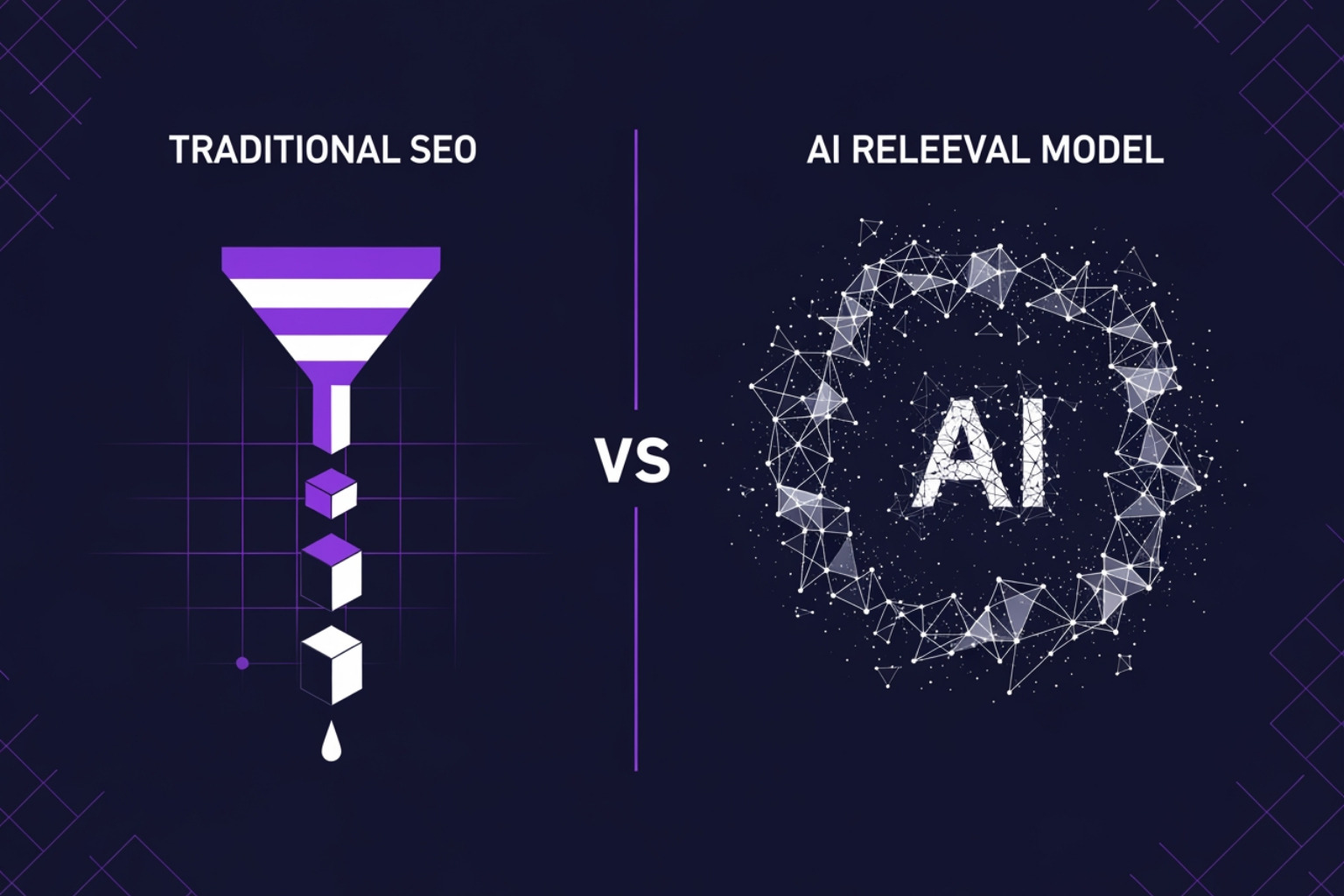
To survive this shift, organizations must rebuild their approach around Content Strategy in the Age of AI. The objective is no longer to rank for keywords, but to establish your brand as an authoritative node within the global entity graph.
Transitioning to an AI Content Strategy at Scale
Static content calendars are a liability in a dynamic search environment. When search engines prioritize real-time data synthesis, your planned three-month editorial calendar becomes obsolete before the first draft is approved.
Organizations must shift from static plans to dynamic, system-level content strategies. This transition requires a deep look at your content operations maturity. If your current workflow relies on manual spreadsheets, ad-hoc editorial reviews, and disjointed team communication, introducing artificial intelligence will only accelerate your production of low-quality noise.
Mature operations treat content as an ongoing, structured asset class. Before deploying automated generation engines, you must define clear ownership, establish strict quality gates, and centralize your asset storage. For enterprises struggling to make this transition, partnering with specialized AI Content Strategy Services provides the external infrastructure needed to audit, structure, and ready your brand data for algorithmic consumption.
The Algorithmic Moat: A Framework for AI Content Strategy at Scale
True brand differentiation cannot be generated by a generic prompt. To win in an automated environment, we developed The Algorithmic Moat Framework, a three-part system designed to make your content citation-worthy and structurally defensible.
This framework shifts your focus from raw output to structured authority. It consists of three core pillars:
- Entity Fact-Density: Structuring your brand's core data so search models can easily parse and verify your claims.
- Experience-Led Attribution: Infusing every piece of content with original data, first-hand experiments, and expert perspectives that cannot be simulated by an LLM.
- Dynamic Model Routing: Matching the complexity of your content tasks to the most efficient, specialized model size rather than relying on a single, expensive engine.
| Attribute | Commodity Content (The Target) | Non-Commodity Content (The Moat) |
|---|---|---|
| Primary Source | Rephrased search results | Original data, lived experience, expert interviews |
| Structure | Standard prose paragraphs | Highly structured tables, lists, schema markup |
| LLM Citation Rate | Extremely low (<5%) | High (>70%) |
| Search Intent | Basic informational queries | Complex, perspective-driven decision queries |
| Production Method | Single-prompt bulk generation | Multi-stage, AI-Driven Content Creation pipelines |
Entity Fact-Density and Algorithmic Coverage
Large language models do not guess; they retrieve facts from structured relationships. If your content lacks clear entity definitions, search engines cannot map your brand to relevant user queries.
Data from Erlin reveals a stark reality: brands with 9 or more discrete facts per entity profile achieve 78% AI search coverage, whereas brands with 0 to 2 facts achieve a mere 9% coverage. This means your brand's visibility is directly tied to how clearly you define your core entities—your products, your executives, your proprietary methodologies, and your target use cases.
To build high entity fact-density, you must publish structured data profiles alongside your narrative content. This involves marking up your articles with schema, maintaining clear, factual resource hubs, and linking your brand consistently to established external entities. For a deeper tactical breakdown of this process, consult our AI Content Optimization Strategies Guide 2026.
Experience-Led Attribution and Non-Commodity Content
Google's search quality guidelines have drawn a sharp line between commodity and non-commodity content. Commodity content is synthetic rehash; non-commodity content is the record of lived experience.
When Google Search Representative Danny Sullivan highlighted this distinction, he signaled the end of the generic SEO writer. If an AI model can write your article based on its existing training data, your article has zero value to a search engine. To build an algorithmic moat, every asset must feature experience-led attribution:
- Real-world experiments: Share actual conversion data, failure points, and testing methodologies.
- Expert commentary: Integrate original quotes from practitioners who have P&L responsibility, not generic industry soundbites.
- Proprietary metrics: Publish internal benchmarks and data points that exist nowhere else on the web.
For instance, when we scale content for venture-backed B2B SaaS companies, we do not write generic guides on "how to manage churn." Instead, we build our entire content strategy around real customer cohorts, actual churn mitigation scripts, and raw financial metrics. This non-commodity approach is detailed extensively in our AI Content Optimization Strategies Guide 2026.
Generative Engine Optimization (GEO) and the Death of the Blue Link
Generative Engine Optimization (GEO) is the new SEO. It is the practice of optimizing your content specifically to be cited by conversational answer engines like ChatGPT, Claude, Gemini, and Perplexity.
This is not a theoretical exercise. Brands cited in AI answers experience a 35% increase in organic click-through rates compared to those left out of the synthesized response. Because LLMs typically cite only two to three brands per query, the traditional multi-page ranking model has collapsed into a binary outcome: you are either cited or you are excluded.
Our research shows that 75% of AI citations come from the top 35% of the page. This means the traditional narrative arc—where you build context slowly before delivering the core answer—is a structural failure for GEO. You must front-load your key claims, definitions, and data points immediately.

To ensure your assets are consistently retrieved and referenced, you must implement the advanced tactics outlined in our guide on Global AI Content Optimization Strategies.
Structuring Content for LLM Retrieval
Language models prefer structured data over dense blocks of prose. When retrieving information to answer a user's prompt, algorithms prioritize formats that are easy to parse, verify, and display.
Studies show that lists, tables, and clear headers achieve 2.3x higher citation rates in AI search engines. To optimize for this retrieval pattern, your content planning must address two distinct surfaces simultaneously:
- The Human Surface: Engaging, narrative-driven prose that builds trust, explains nuance, and drives conversion.
- The LLM Surface: Structured data blocks, key-value pairs, and explicit prompt sets embedded in the code to help AI agents categorize your content.
By designing your content for this dual-surface reality, you ensure that humans find your articles readable, while AI scrapers find them highly indexable. For a step-by-step implementation plan, refer to our AI Content Optimization Strategies Guide 2025.
Building the Machine: Model Routing and Content Operations Maturity
Using a massive, frontier language model for every basic content task is an operational and financial mistake. It is the equivalent of using a heavy industrial crane to hang a picture frame.
A mature AI content engine relies on a model routing philosophy. By breaking down your content production into discrete, atomic tasks, you can route each step to the most efficient model size. For example, a technical content engine can use a lightweight 2B model for fast filtering and competitor fluff removal, a medium-sized 26B Mixture-of-Experts (MoE) model for comparative analysis and semantic gap detection, and reserve a large 31B dense model exclusively for long-form narrative synthesis.
This multi-model orchestration prevents the "echo chamber" effect—where a single model repeatedly refines its own generic outputs—and ensures your production pipeline remains fast, cost-effective, and highly specialized. This architecture is modeled closely on real-world engineering projects like the GemmaForge AI Content Engine, which successfully solved the echo problem by isolating task complexity across different model sizes.
To understand how to integrate these advanced model architectures into your broader marketing org chart, review our AI Transformation Roadmap.
Operationalizing AI Content Strategy at Scale
The primary bottleneck in enterprise content production is not writing; it is decision-making. When teams rely on disconnected data sources, planning and approval cycles stall.
Organizations that centralize their marketing data make content decisions three times faster than those with siloed systems. By establishing a single source of truth—such as a centralized marketing data warehouse—you allow your AI strategic layers to ingest clean, real-time performance data.
This continuous feedback loop enables automated systems to identify keyword cannibalization, surface content gaps, and map out topical clusters without manual intervention. To see how these automated pipelines operate at scale, look at how enterprise platforms deploy purpose-built agents for AI for Content Production | InteractiveAI. These systems connect directly to your CMS and marketing stack to publish, govern, and optimize multi-format assets simultaneously.
Maintaining Brand Integrity and Voice in Automated Pipelines
Scaling your content output with AI should not mean diluting your brand identity. Without strict governance, automated pipelines quickly produce generic, off-brand content that damages your market positioning.
To prevent this, you must encode your brand voice into deterministic routines rather than relying on loose, conversational prompts. A deterministic routine uses explicit rules, formatting constraints, and negative examples to evaluate every generated asset before it reaches a human editor.
This automated governance layer checks for readability, alignment with your core brand guidelines, and adherence to your editorial style. By implementing these structural guardrails, you can scale production across multiple regions and languages without losing your brand's unique character. Our framework for setting up these guardrails is detailed in our guide on Ensuring Brand Voice Consistency in AI Generated Content.
Training Models on Brand DNA
An AI model cannot write in your voice if it has never analyzed your actual writing. To build a truly custom voice profile, you must feed the model your brand's core DNA.
This is achieved by building structured voice reference files—such as a voice.md file—and storing them in a centralized repository. You can use specialized AI agent skills to analyze your historical publications, identify your unique linguistic patterns, and document your preferred sentence structures, opening formulas, and data philosophies.
By connecting this brand DNA profile to your local knowledge management systems (like an Obsidian second brain), you ensure that your AI content generators draw from a deep, personalized body of work rather than generic web data. For a complete guide on setting up this technical workflow, read our resource on How to Train AI to Write in Your Brand Voice.
Frequently Asked Questions about AI Content Strategy
How does AI change content planning from research to distribution?
AI transforms content planning from a linear, manual process into a continuous, compounding flywheel. Instead of starting from scratch every month, teams use AI as a discovery layer to analyze search engine results pages, identify semantic gaps, and automatically group keywords into structured topic clusters.
Once the core pillar content is created, automated pipelines handle multi-platform distribution. A single high-quality asset—such as an original research report—can be programmatically broken down into social media posts, email newsletters, and video scripts while maintaining absolute voice consistency. This multi-channel repurposing is best executed using specialized AI Content Repurposing Tools.
What metrics are required to track AI-powered content performance?
Traditional metrics like raw page views and keyword rankings are no longer sufficient in an AI-first search environment. To measure the true impact of your content, you must track:
- Citation Share of Voice: How often conversational search engines (like Perplexity and Gemini) cite your brand compared to your direct competitors.
- LLM Coverage: The percentage of relevant industry queries where your brand's core entity profile is successfully retrieved and displayed.
- Organic Click-Through Rate (CTR): Monitoring how effectively your structured, citation-worthy content drives actual traffic from AI Overviews.
To build a modern measurement framework that aligns these metrics with bottom-line revenue, explore our strategic guide on AI for Growth.
How should teams balance AI automation with human oversight?
We recommend implementing the 80/20 Rule of AI Content Production. This framework dictates that while AI can handle 80% of the operational heavy lifting—including data ingestion, initial research, drafting, and formatting—the remaining 20% requires irreplaceable human input.
Human editors must own the emotional resonance, the strategic positioning, and the final editorial sign-off. AI should be treated as a highly efficient freelance copywriter that provides a solid first draft, not as a set-it-and-forget-it publishing tool. This balance ensures your brand maintains its distinctiveness in an automated world, a concept we discuss in detail in our guide on Generative AI for Marketing.
Conclusion
In the age of automated production, brand is your only sustainable moat. When anyone can generate a thousand blog posts with a single click, the value of generic information drops to zero. The companies that win will be those that use AI as a force multiplier for distinctiveness, not as a shortcut to mediocrity.
As marketing leaders, we must defend our budgets, restructure our teams around content operations maturity, and align our strategies with the reality of algorithmic discovery. This requires a deep understanding of AI Strategy for CMO and a commitment to building systems that compound in value over time.
For a comprehensive blueprint on leading this organizational shift and restructuring your marketing department for the algorithmic era, download our CMO AI Strategy Complete Guide and implement our step-by-step AI Transformation Roadmap. If you are looking to hire or train the talent needed to run these advanced engines, consult our resource on AI Marketing Jobs.
Ready to secure your brand's visibility in the age of conversational search? Get our AI Content Optimization Strategies Guide 2026 or Sign Up for The Brand Algorithm Newsletter to receive weekly, practitioner-tested frameworks delivered straight to your inbox.