10 Ways to Turn AI Creative Examples into Your Best Campaigns

What Separates the AI Creative Examples Best Campaigns from Expensive Slop
Most marketing executives looking for ai creative examples best campaigns are actually searching for a way to salvage their diluting brand equity.
If you want a quick diagnostic tool to identify what makes these campaigns work, look for these three markers:
- Strategic Synthetic Asymmetry: They use AI's weirdness as a deliberate creative choice rather than trying to mimic expensive live-action shoots.
- In-Flight Audience Co-Creation: They deploy real-time behavioral loops, turning supply chain crises or local cultural moments into instant episodic content.
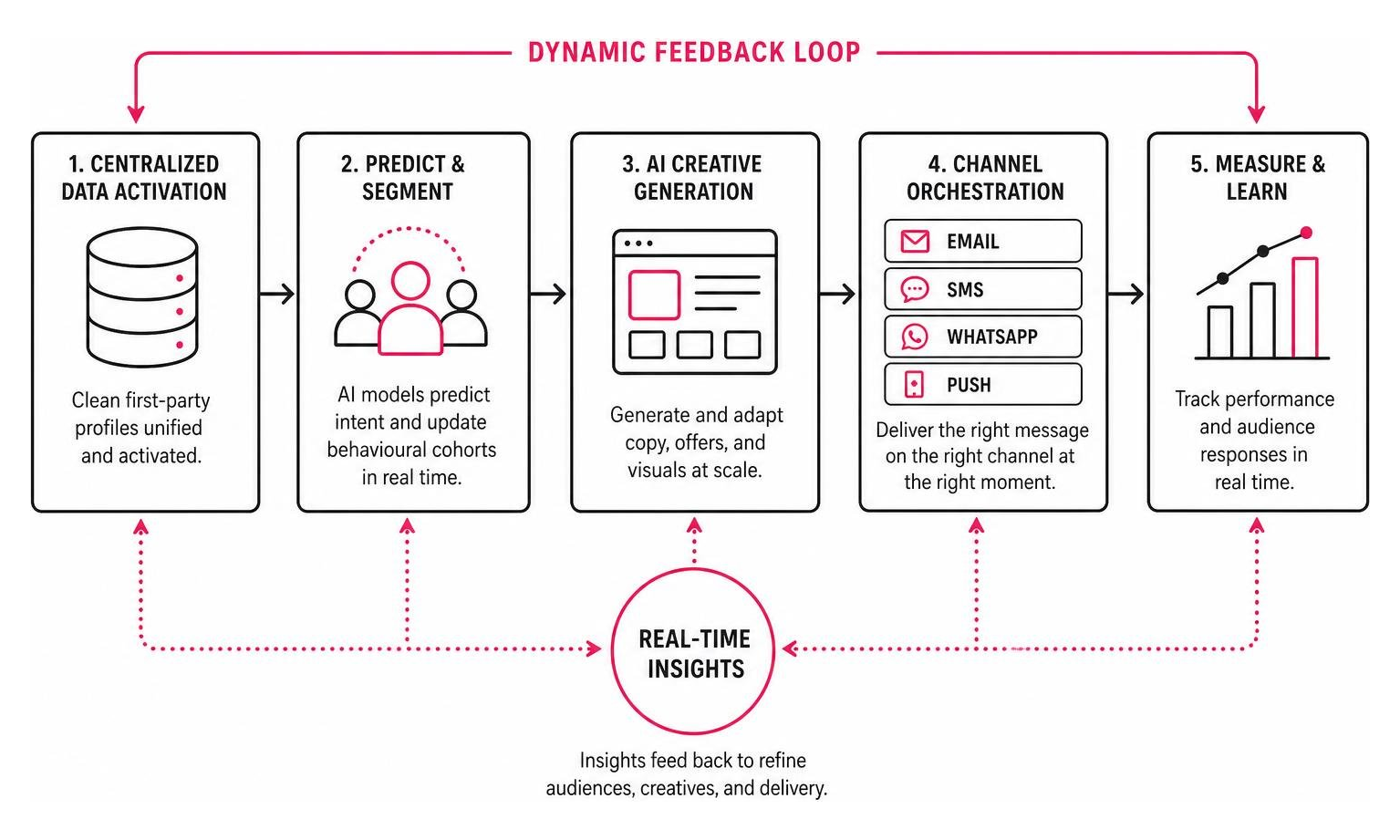
- Centralized Data Activation: They feed clean, first-party customer profiles into predictive models to dynamic-test copy variations at scale.
CMOs are under immense pressure to cut costs, but reducing creative production to a commoditized assembly line is a race to the bottom. When everyone has access to the same LLMs, the technology itself stops being a differentiator. The value shifts entirely to strategic positioning, human curation, and having a rigid brand system that acts as an editorial filter. The difference between high-performing AI marketing and expensive digital clutter lies in treating artificial intelligence as a creative multiplier rather than a cost-cutting shortcut.
I'm Florian Radke, and over the past 25 years, I have built technology-driven brands and engineered high-performance content engines, giving me a front-row seat to the evolution of the ai creative examples best campaigns that actually drive enterprise value. Understanding this shift requires looking past the surface-level tech and analyzing the strategic divergence between static automation and dynamic creativity.
The Strategic Shift: Why Most AI Marketing Campaigns Fall Flat
Many marketing teams treat generative tools as an automated pen. They write a prompt, hit generate, and publish the output with minimal editing. This approach fails because it ignores the fundamental law of the modern attention economy: when the cost of producing content drops to zero, the volume of noise increases exponentially.
To break through this noise, we must transition from static, pre-planned campaign rules to dynamic, in-flight optimization. Traditional campaigns lock in audience segments, copy variations, and distribution times days before launch. AI-driven campaigns, conversely, analyze real-time behavioral signals to rewrite their own execution parameters on the fly.
| Metric / Dimension | Traditional Static Campaigns | AI-Driven Dynamic Campaigns |
|---|---|---|
| Audience Segmentation | Static cohorts built on historical demographic data | Real-time behavioral cohorts updated continuously |
| Creative Iteration | Manual A/B testing with limited creative variants | Automated multivariate testing using predictive analytics |
| Content Delivery | Fixed schedule across pre-selected channels | Behavior-triggered orchestration across SMS, WhatsApp, and email |
| Data Reliance | Siloed third-party platforms | Centralized, clean first-party data profiles |
Deploying this level of agility requires a robust organizational foundation. Without centralized data, your predictive engines lack the context to make accurate decisions. This is where a clear AI Brand Strategy Complete Guide becomes critical. By integrating your customer data platform with agentic AI models, you can move away from broad demographic assumptions and target users based on their exact purchase likelihood.
The goal is not to produce more content, but to build a defensible strategic moat through Generative AI Branding. The brands winning in 2026 are those using machine learning to deepen emotional connections, not those using it to automate spam.
Deconstructing the AI Creative Examples Best Campaigns of 2026
Looking at real-world applications reveals how leading brands use AI as a strategic force multiplier. They do not use the technology to replace their creative vision; they use it to scale execution and bypass traditional production bottlenecks.
Dollar Shave Club: Bypassing Production Drag
Dollar Shave Club built its initial brand equity in 2012 with a viral YouTube video that cost $4,000. Fourteen years later, they executed a highly successful campaign by spending only $400 using generative video tools. As detailed in How Dollar Shave Club uses generative AI to unlock advertising creativity | Marketing Dive, the grooming brand used AI to animate abstract objects to represent sensitive anatomical concepts, bypassing advertising censorship and high production costs. By moving production entirely in-house, their creative team moved from concept to finished asset in less than a week.
KFC Arabia: Turning Crisis into Serialized Drama
When KFC Arabia faced a regional shortage of their popular cheddar sauce, they did not issue a dry corporate apology. Instead, they worked with TBWA/RAAD to launch a three-part AI-generated social media drama series, as highlighted in KFC Arabia Turns a Cheddar Sauce Crisis Into a Viral AI Drama | LBBOnline. The campaign cast fries, pickles, and chicken strips as characters searching for the missing cheese, generating over 4 million organic views and transforming a supply chain failure into a community-building moment.
KFC South Africa: Culturally Nuanced AI Characters
In South Africa, KFC launched a multi-platform campaign featuring a fictional, culturally nuanced AI assistant named KAIIA. The narrative, documented in KFC South Africa Cooked Up Its Own AI Assistant | LBBOnline, followed the digital assistant as it became obsessed with the taste of fried chicken. By grounding a high-tech concept in local cultural nuances and the brand’s core truth, they created an engaging, interactive narrative that resonated across drive-thrus and social media.
PODS & Tombras: The World's Smartest Billboard
To scale a hyper-local out-of-home campaign in New York City, moving company PODS worked with agency Tombras to turn physical moving containers into dynamic real-time billboards. As explored in Impossible Ads: Tombras’ AI-powered campaign - Think with Google, they used Google's Vertex AI to generate 6,000 lines of neighborhood-specific copy, displaying localized messages that updated based on the truck's real-time coordinates. The campaign resulted in a 60% increase in website sessions and a 33% lift in quote requests.
Underneat: The Conversational Superhero
D2C shapewear brand Underneat took their on-site AI shopping assistant and turned it into the central character of a celebrity-led cinematic campaign. According to the case study Underneat Built a Superhero Campaign. The Superhero Was Our AI., the campaign directly mirrored the helpful, consultative behavior of their digital assistant. By bridging top-of-funnel storytelling with bottom-of-funnel utility, they achieved a 4.67x conversion rate uplift among users who interacted with the AI.
These examples show that whether you are scaling physical campaigns like those in our B2B Brand Campaign Examples or driving retail breakthroughs via Innovation at Nike, the best campaigns use technology to solve real business and creative challenges.
How to Evaluate AI Creative Examples Best Campaigns for Your Brand
Before integrating generative tools into your workflow, you must establish an editorial spine. If your brand guidelines are vague, AI will produce generic, commoditized assets. You must decide when to use a synthetic aesthetic for comedic or abstract concepts, and when to stick to live-action footage for messages requiring deep human authenticity.
To build a sustainable pipeline, focus on scaling AI-Driven Content Creation through structured in-house workflows. This allows your team to run rapid, low-cost creative experiments while maintaining strict brand alignment. For a deeper look at managing this transition, explore our strategic guide on Generative AI for Marketing.
The Human-in-the-Loop Guardrails: Balancing Strategy with Automation

The most significant risk of AI-driven marketing is the loss of human taste. When brands rely entirely on automated generation, they risk producing uncanny, emotionally sterile content that alienates their audience.
High-profile campaigns from legacy brands have faced public backlash when fully synthetic visuals felt cold or disconnected from the brand's heritage. To prevent these failures, human curators must act as the ultimate filter. Humans must define the emotional beats, curate the outputs, and ensure that the final asset aligns with the brand's core identity.
For example, when energy brand YPF wanted to celebrate Argentina's football victory, they did not rely on generic automated templates. Instead, as detailed in YPF Honours Lionel Messi with AI Love Letter from Argentina | LBBOnline, they used generative video tools under strict creative direction to craft an emotionally direct, high-craft tribute film. The campaign worked because the technology remained subservient to a simple, powerful human message of gratitude.
To successfully coordinate these campaigns, marketers must understand how to protect their brand while staying agile. This involves setting clear boundaries for synthetic media, establishing ethical guidelines for using digital twins, and using creative tactics like those highlighted in our analysis of Examples of Ambush Marketing. Maintaining high standards of Creative in Digital Marketing is what prevents your campaigns from looking like generic digital clutter.
Hard Metrics: Measuring Real ROI Beyond the Hype
To defend your marketing budget, you must move past soft engagement metrics and focus on hard business outcomes. The success of an AI-powered campaign should be measured by its direct impact on conversion rates, revenue, and customer retention.
Key performance indicators that demonstrate real ROI from advanced marketing campaigns include:
- Conversion Rate Uplift: Implementing behavior-triggered intelligent timing can yield a 41% conversion rate on cross-channel messages.
- Channel Efficiency: AI-personalized campaigns on WhatsApp have driven 6x higher purchase rates compared to traditional email marketing.
- Predictive Targeting: Targeting users based on high purchase likelihood scores can generate a 3.75x lift in conversions while reducing overall message volume.
- Revenue Optimization: Dynamic cohort assignment and personalized welcome journeys can drive a 10% lift in revenue per user.
- Conversion Speed: Using AI to generate individualized, real-time content has delivered a 90% increase in booking conversion rates.
- Retention Improvement: Dynamic personalization within onboarding flows can result in an 81% reduction in unsubscribe rates.
- Cross-Selling Performance: Utilizing reinforcement learning models to automate message variations can drive a 105% increase in cross-selling.
- Acquisition Cost Reduction: Optimizing international programmatic ad spend with predictive models can yield a 12% reduction in Cost Per Install (CPI) and a 14% increase in Conversion Rate (CVR).
Tracking these numbers across multiple channels is essential for proving the value of your marketing investments. For a comprehensive framework on setting up these measurement models, read our guide on AI Campaign Measurement, or look at how global enterprises track performance in our breakdown of the Deloitte Green Dot Campaign.
Frequently Asked Questions about AI Creative Examples Best Campaigns
What Distinguishes the AI Creative Examples Best Campaigns from Generic Automation?
The best campaigns use AI as a creative multiplier to scale a distinct, human-guided brand voice rather than using it as a shortcut to produce generic content. They focus on solving specific creative or operational challenges—such as hyper-localizing copy or responding to real-time cultural crises—while maintaining a clear editorial filter.
How Do Brands Mitigate Legal and Copyright Risks in AI Campaigns?
Successful brands establish strict compliance guardrails, use custom-trained models built on licensed or proprietary datasets, and ensure that any digital twins of real models are fully owned and controlled by the creators themselves. They also employ human-in-the-loop QA layers to review every asset for brand safety before publication.
What Role Does First-Party Data Play in AI Personalization?
First-party data is the foundational engine of effective personalization. Without centralized, clean customer profiles, predictive decisioning models lack the context required to deliver accurate, real-time product recommendations or trigger behavior-based messaging across channels.
Conclusion
In the age of generative media, brand is the ultimate moat. As content production becomes completely commoditized, the companies that win will not be those with the fastest generation tools, but those with the most distinctive, defensible brand systems.
To lead your organization through this transition, you must restructure your team, centralize your data, and treat AI as a partner for strategic creativity. If you are ready to build a high-performance, AI-native marketing organization, explore our AI Transformation Roadmap or Sign Up to join our community of senior marketing executives.