Ultimate Guide to AI Marketing Automation Platforms Comparison

Why Most AI Marketing Automation Comparisons Miss the Point
The ai marketing automation platforms comparison most vendors want you to run is a feature checklist exercise. Yours should be a brand preservation audit.
Here is a fast-reference comparison of the leading AI marketing automation platforms by primary use case, so you can orient quickly before we go deeper:
| Platform | Best For | AI Capability Level | Stack Type |
|---|---|---|---|
| HubSpot Breeze AI | B2B SaaS and services | Assisted automation | All-in-one |
| Klaviyo AI (K:AI) | B2C ecommerce and DTC | Assisted + agentic | Specialist |
| Salesforce Agentforce | Enterprise CRM-led | Agentic | All-in-one |
| ActiveCampaign AI | Email-led SMB automation | Assisted automation | Specialist |
| Tofu | B2B ABM personalization | Agentic | Specialist |
| Marketo Engage | Enterprise B2B demand gen | Assisted automation | All-in-one |
| Brevo | Budget-conscious SMBs | Assisted automation | All-in-one |
| Mailchimp | Entry-level email marketing | Assisted automation | All-in-one |
The market has exploded to over 15,000 MarTech solutions in 2026. Ninety percent of marketing organizations now use AI agents somewhere in their stack. And yet the most common complaint from senior marketers is not that they lack automation — it is that everything they automate sounds like everyone else.
That tension is the real subject of this guide.
Every platform in this comparison can send faster, score leads smarter, and generate copy without a copywriter. What none of them will tell you in the sales deck is what happens to your brand when you hand the creative keys to a system trained on the entire internet. The efficiency gains are real — marketers using AI tools report saving 11 to 13 hours per week. The brand risk is equally real, and almost no one is measuring it.
This guide is written for marketing executives who have already moved past "should we use AI?" and are now asking the harder question: which platforms will scale our campaigns without flattening our competitive edge, and what does the actual total cost of ownership look like when you factor in contact tiers, credit overages, and the governance overhead of the EU AI Act?
I'm Florian Radke, brand strategist, fractional CMO, and founder of The Brand Algorithm — I've spent 25 years building and protecting brand equity at the intersection of technology and marketing, including leading AI-driven content engines for international brands and scaling DTC campaigns that generated over 25 million in earned media, and this ai marketing automation platforms comparison is built from that practitioner's perspective. What follows is not a vendor feature matrix — it is a strategic framework for choosing infrastructure that compounds your brand's distinctiveness rather than eroding it.
The Commoditization Trap: Why Automated Scale Dilutes Your Brand Moat
When every competitor uses the same algorithms to optimize the same channels, marketing converges on a sterile, optimized average. This is the commoditization trap. If your AI-generated emails read like your competitor's AI-generated emails, you are not building a brand — you are running an expensive spam engine.
The math of organic search and discovery has fundamentally shifted. Pure, unedited AI content delivers significantly lower organic performance over time. While pure AI content fails to build long-term search equity, a hybrid approach — where human strategists refine, challenge, and inject original brand point-of-view into AI drafts — performs 127% better than raw machine output. Human-written content containing unique, earned insights still delivers 5.44 times more organic traffic than pure AI content.
This performance gap exists because modern search engines and LLM-driven recommendation tools prioritize what we call Algorithmic Authority: the distinctiveness, depth, and structural credibility of your brand's digital footprint. To protect this authority, we must deploy a structured governance model.

Our Brand Preservation Framework acts as an operational filter to prevent automated systems from producing generic output. It consists of three pillars:
- Identity Guardrails: Instead of relying on generic prompts, we feed the system custom knowledge bases containing our core brand strategy, negative vocabularies, and unique industry stances. This ensures that any generated asset aligns with our distinct brand voice. For a deeper look at this process, see our guide on AI Content Generators with Built-in Brand Voice Customization.
- Contextual Reasoning: AI systems must evaluate real-time customer intent and behavioral signals rather than executing static sequences. If a customer shows high intent, the platform should adapt the tone and channel mix dynamically based on past interactions, rather than sending a generic drip sequence.
- Topical Integrity: We restrict automated content creation to areas where our brand has established first-party authority. If we lack real-world expertise on a topic, we do not let the machine write about it.
By implementing these guardrails, we transition our martech stack from a generator of generic noise into a highly targeted engine for brand differentiation.
Architectural Battleground: AI Agents vs. Assisted Automation Platforms
To make an informed choice, we must first clear up a major point of confusion in vendor sales decks: the structural difference between an AI agent and an assisted automation platform.
An AI agent possesses autonomous decision-making capabilities. It uses algorithmic reasoning to analyze data, determine the next best action, and execute multi-step workflows across different systems without human intervention. A true agent does not rely on rigid if-then rules; it adapts to new inputs in real time.
An assisted automation platform relies on predefined, structured workflows. It uses AI to optimize specific steps within those workflows — such as generating email copy, predicting the best send time, or scoring a lead — but the path itself is fixed. The system cannot break out of its pre-configured tracks.
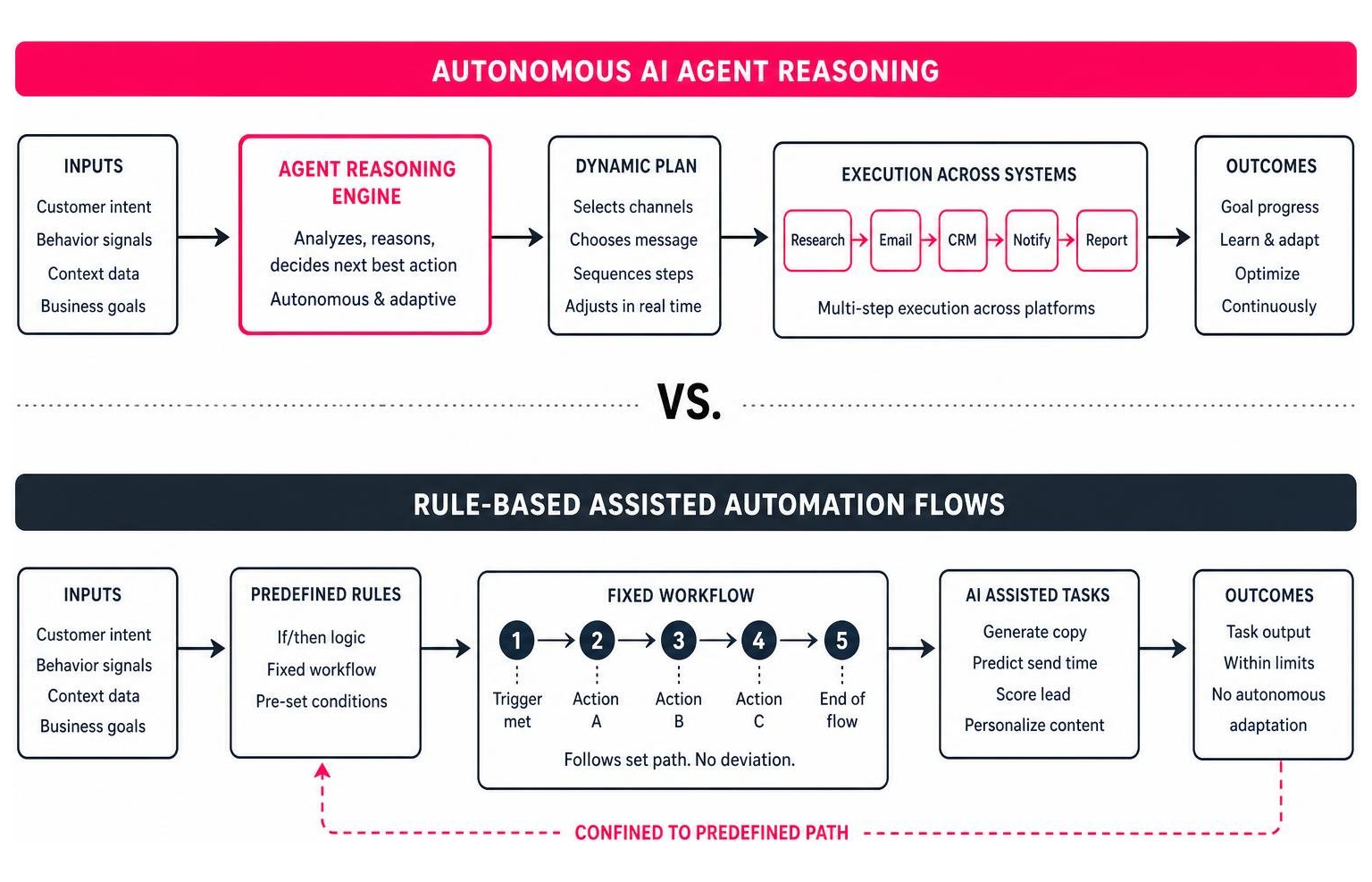
This architectural difference shapes how we design our modern marketing stack. When building out your infrastructure, you must decide whether to orchestrate these workflows using managed, closed-source models or open-weight architectures. For an in-depth architectural breakdown, read the analysis of OpenAI vs Hugging Face vs xAI Grok: Which Is Best for Marketing Automation in 2026? | AdTools.org.
Evaluating Autonomous AI Agents for Marketing Execution
Autonomous agents are particularly valuable when your workflows cross platform boundaries. Traditional tools are confined to their own database walls. If you need to research a competitor’s new product, update a tracking spreadsheet, draft an email, and push a notification to a sales representative, a traditional platform requires manual setup or complex API middleware.
Autonomous tools execute these multi-step processes across your entire software ecosystem.
- Klaviyo K:AI deploys specialized autonomous marketing and customer service agents that actively analyze site data to design and launch campaigns, while resolving customer inquiries across chat, SMS, and email.
- Salesforce Agentforce operates natively within the Salesforce CRM ecosystem, autonomously qualifying pipeline, routing leads, and updating contact records based on real-time conversations.
- Sai acts as a cross-platform browser agent, executing tasks across different web applications to eliminate manual data-entry bottlenecks.
- Tofu focuses on end-to-end B2B campaign personalization, allowing teams to scale customized account-based campaigns across hundreds of target accounts.
- Gumloop and Relevance AI provide no-code environments to build custom agentic workflows, giving operations teams the flexibility to design custom reasoning chains.
These tools are highly effective for scaling complex, multi-system workflows, but they require strict governance. An autonomous agent with write-access to your ad budgets, CRM records, or live email servers can cause significant brand and financial damage if it operates without clear boundaries.
The Limits of Assisted AI Marketing Automation Platforms Comparison
Assisted automation platforms are the standard systems most teams are familiar with. They are highly reliable for executing predictable, high-volume communications, but their AI capabilities are designed to optimize tasks within their own walled gardens.
- HubSpot Breeze AI provides assisted capabilities that make it easier to write copy, remix content assets, and build workflows, but it remains a system of predefined paths.
- ActiveCampaign AI and Mailchimp Intuit AI excel at optimizing email delivery, suggesting subject lines, and building simple segments, but they cannot autonomously orchestrate a multi-channel campaign across external systems.
If your primary goal is to run structured, high-volume email and SMS campaigns with clear data paths, assisted platforms offer a stable and predictable solution. However, if you need to coordinate complex, multi-system campaigns that adapt to real-time customer behavior, relying solely on assisted automation will leave your team stuck managing manual data transfers. For a deeper look at integrating these tools, read our guide on AI Tool Integration.
Strategic Stack Selection: All-in-One Suites vs. Modular Specialist Stacks
The choice between an all-in-one suite and a modular, specialist stack is a strategic decision that shapes your entire marketing organization.
All-in-one suites like HubSpot or Salesforce promise a single source of truth and pre-built integrations. However, they often lock you into their specific ecosystem, and their specialized channel capabilities can be weaker than dedicated point solutions.
Modular stacks allow you to select the best tool for each channel — such as Klaviyo for email or Tofu for ABM — and connect them via APIs. This approach gives you greater flexibility, but it requires more technical resources to maintain data alignment across your systems.
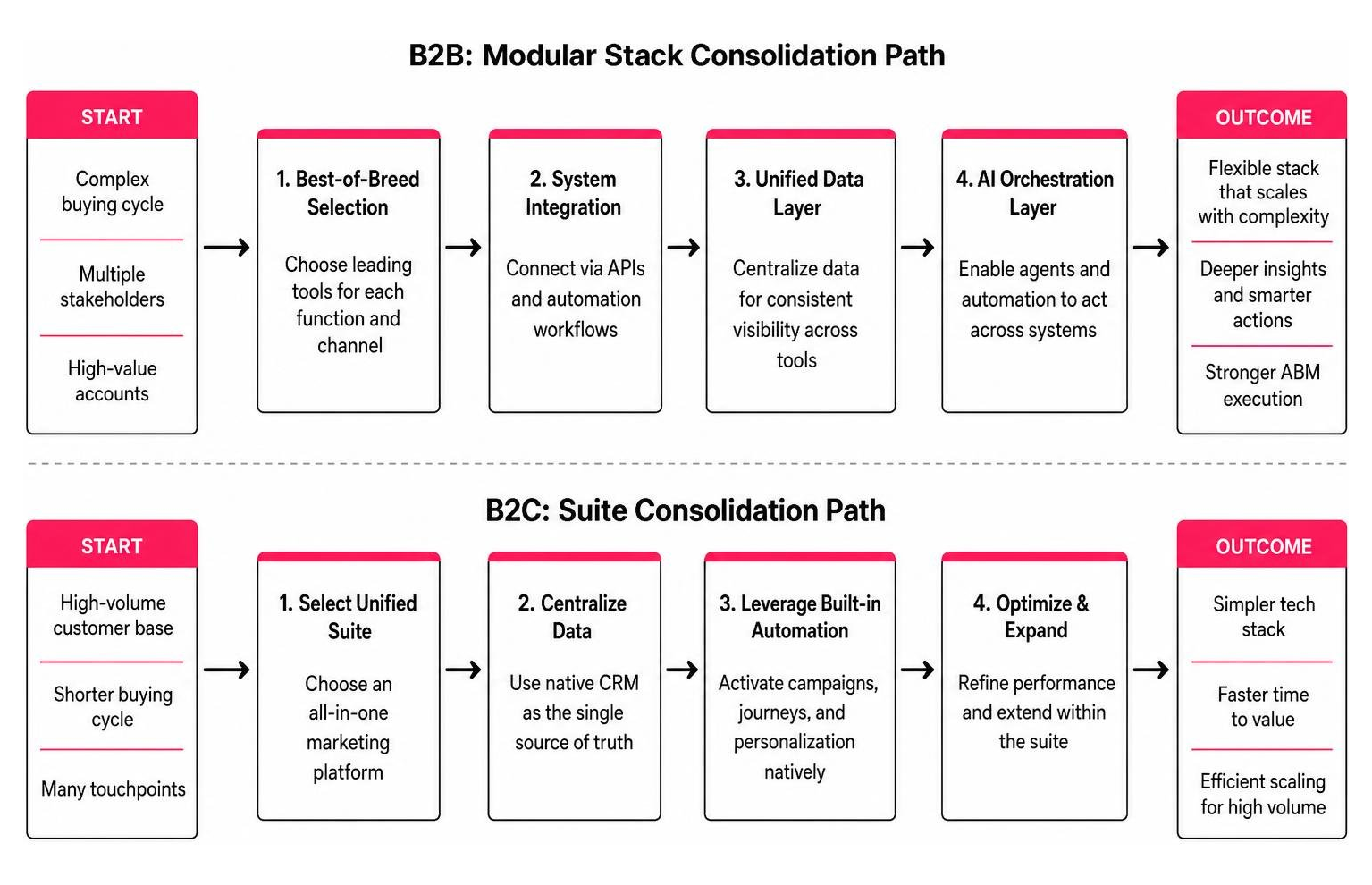
To help you evaluate your options, here is how the top platforms compare across key data and decision-making capabilities:
| Platform | Lead Scoring Model | Segmentation Depth | Predictive Analytics | Channel Integration |
|---|---|---|---|---|
| HubSpot | Rules-based + predictive contact scoring | High; relies on unified CRM properties | Predictive deal value and win probability | Native email, landing pages, ads, and CRM |
| Klaviyo | Behavioral engagement scoring | Deep; real-time event-level tracking | Predictive CLV, churn risk, and gender | Native email, SMS, push, and reviews |
| Abmatic AI | Intent-based account scoring | Account-level and contact-level | Real-time buying intent signals | Email, LinkedIn, web, and CRM |
| Salesforce | Einstein predictive lead scoring | High; requires Data Cloud for real-time | Predictive conversion and engagement | Omnichannel via Marketing Cloud |
Choosing the right approach depends heavily on your business model. Let's look at how this selection plays out in B2B and B2C environments.
Enterprise B2B ABM Consolidation: HubSpot vs. Abmatic AI
In enterprise B2B marketing, the primary challenge is aligning sales and marketing around high-value accounts.
HubSpot Marketing Hub provides a highly intuitive, unified database that excels at managing inbound marketing and sales handoffs. However, for complex Account-Based Marketing (ABM), its native account-level intelligence can be limited. If you are comparing HubSpot with other enterprise B2B platforms, you can read our detailed HubSpot vs. Pardot: AI Analysis (2026) | Trakkr to see how these systems perform.
Abmatic AI is built specifically for B2B account-based revenue. It consolidates multiple point tools — including web personalization, contact-level deanonymization, and outbound sequencing — into a single platform. Instead of relying on rigid, rules-based campaigns, Abmatic AI uses autonomous workflows that monitor real-time intent signals across the web and automatically enroll target accounts in personalized outreach campaigns. For a complete breakdown of this consolidation strategy, read the Marketo vs Abmatic AI 2026: ABM Platform Consolidation Guide.
If your B2B organization relies on a high-volume inbound model with a straightforward sales cycle, HubSpot's all-in-one platform is often the most efficient choice. However, if your growth relies on targeting a specific list of enterprise accounts with highly personalized campaigns, consolidating your stack around an AI-native ABM platform like Abmatic AI will deliver faster execution and cleaner data.
B2C Ecommerce Retention: Klaviyo vs. Mailchimp
For B2C ecommerce, success depends on your ability to turn customer data into personalized retention campaigns at scale.
Mailchimp remains a popular entry point for early-stage brands due to its simple setup and utility-grade email features. However, as your customer list grows, Mailchimp's segmentation limits and basic data architecture can restrict your ability to run complex, multi-channel campaigns. To see how Mailchimp compares to enterprise-grade systems, read our Marketo vs. Mailchimp: 2026 AI Visibility Analysis | Trakkr.
Klaviyo is built specifically for ecommerce data. It processes billions of daily events and retains detailed, event-level customer data indefinitely. This allows brands to build highly precise segments based on past purchases, browsing behavior, and predicted customer lifetime value. By consolidating email, SMS, and push notifications onto a single platform, brands can orchestrate consistent customer journeys that adapt to real-time actions.
If you are running a simple newsletter or managing a small contact list with straightforward communication needs, Mailchimp offers an accessible entry point. But if you are scaling a DTC brand and need to maximize customer lifetime value, Klaviyo's data infrastructure and specialized ecommerce features provide the foundation required for high-performance retention marketing. For a step-by-step guide to setting up these campaigns, see our AI Email Marketing Complete Guide.
The True Cost of Algorithmic Scale: An AI Marketing Automation Platforms Comparison
The pricing models of modern marketing platforms are often designed to obscure the true cost of scaling your campaigns.
Many vendors pitch low starter pricing to win your business, but include steep pricing multipliers that trigger as your contact list grows or your campaign volume increases. To avoid unexpected budget increases, you must calculate the total cost of ownership over a 12-month period based on your actual projected volumes. For a comprehensive look at evaluating these costs, read our Marketing Automation Software 2026: Buyer’s Guide and Comparison.
Auditing the Hidden Costs of an AI Marketing Automation Platforms Comparison
When evaluating platforms, look closely at these four cost drivers:
- Contact Tiers: Many platforms charge based on the total number of contacts in your database, even if you only message a fraction of them. As your list scales, these database fees can increase significantly.
- Send Limits: Some tools restrict the number of emails or messages you can send per month, charging overage fees if you exceed your limit during peak promotional periods.
- Credit Consumption: Generative AI features — such as copy generation, image creation, or automated translation — often run on a credit-based system. If your team uses these features frequently, your monthly credit costs can quickly exceed your base subscription fee.
- Implementation Timelines: Setting up an enterprise marketing platform is a complex process. While sales representatives may promise a four-week rollout, a realistic implementation timeline is 12 weeks. Attempting to rush this process usually results in broken data connections and misaligned tracking systems.
To protect your budget, model your usage across all four categories before signing a contract. We recommend signing a maximum 12-month agreement to maintain the flexibility to adapt as platform features and pricing models evolve. For advice on measuring these operational metrics, read our guide on AI Campaign Measurement.
Compliance and Governance: GDPR and the EU AI Act in July 2026
If you collect or process customer data from individuals in the UK or European Union, data compliance is a critical factor in your platform selection. With the enforcement of the EU AI Act, the regulatory requirements for using AI in marketing have become much stricter.
When choosing a platform, you must verify the following compliance standards:
- Data Residency: Ensure the platform provides options for EU/UK data residency to keep your customer data within compliant geographic boundaries.
- Legitimate Interests Assessments: Any tool that processes customer data through an LLM or machine learning model to make automated decisions must have a documented legitimate interests assessment.
- Model Transparency: You must be able to verify how the platform's AI models are trained, ensuring they do not use your proprietary customer data to train public models.
- Audit Trails: The platform must maintain clear audit trails of all automated decisions, including budget adjustments, lead scoring changes, and automated communications.
Choosing a platform with weak compliance standards exposes your brand to significant legal and financial risks. Ensure your legal team reviews any vendor's data processing agreements before you commit to their system. For a strategic look at how major enterprise platforms handle these governance challenges, read our analysis of AI Marketing OS: Adobe vs Google vs Salesforce.
Frequently Asked Questions about AI Marketing Automation
What is the difference between an AI agent and an AI automation platform?
An AI agent has autonomous decision-making capabilities. It uses algorithmic reasoning to analyze data, adapt to new inputs in real time, and execute multi-step workflows across different software systems without human intervention. An AI automation platform executes predefined, structured workflows. While it uses AI to optimize specific steps within those paths — like suggesting a subject line or predicting a send time — it cannot adapt the overall workflow or execute actions outside its pre-configured rules.
How do you maintain brand voice consistency across AI-generated content?
Maintaining consistency requires moving away from generic prompt engineering and building custom brand knowledge bases. You must feed your automation tools your specific brand guidelines, tone-of-view documents, negative vocabularies, and target audience personas. Additionally, you should implement a hybrid content workflow where human editors review and refine all machine-generated drafts before they go live. For practical advice on setting up these workflows, read our guides on AI Content Generators with Built-in Brand Voice Customization and AI Social Media Content Creation Brand Voice Preservation.
What are the critical GDPR and EU AI Act compliance factors for AI marketing tools?
Key compliance factors include verifying EU/UK data residency options, ensuring the platform maintains clear audit trails of all automated decisions, and confirming that the vendor executes robust Data Processing Agreements. Under the EU AI Act, you must also document legitimate interests assessments for any automated profiling or scoring activities, and ensure that the AI models used do not ingest your proprietary customer data to train public systems.
Conclusion: Building a Defensible AI Martech Stack
The goal of running an ai marketing automation platforms comparison is not to find the tool that can generate the most content. The goal is to build an infrastructure that scales your operations while protecting your brand's unique competitive advantage.
In an environment where anyone can use AI to produce high-volume, generic campaigns, your brand's distinctiveness is your only defensible moat. The platforms you choose must serve as force multipliers for that distinctiveness, rather than systems that average out your voice.
As you design and build your marketing stack, prioritize data integrity, clean identity resolution, and strong governance over flashy creative features. Choose systems that give you full control over your brand voice and allow you to maintain compliance with changing data regulations.
To take the next step in designing your marketing infrastructure, read our comprehensive The Brand Algorithm Marketing Technology Stack Guide or Sign Up for our newsletter to receive strategic insights on building a defensible, high-performance marketing engine.