How to Integrate AI Writing Tools Without Losing Your Soul


The Real Reason Your AI Content Workflow Isn't Working Yet
Advanced AI techniques for content creators workflow optimization aren't just about picking the right tool — they're about building a system that makes every stage of production faster, sharper, and more consistent.
Here's a quick answer if you're short on time:
The 6 core AI techniques that optimize content creator workflows:
- AI-powered research and trend analysis — scan thousands of sources to surface ideas before competitors do
- Generate-Edit-Refine (GER) framework — structured prompting with human checkpoints at every stage
- Brand context loading (RAG) — feed your tone, voice, and style into AI so outputs sound like you
- Multi-agent systems — assign specialized AI agents to research, drafting, editing, and fact-checking
- Automated repurposing — turn one piece of content into social posts, newsletters, and video scripts
- Closed-loop performance tracking — feed analytics back into your workflow to improve future output
Content marketers spend up to 65% of their time managing workflow — not creating. Brainstorming, drafting, editing, scheduling, and chasing deadlines eat the calendar whole.
AI promised to fix that. For many teams, it hasn't. Not because the tools are bad, but because most people are using them like a vending machine: drop in a prompt, hope for something useful, get frustrated when it sounds generic.
The problem isn't the technology. It's the absence of a structured process around it.
Teams that pair AI with a deliberate workflow produce 2x more publishable content than those using it ad hoc. Those skipping editorial review see engagement drop by an average of 34%. The gap between "AI that helps" and "AI that hurts your brand" comes down almost entirely to how you've built the system around it.
This guide walks you through exactly how to build that system — without losing the voice, judgment, and originality that make your content worth reading.
Advanced ai techniques for content creators workflow optimization helpful reading:
Mapping the Advanced AI Techniques for Content Creators Workflow Optimization
To truly optimize a workflow, we first have to admit where it’s broken. Most creators operate in a state of "reactive production"—scrambling for an idea on Monday to publish by Wednesday. When we introduce AI into a chaotic environment, we just get faster chaos.

The first step in advanced ai techniques for content creators workflow optimization is a comprehensive workflow audit. We need to map the five stages of the content lifecycle: Ideation, Research, Drafting, Editing, and Distribution. By identifying bottlenecks—those moments where a draft sits in an inbox for three days or where a creator stares at a blank cursor for three hours—we can strategically allocate AI resources.
Research indicates that workers using generative AI report productivity improvements of roughly 40%. However, the goal isn't just "more" content; it’s better resource allocation. By automating the mechanical tasks (formatting, basic research, initial drafting), we free up human capital for high-level AI in Marketing strategy and creative direction.
Phase 1: AI-Powered Research and Ideation
The "blank page" problem is the most expensive bottleneck in any creative department. Traditional research involves manual scanning of dozens of articles, extracting insights, and hoping you didn't miss a burgeoning trend.
Advanced AI research assistants now perform this at a scale humans can't touch. Tools can scan over 500,000 data sources daily to identify "micro-trends" weeks before they hit the mainstream. According to McKinsey, generative AI’s breakout year in 2023 set the stage for these tools to become strategic partners rather than just writing aids.
By using topic clustering and audience intent analysis, we can move beyond generic keywords. AI can analyze search engine results pages (SERPs) to tell us exactly what questions people are asking but no one is answering. This "gap analysis" ensures that our content isn't just noise; it’s a signal that satisfies user intent.
Phase 2: The Generate-Edit-Refine (GER) Framework
One-shot prompting is the enemy of quality. If you ask an AI to "write a 1,000-word blog post on SEO," you will get a generic, beige piece of content. To implement advanced ai techniques for content creators workflow optimization, we use the GER framework:
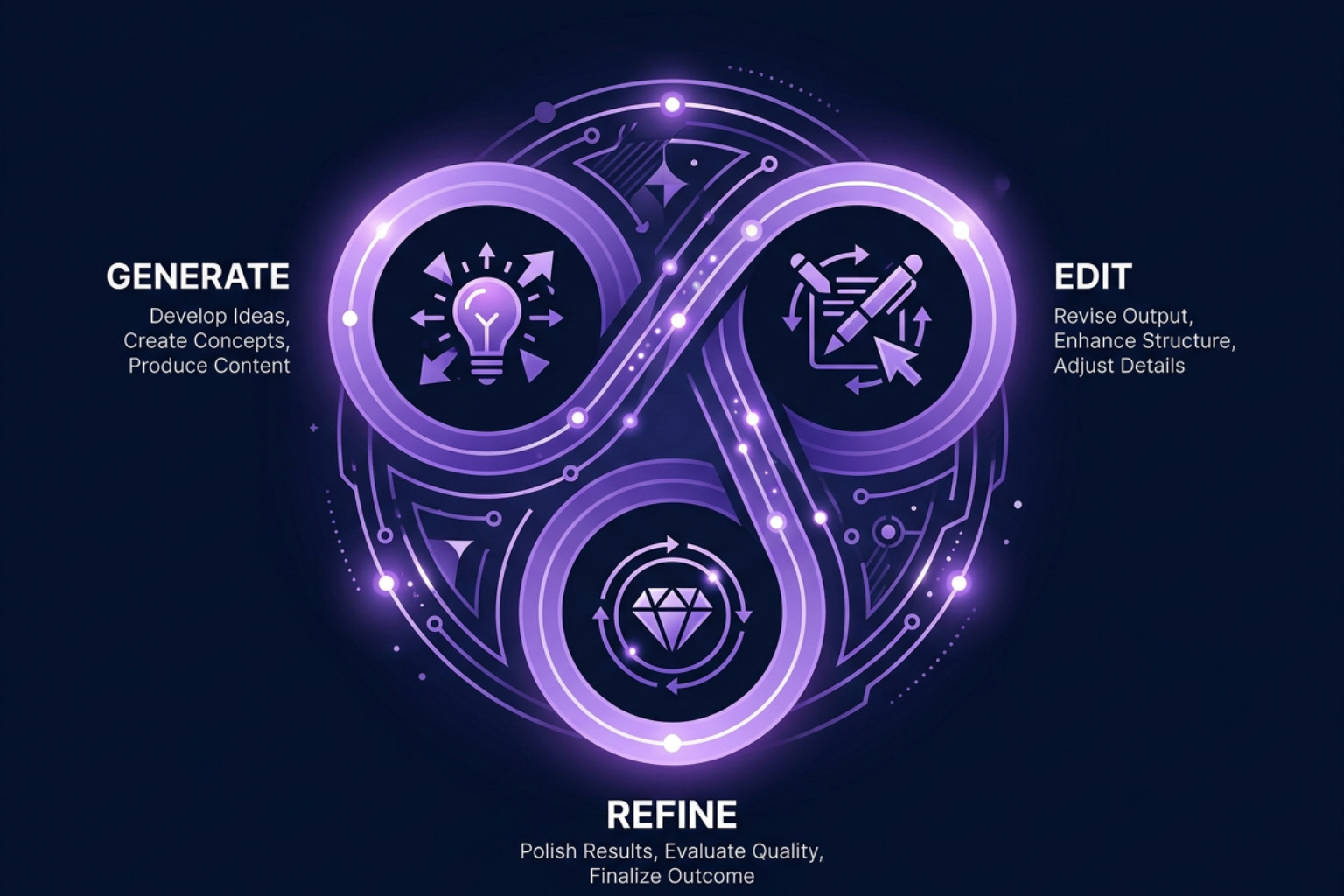
- Generate: Instead of asking for a full draft, start with an outline. Provide the AI with "Context Loading"—uploading your brand guidelines, audience profiles, and existing high-performing content.
- Edit: Once the AI generates a section, use "inline editing." Instead of rewriting manually, ask the AI to "make this paragraph more punchy" or "add a counter-intuitive insight here."
- Refine: This is the human-in-the-loop stage. We apply editorial checkpoints to ensure the content aligns with our unique perspective.
Teams using this structured approach report saving 50–85 hours per month. It shifts the creator's role from "writer" to "editor-in-chief."
Must-Have Features for High-Impact AI Integration
Not all AI tools are created equal. To move from basic automation to advanced optimization, your tech stack needs specific capabilities.
The biggest impact comes from features that reduce "tool fragmentation"—the need to jump between five different apps to get one post live. We look for tools that offer brand voice matching, multi-platform automation, and integrated performance tracking.
| Feature | Impact on Workflow | Why It Matters |
|---|---|---|
| Brand Voice Matching | High | Prevents "AI-sounding" content; maintains consistency. |
| Multi-Platform Publishing | Medium | Saves hours on manual copy-pasting and formatting. |
| Performance Tracking | High | Creates a feedback loop to improve future AI prompts. |
| API Connectivity | Medium | Allows AI to talk to your CMS (WordPress, Wix, etc.). |
Advanced AI Techniques for Content Creators Workflow Optimization: Brand Context and RAG
The secret sauce of professional AI content is Retrieval-Augmented Generation (RAG). This is a fancy way of saying we give the AI a "brain" filled with our specific brand data before it starts writing.
Instead of relying on the AI’s general training data, we provide a knowledge base. This includes:
- Tone Descriptors: Are we "authoritative but accessible" or "irreverent and bold"?
- Vocabulary Tailoring: A list of "banned phrases" and "preferred terminology."
- Style Guides: Specific formatting rules (e.g., Oxford commas, H2 structures).
By setting up this brand context through AI Content Strategy Services, we ensure the AI doesn't hallucinate or sound like a generic corporate brochure. We've found that teams who load context before prompting produce publishable first drafts 3x more often than those who don't.
Step-by-Step: Implementing a Multi-Agent Content System
The next level of advanced ai techniques for content creators workflow optimization is the "Multi-Agent System." Think of this as a digital newsroom where different AI models are assigned specific roles.
A single model trying to research, write, and fact-check all at once often fails. By breaking these into specialized agents, we increase accuracy and depth:
- The Research Agent: Queries the live web, summarizes sources, and provides citations.
- The Writing Agent: Takes the research and the brand voice pack to create the first draft.
- The Fact-Checking Agent: Cross-references every claim in the draft against the original research sources.
- The Optimization Agent: Analyzes the draft for SEO and Marketing Automation triggers.
These agents communicate via structured handoffs—often using JSON formats—to ensure no information is lost in transition. This modular approach allows us to scale production without the "quality bleed" that usually happens when teams grow too fast.
Advanced AI Techniques for Content Creators Workflow Optimization: Repurposing and Distribution
The most efficient way to use AI is to treat every long-form piece of content as a "seed." One well-researched article can be the source for:
- A 5-email nurture sequence.
- Ten LinkedIn posts (using different "hooks").
- A newsletter summary.
- A 60-second video script.
73% of marketing teams now use generative AI for content creation tasks like this. By integrating your AI tool directly with platforms like WordPress, Medium, or social media schedulers, you can move from "finished draft" to "live everywhere" in a single click. This isn't just about speed; it's about maximizing the ROI of every single idea you generate.
Quality Control: Avoiding the "AI Slop" Pitfall
If we aren't careful, AI can become a "slop machine"—producing content that looks correct on the surface but lacks soul and accuracy. AI-generated content that skips editorial review averages 34% lower engagement. To avoid this, we implement a rigorous quality control (QA) process.
Our 10-point QA checklist includes:
- Factual Accuracy: Does every claim have a verifiable source?
- Brand Voice Alignment: Does this sound like "us," or did the AI use "delve" and "tapestry" again?
- E-E-A-T Compliance: Does the content demonstrate Experience, Expertise, Authoritativeness, and Trustworthiness?
- Originality Check: Does the piece offer a unique perspective, or is it just a summary of the top 3 Google results?
Following Google's guidance on helpful content is crucial here. Google doesn't penalize AI content specifically; it penalizes unhelpful, low-quality content regardless of how it was made. By maintaining "Human-in-the-Loop" safeguards, we ensure our content remains "helpful" in the eyes of both readers and algorithms.
Frequently Asked Questions about AI Workflow Optimization
How do I maintain brand voice at scale?
Maintaining voice requires more than a good prompt. We recommend building a "Brand Voice Pack" that includes persistent system prompts and a RAG corpus. This acts as a permanent set of instructions for the AI. Use advanced LLMs like Claude Sonnet 4.5 or GPT-5 which are better at nuanced tone than earlier models. Regularly audit your outputs and feed "corrected" versions back into the system to fine-tune the model's understanding of your style.
Does Google penalize AI-generated content?
No. Google's guidance explicitly states that their focus is on the quality and helpfulness of the content, not the production method. Content that provides original value and satisfies user intent will rank well. The risk isn't using AI; the risk is using AI to create "search-engine first" content that offers no real expertise or unique insights.
What is the ROI of AI for small agencies?
The ROI is often transformative. Small teams using advanced ai techniques for content creators workflow optimization report saving an average of 11 hours per week per person. Businesses have been able to produce up to 21x more content without increasing staff, leading to significant revenue growth. By cutting production time by 50–70%, agencies can shift their focus from "execution" to "strategy," allowing them to handle more clients with higher margins.
Conclusion
At The Brand Algorithm, we believe that the AI era isn't about the replacement of creators, but the evolution of the craft. With 96% of companies expected to use generative AI for content by 2025, the competitive advantage will no longer be "using AI"—it will be how elegantly you integrate it into your human workflow.
The transition from AI-assisted to AI-native workflows requires a strategic shift. We must move away from the "vending machine" mentality and toward a "multi-agent" newsroom model. By focusing on brand context, structured frameworks like GER, and rigorous QA, you can scale your production without losing your soul.
Ready to stay ahead of the curve? Sign up for the latest AI marketing insights and join a community of senior marketers mastering the art and science of the AI-driven brand.