Global AI Content Optimization Strategies for 2026


The Search Landscape Just Changed — Is Your Brand Visible?
Global AI content optimization strategies are now the difference between being cited by AI engines and being invisible to the consumers who use them.
Here's the short version of what you need to know:
| What's Changed | What It Means for Your Brand |
|---|---|
| ~50% of Google searches now surface AI summaries | Your content competes for citations, not just rankings |
| Nearly 69% of searches end without a click | Traffic volume is falling; citation quality is rising |
| Brand websites account for only 5-10% of AI source citations | You can't rely on owned content alone |
| Brands cited in AI Overviews see 35% higher organic CTR | Being referenced by AI is now a growth lever |
| Unprepared brands face 20-50% declines in traditional search traffic | Inaction has a measurable cost |
If you're a CMO, agency strategist, or brand leader, you've probably already felt this shift — traffic patterns are changing, click-through rates are dropping, and the board wants answers.
The reality is blunt: AI-powered answer engines like Google AI Overviews, ChatGPT, and Perplexity are becoming the first stop for consumer discovery. Not your website. Not your ads. An AI summary that may or may not include your brand.
What makes this especially disorienting is that traditional brand strength doesn't protect you. Research shows that market-leading brands in categories like credit cards, hotels, and electronics are routinely absent from AI-generated answers — despite holding dominant market share. Awareness built over years doesn't automatically translate into AI citations.
By 2028, an estimated $750 billion in US revenue will flow through AI-powered search. The brands earning that revenue won't just be the ones with the best products. They'll be the ones that understood — early — how to make their content findable, extractable, and trustworthy to AI systems operating at a global scale.
That's exactly what this guide covers.
From SEO to GEO: The New Global AI Content Optimization Strategies
For decades, we’ve played the SEO game: keywords, backlinks, and meta descriptions designed to coax a blue link onto page one. But as Large Language Models (LLMs) take over, the rules are shifting toward Generative Engine Optimization (GEO).
While SEO focuses on ranking, GEO focuses on citations. In an AI-driven world, your goal isn't just to be "found"—it's to be synthesized. When a user asks ChatGPT or Google Gemini for a recommendation, the engine doesn't just list sites; it constructs a narrative. If your brand isn't part of that narrative, you don't exist in that consumer's decision journey.
The stakes are incredibly high. Organic click-through rates have plummeted by 61% for queries where an AI Overview is present. However, there is a "Citation Advantage": brands that are cited as sources within these AI summaries experience a 35% higher organic CTR compared to standard results.
To win, we must understand Retrieval-Augmented Generation (RAG). This is the framework AI engines use to pull facts from the live web to answer a query. To be the "fact" the AI chooses, your content needs "Information Gain." Google’s 2022 Patent for Information Gain Scores suggests that the algorithms now prioritize content that brings new information to the table rather than just restating what everyone else has said.
| Feature | Traditional SEO | Generative Engine Optimization (GEO) |
|---|---|---|
| Primary Goal | Rank #1 for specific keywords | Earn citations and mentions in AI summaries |
| Success Metric | Click-Through Rate (CTR) | Share of Model (SOM) and Sentiment |
| Content Focus | Keyword density and length | Fact density and information gain |
| Discovery Path | Search Engine Results Pages (SERP) | Answer synthesis and recommendation |
| Authority Signal | Backlinks and Domain Authority | Entity clarity and "Ground Truth" data |
At The Brand Algorithm, we help leaders navigate this transition through specialized AI Content Strategy Services, ensuring your brand remains the signal in a world of AI-generated noise.
The Four-Phase Framework for Scaling Global AI Visibility
Scaling global ai content optimization strategies isn't a weekend project; it requires a fundamental shift in how your marketing team operates. We recommend a structured four-phase framework to move from "unprepared" to "AI-dominant."
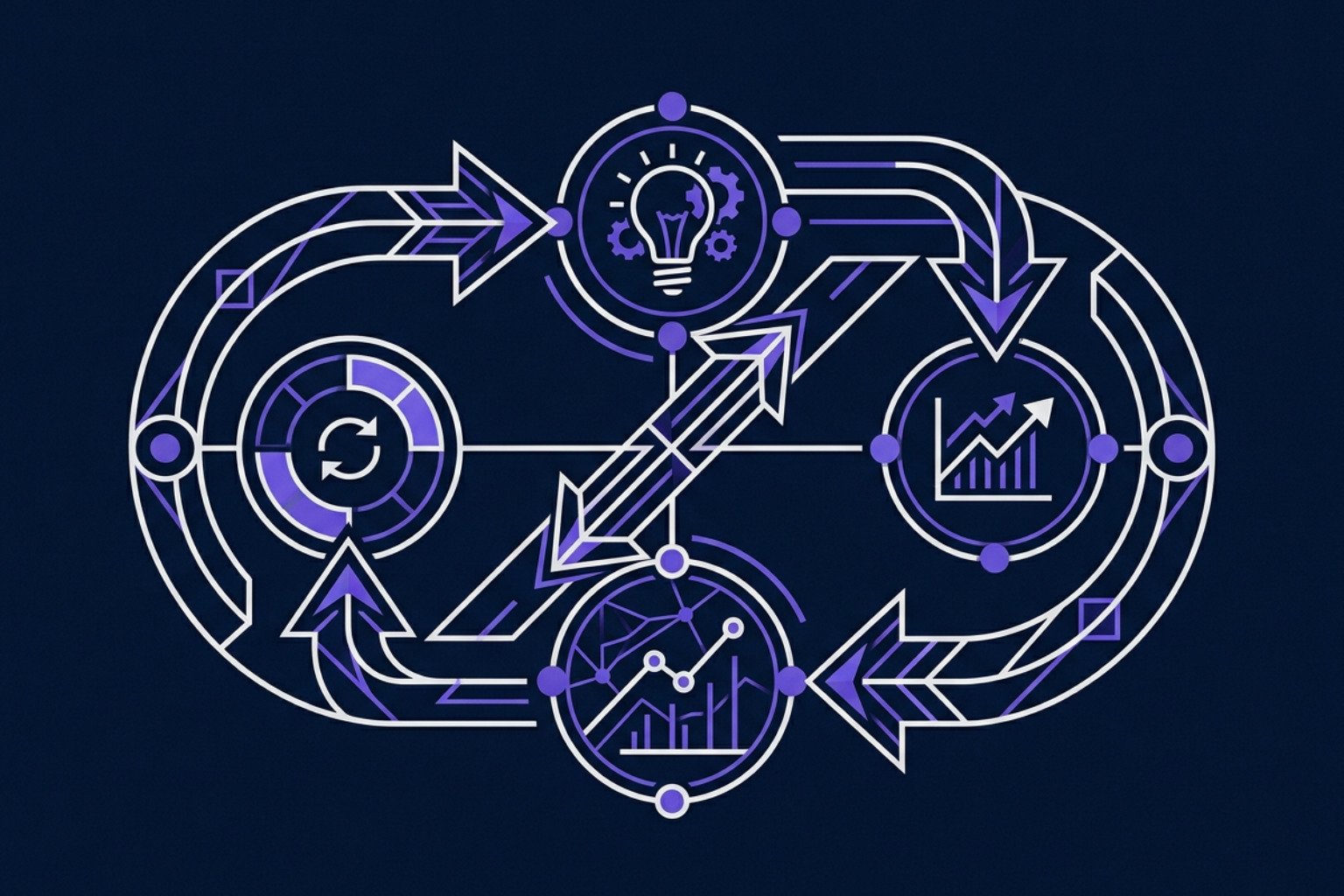
This transition requires cross-functional collaboration. Your SEO team, content creators, and technical architects must work in sync to ensure that every piece of content published serves two masters: the human reader and the AI crawler. You can explore more on this evolution in our section on AI in Marketing.
Phase 1: Diagnosing Global AI Content Optimization Strategies Performance
Before you can optimize, you need to know where you stand. Traditional tools like Google Search Console only tell part of the story. You need to measure your Share of Model (SOM)—the percentage of time an LLM mentions your brand when prompted with relevant category questions.
Key diagnostic questions include:
- Citation Frequency: How often are your URLs appearing as footnotes in Google AI Overviews or Perplexity?
- Sentiment Velocity: Is the AI describing your brand as a "premium leader" or a "budget-friendly alternative"? LLMs don't just find you; they label you.
- Visibility Gaps: Are your competitors appearing in "Best of" AI summaries while you are absent?
Currently, only 16% of brands systematically track their AI search performance. This is a massive opportunity for early adopters to gain a competitive edge before the predicted 20-50% traffic decline hits the laggards.
Phase 2: Executing Global AI Content Optimization Strategies for Extractability
AI engines don't "read" pages like humans; they "extract" data. To be extractable, your content must be structured into self-contained "chunks." If a paragraph requires the context of the entire article to make sense, an AI might skip it.
Here is how to optimize for machine extractability:
- Front-Load the Answer: Place the most important information in the first 50 words. Use a "TL;DR" (Too Long; Didn't Read) summary at the top of long-form guides.
- Increase Fact Density: Research confirms that "Statistics Addition" is a powerful GEO lever. Adding unique, quantitative data points (e.g., "78% of users reported...") significantly boosts the likelihood of being cited. Research on Statistics Addition suggests this can increase AI visibility by up to 40%.
- Aggressive Schema Markup: Use JSON-LD Schema to tell the AI exactly what it's looking at. This isn't just for FAQs; use Organization, Product, and Author schema to create "Entity Clarity."
- Linguistic Struts: Use secondary and tertiary keywords that act as semantic anchors. If you're writing about "Global SEO," include related entities like "hreflang tags," "cross-market analysis," and "cultural transcreation."
Scaling Multilingual Content with AI and First-Party Data
For a global brand, the challenge is multiplied by language and culture. A staggering 75% of internet users prefer to buy in their native tongue. Simply running your English blog through a basic translator is no longer enough; you need a strategy for global ai content optimization strategies that accounts for local nuances.

AI enables a "two-dimensional matrix" of content: Format x Market.
- Localization is the technical translation of words.
- Transcreation is the cultural adaptation of meaning.
To scale this, we use AI-powered "blends." For example, a "YouTube Blend" workflow can take a high-performing English video, transcribe it, translate it with cultural context, and turn it into a localized blog post for the German market in minutes.
The "secret sauce" here is proprietary data. By using server-side first-party data, you can feed the AI information about how local audiences actually behave. This reduces "hallucinations" (where the AI makes things up) and ensures the content resonates with local search intent.
Building Off-Page Authority and Entity Clarity Beyond Owned Sites
One of the most surprising findings in recent GEO research is that brand websites only account for 5% to 10% of citations in AI responses. The AI prefers "Ground Truth"—data from third-party sources it deems objective.
To build AI visibility, you must look beyond your own domain:
- Reddit and Community Platforms: LLMs heavily weight discussions on Reddit and LinkedIn. If your brand is being discussed positively in these communities, the AI learns that you are a trusted entity.
- User-Generated Content (UGC): Reviews provide the "raw data" AI needs to reduce hallucinations. High-volume, attribute-rich reviews (e.g., "these shoes are great for wide feet") help the AI answer complex, long-tail queries.
- Digital PR and Branded Mentions: Even a mention without a link is valuable. It teaches the AI that your brand belongs in a specific "cluster" (e.g., "Best Sustainable Tech").
- Visual AI: With over 20 billion visual searches monthly via Google Lens, your images need to be as optimized as your text. High-quality, original photography with descriptive alt-text is essential for multimodal discovery.
Common Pitfalls and the Future of Agentic Commerce
As we rush to optimize, we must avoid the "WTF" moments of AI implementation. Here are the "Don'ts" of AI optimization:
- Don't Blindly Trust: AI can hallucinate. Always have a human-in-the-loop to verify facts and brand voice.
- Don't Keyword Stuff: This isn't 2005. Over-optimizing for keywords actually decreases visibility in modern AI engines, which prioritize readability and flow.
- Don't Ignore Brand Voice: If your AI-generated content sounds like a generic robot, your brand equity will erode. Use detailed "Brand Hubs" to keep your tone consistent.
Looking ahead, we are moving toward Agentic Commerce. By 2030, an estimated $5 trillion volume in transactions could be facilitated by AI agents—software that doesn't just "search" but "does." To be "agent-ready," your site must be machine-readable, with clear structured data on stock status, return policies, and shipping.
The rise of vertical AI engines—engines specialized in specific industries like travel or finance—will further fragment the landscape. Staying ahead requires predictive analytics and a commitment to being a "future-ready" marketer. Learn more about these shifts in our deep dives on AI Marketing.
Frequently Asked Questions about Global AI Content Optimization
What is the difference between traditional SEO and GEO?
Traditional SEO is about ranking a specific page for a specific keyword to drive a click. GEO (Generative Engine Optimization) is about influencing the synthesis of an AI's answer so your brand is cited as a trusted source. SEO is about the link; GEO is about the mention.
How does AI-powered search change the consumer decision journey?
The journey is becoming "compressed." Instead of visiting five different websites to compare running shoes, a consumer gets a synthesized summary of the best options based on their specific needs (e.g., "best shoes for flat feet under $150"). This means brands must be present at the "synthesis" stage or they risk being cut out of the journey entirely.
Which new metrics should brands track in a zero-click economy?
Forget raw traffic for a moment. You should track Share of Model (SOM), Citation Frequency, and Assisted Conversions. In a zero-click economy, the value is in the "Citation Advantage"—the trust built when an AI engine endorses your brand as the answer.
Conclusion
The transition to global ai content optimization strategies is not a threat; it’s an invitation. It’s an invitation to stop chasing clicks and start building true authority.
At The Brand Algorithm, we believe that the future of marketing belongs to those who can marry human creativity with AI's scale. The search landscape has changed, but the goal remains the same: meeting your customer exactly where they are with the information they need.
The brands that win in 2026 and beyond will be those that treat their content not as a collection of pages, but as a sophisticated data system designed for both humans and machines.
Ready to lead the AI era? Sign up for the newsletter to get practitioner-level analysis delivered to your inbox 3-4 times a week.